- Search Results
Economic Wars : The WTO, USA & China [1]
Dr. Godfree Roberts
The Unz Review
March 25, 2018[Y Forward
Many people in the West have been brainwashed by the neo-colonial western powers to believe that China and other emerging nations are taking advantage of the fair and equitable systems set up for international trade such as the GATT and WTO.Nothing can be further from the truth. These institutions have been constructed for only one purpose – to ensure the neo-colonial powers retain control of world trade and exploit the emerging nations in the process, backed up by the use of military force thinly disguised as colour revolutions or human rights.
The reasons by the US to smooth entry into the WTO for China is a story in its own right – to do it justice requires a post in itself. Briefly, it can be said that without China’s economic rise, the US fiat dollar hegemony would have – in all probability – collapsed within the first decade of the 21st century.
I am here to set some of the records straight. China’s rise is causing extreme panic in the capitals of these western powers that are being beaten at their own game and with their own tools.
This is no mean feat, but then the west never really understood or cared to credit the ancient Chinese for what they really are – the Grandmasters of Financial Chess.
Again as always – thanks for reading. – Y

Dr Godfree Roberts is a retired Ed.D. Education & Geopolitics, University of Massachusetts, Amherst. He contributes part of his time to political blogs on his insights from more than 20 years working and living in China.

In 2003 I congratulated a young Chinese banker on his country’s accession to the WTO, cautioning that the trade body was a Western ideological post-Cold War creation designed not merely to enshrine export-oriented development models but to advance neoliberal trade norms.
After a moment’s reflection he responded, “I agree with your view of the WTO’s history but this is a game we can win”.
‘Free trade’ has always been an imperial project and withdrawal from free trade pacts–whether formal or informal always occurs when the imperial trading power wanes and its losses begin to outweigh gains.
British governments practised free trade imperialism throughout the 19th century, forcing dependent members of the empire, like India, to accept free trade by using their naval power to cajole weaker nations into signing treaties which involved no concessions by Britain herself–a strategy that remained an important element in British imperial expansion until the early 20th century.
When the WTO came into existence in 1994, the U.S. and E.U. owned 56% of global GDP and, because of the their huge markets, controlled the Uruguay Round negotiations that led to the WTO’s creation, which they viewed as a victory, in constitutional terms, for economic liberalism.
In a memorable moment of triumphalism the US–never reluctant to claim victory prematurely– promised that China’s membership would transform it into a market economy and move it towards liberal democracy.
China had requested membership of GATT in 1986 but it was not until 2001 that WTO members approved her accession (in Doha) after forcing her to accept reduced rights against other members compared to standard WTO rules, to open her markets, eliminate state monopolies on imports and exports and to significantly change her domestic laws, regulations, and practices.
[Y – these are one-sided conditions in their own right. No western country that as a member was required to accept any of the above terms -Y]
China was forced to agree to open its economy to competition and to overhaul its domestic laws, regulations, procedures, and administrative and judicial institutions across all levels of government, to make deep tariff commitments for imports, to significantly liberalize services and to agree that all regulations affecting trade would be nondiscriminatory and that government standard-setting would be transparent and based on international standards.
China further committed to stringent IP protection and independent review of all trade-related administrative actions by judicial or administrative tribunals.
[Y – again ‘overhauling’ implied putting the country’s administration and judiciary under foreign approvals – this is nothing short of colonialism. The matter of tariffs, service liberalisation and regulations were all weighted against China in favour of the western bloc-Y]
The country had started revising its laws before it joined the WTO when, as gatekeeper to China’s accession, the U.S. pressed China to agree to China-specific rules that granted other WTO members greater rights against China than China had against them–thus violating the core nondiscrimination norm in WTO law–particularly galling provisions given China’s legacy of ‘unequal treaties’ with imperialist powers.
China was also forced to accept market access tariff commitments far deeper than any comparable economy: the imposition of tariffs on trade goods reduced to 10% by 2008, for example, while richer Brazil agreed to 31% and India, 48%.
China was also required to make broader and deeper commitments on services liberalization in key sectors like financial, telecommunication, professional, and distribution services than any comparable economy.
But by 2009 her rising economic power and strengthened legal capacity had changed the situation dramatically and, in 2010, China became the world’s largest economy and Nobelist Robert Fogel predicting that, by 2040, its GDP would be twice America’s and Europe’s combined.
In 2013 it became the world’s largest trader in goods and international legal scholars began talking of a “Beijing consensus” displacing the neoliberal “Washington consensus.”
How did this reversal come about?
In 2001, Western negotiators were probably unaware that they were dealing with a nation so skilled in national trading that it had actually made profits on the ‘gifts’ that powerful barbarian tribes extorted from it for centuries so there was huge enthusiasm in China for the move.
The government sponsored WTO centers around the country, staged thousands of seminars and published more of books on WTO law than the WTO itself.
It organized a ‘WTO Knowledge Contest’ in which five million people participated and broadcast the final session on CCTV like a game show and the winner was feted and flown to Geneva to meet WTO Director-General Supachai Panitchpakdi.
Hundreds of Chinese officials, judges, and scholars visited the U.S. for WTO law training and even more traveled to China to teach it.
Fast forward to 2018 and American officials increasingly view China’s joining the WTO as a bad bargain and, as a result, appear less committed to upholding the regime it created and its complaints now focus on how the rules it imposed asymmetrically help China.
While China has learned to use the WTO legal regime to effectively challenge U.S. trade remedy measures, the U.S. has found it increasingly difficult to use WTO rules to address China’s trade barriers.
When China required Internet companies to use local servers and software companies to hand over source code, the U.S. found WTO rules unavailing.
The US has been unable to make headway in modifying or introducing WTO rules to constrain China and has began seeking alternative arrangements in which China does not participate in negotiations.
The Obama administration tried but failed to thwart existing WTO jurisprudence through the TPP in Asia and the TTIP in Europe but, since the Trump administration abandoned the TPP, China has taken the lead in negotiating trade agreements governing Asian economic integration by excluding the United States.
This apparent victory did not come easily. Chinese exports have faced close regulatory and legal scrutiny and have triggered far more anti-dumping, countervailing duty and import relief measures than products from any other country.
By 2009, China was the object of forty percent of all anti-dumping investigations and seventy-five percent of countervailing duties in the world.
For the first few years, China had tried to avoid litigation by settling every complaint brought against it while formally proposing to limit to two the number of complaints that a developed country could bring against a developing-country member in a calendar year, since ‘the lack of human and financial resources as well as capacities and experiences of developing-country Members results in de facto imbalance in the participation in the dispute settlement mechanism’.
[Y : Essentially the western powers tried to use the WTO as a medium to control the Chinese economy in their favour by resorting to litigation, believing the Chinese would not be able to defend their case in a Western court of law. Big mistake! -Y]
But in the meantime the government invested in studying the dispute settlement process by attending every WTO panel proceeding as a third party and learning from the example of the United States and E.U. Then, after learning how the system operated, China became active as a litigant, first as a respondent and then as a complainant.
Beginning with the China-Auto Parts case in 2006, she began to raise strong defenses in almost every case through substantive and procedural arguments. Its litigation strategy became even more aggressive and it advanced creative interpretations of its accession protocol commitments to reduce asymmetries, a change that represented a ‘transformation for China from the perspective that litigation is not the goal’ to one where ‘we now accept that multilateral dispute settlement process is an appropriate channel for resolving disputes.
‘Although many in government feel shocked that we are a defendant in an international court, and still think that litigation is not good, which is a reflection of our heritage, our culture, we now accept it’.
One official thought ‘highly of the system’ because it ultimately makes it ‘easier to settle’ disputes thanks to the third-party rulings.
The U.S. and the E.U. have lost four important WTO cases to China since 2010 involving billions of dollars of imports.
The pneumatic tires case (DS379) against the U.S., involved $18 billion in imports while a case against the E.U. involving steel fasteners (DS397) involved almost $5 billion and created precedent regarding the legality of U.S. and E.U. anti-dumping and countervailing duty methodologies that affect China trade totaling $463 billion in imports to the U.S. and $368 billion in imports to Europe.

How did a Confucian, anti-legalist country fare so well in an organization where English is the governing language and build such trade law capability?
Largely thanks to the Ministry of Justice’s 2001 “Accelerating the Reform and Development of the Legal Profession after China’s Accession to the WTO,” which it noted,
“Chinese lawyers are weak in handling international legal business, and China lack talents who can comfortably handle foreign legal services, and the lawyers’ competitive capacity in the international legal service market are weak.”
Today most Chinese WTO scholars have graduated from elite law schools and the have overseas experience. Zhang Naigen at Fudan University studied WTO law for a year under Professor John Jackson at the UMichigan and was a visiting scholar at Columbia, George Washington and the Max Planck Institute of Comparative Public Law and International Law in Heidelberg.
Zhang founded and directs the Center for Intellectual Property Study of international, domestic, and comparative intellectual property law and is Vice President of the Shanghai Society for Intellectual Property Law–which helped Shanghai to become a favored venue for international litigation.
Since WTO accession required China to participate in the The Agreement on Trade-Related Aspects of Intellectual Property Rights (TRIPS), Chinese law firms have developed strong intellectual property practices and Chinese domestic courts often apply TRIPS in private cases.
Although the Supreme People’s Court has vigorously rejected proposals that WTO law should be directly applicable before domestic courts it does suggest that, where possible, Chinese law should be interpreted to comply with WTO requirements and Chinese courts now reference WTO law in important decisions.

China has also made clever use of foreign lawyers to facilitate legal technology transfer. Huawei, with more than a hundred in-house counsel, hired famed international trade lawyer James Lockett, as its Vice-President and Head of Trade Facilitation and Market Access, for example.
[Y: Technology transfer is legal and part of the WTO trade process. As long as technology transfer occurs within the contractual framework of the WTO there is nothing illegal about it -Y]
Lockett came from the U.S. Department of Commerce, had served as the Chairman of the American Chamber of Commerce in Brussels and been a lawyer for U.S. law firms in Brussels and Vietnam and was highly familiar with U.S. and E.U. regulatory systems.
So strong is Huawei’s legal team that it has filed briefs at odds with the Chinese Government’s stated positions. China is a critical player in the WTO system–indeed, its strongest supporter–and a formidable and tenacious opponent of the U.S. and the E.U. It knows how the WTO works and does not hesitate to threaten litigation.
As China has begun shaping WTO jurisprudence to constrain the U.S. and E.U., U.S. and European perceptions of the WTO have changed but, since their proposed alternatives like the TPP and the TTIP have proven unattractive, they may be forced to retreat into bilateralism or participate in a world order shaped by China and designed to even the playing field for the majority of the world’s nations.
For those of the legal persuasion, I warmly recommend China’s Rise: How it Took On the U.S. at the WTO [2] by Gregory Shaffer and Henry Gao, from which much of this post is derived. Their clearly written, generously footnoted legal howdunnit makes captivating reading
Godfree Roberts
The Unz Review[Y : The current atmosphere to blame China or India or Russia is a US political tool used by US policy makers, big-business and the super rich to deflect the blame of who actually is responsible for the American economy.
China is carrying out trade under adverse conditions and still winning. A US Treasury report in 2005 cleared China of currency manipulation – of course this will never reach the American people.
Regardless of unilateral trade or other actions by the United States and other neo-colonial powers – I am confident China will be able to cement its position as the harbinger of a new economic order so desperately needed in the world today. – Y]
[1] http://www.unz.com/article/the-wto-and-china/
[2] https://papers.ssrn.com/sol3/papers.cfm?abstract_id=2937965 {PDF download]What price will mankind have to pay for the collapse of the Empire?
The Saker
The Unz Review
The Saker is the nom-de-guerre of a political and military analyst who is widely respected in the alternative mdeia. He is quoted and followed by other well respected personalities such as the Hon. Dr. Ron Paul, Paul Craig Roberts and Charles Hugh Smith, among others.- “I am surrounded, they are outside, I don’t want them to take me and parade me, conduct the airstrike, they will make a mockery of me and this uniform. I want to die with dignity and take all these bastards with me. Please my last wish, conduct the airstrike, they will kill me either way. This is the end commander, thank you, tell my family and my country I love them. Tell them I was brave and I fought until I could no longer. Please take care of my family, avenge my death, goodbye commander, tell my family I love them“
- Alexander Prokhorenko [16]
- “This is for our guys”
- Roman Filipov [17]
Preamble
We are currently living the most dangerous days in human history. You think that this is hyperbole?
Think again.
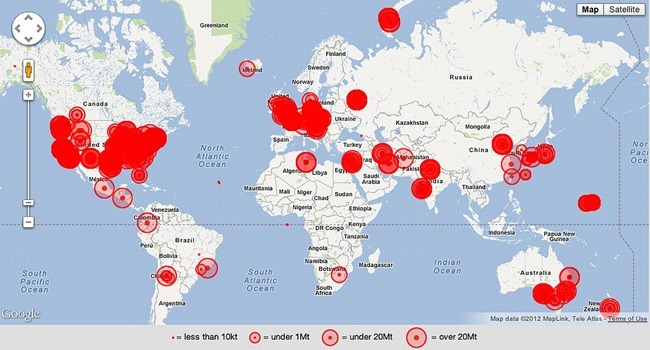
We are risking a nuclear ArmageddonThe first thing to realize is that this is not, repeat, not about Syria or chemical weapons, not in Salsbury [2], not in Douma [3].
That kind of nonsense is just “mental prolefeed” [4] for the mentally deficient, politically blinded or otherwise zombified ideological drones [5] who, from the Maine [6], to the Gulf of Tonkin [7], to NATO’s Gladio bombing of the Bologna train-station [8], to the best and greatest of them all – 9/11 of course [9] – will just believe anything “their” (as they believe) side tells them.
The truth is that the AngloZionists are the prime proliferators of chemical weapons in history (and the prime murderers of Arabs and Muslims too!). So their crocodile tears are just that – crocodile tears, even if their propaganda machine says otherwise.
Does anybody seriously believe that Trump, May, Macron or Netanyahu would be willing to risk an apocalyptic thermonuclear war which could kill several hundred million people in just a few hours because Assad has used chemical weapons on tens, hundreds or even thousands of innocent Syrian civilians (assuming, just for argument’s sake, that this accusation is founded)?
Since when do the AngloZionist care about Arabs?! This makes absolutely no sense whatsoever!
For those who would say that speaking of “several hundred million people” killed is hyperbole, I would recommend looking up past western plans to “solve the Russian problem” including:
Plan Totality (1945) [10]: earmarked 20 Soviet cities for obliteration in a first strike: Moscow, Gorki, Kuybyshev, Sverdlovsk, Novosibirsk, Omsk, Saratov, Kazan, Leningrad, Baku, Tashkent, Chelyabinsk, Nizhny Tagil, Magnitogorsk, Molotov, Tbilisi, Stalinsk, Grozny, Irkutsk, and Yaroslavl.
Operation Unthinkable (1945) [11] assumed a surprise attack by up to 47 British and American divisions in the area of Dresden, in the middle of Soviet lines. This represented almost a half of roughly 100 divisions (ca. 2.5 million men) available to the British, American and Canadian headquarters at that time.(…) The majority of any offensive operation would have been undertaken by American and British forces, as well as Polish forces and up to 100,000 German Wehrmacht soldiers.
Operation Dropshot (1949) [12]: included mission profiles that would have used 300 nuclear bombs and 29,000 high-explosive bombs on 200 targets in 100 cities and towns to wipe out 85% of the Soviet Union’s industrial potential at a single stroke. Between 75 and 100 of the 300 nuclear weapons were targeted to destroy Soviet combat aircraft on the ground.
Articles like this one, [13] this one [14], and this one [15] are also good pointers (these are all estimates, of course, nobody knows for sure; all that matters is an approximate orders of magnitude).
By the way, I am not suggesting that at this point in time the AngloZionists would want to deliberately start a thermonuclear war with Russia.
What I am suggesting is that there is a very simple and basic asymmetry between the Russian and AngloZionist forces in the Middle-East which could lead to such an outcome regardless of original intentions.
Here is how:
Part I : How are we risking a nuclear Armageddon?Step one: the AngloZionists strike Syria hard enough to force the Russians to retaliate.
Step two: now outraged by the Russian response, the AngloZionists retaliate against the Russian forces in Syria.
At this point it is crucial to remember that while the Russians have better equipment and far better soldiers than their “western” opponents (the examples of Alexander Prokhorenko [16] or Roman Filipov [17] will tell you all you need to know about how Russians in Syria fight, especially compared to the kind of personnel deployed by the US and NATO), the CENTCOM+NATO+Israel+KSA have an immense numerical advantage.
It does not matter how effective the Russian air defenses or (tiny) air superiority aircraft force is when it can simply be overwhelmed by numbers. All the Empire needs to do is first fire a large number of dumb old Tomahawk cruise missiles, let the Russian use their stores of air defense missiles and then follow-up with their more advanced weapons. The truth is that if the Empire wanted to, it could even establish a no-fly zone over Syria and completely wipe-out the Russian task force.
Sure, there would be losses on both sides, the Russians would fight heroically, but they would lose. Unless, of course, they got help from the Motherland, specifically in the form of cruise missile attacks from the Black Sea Fleet, the Caspian Flotilla, the aircraft stationed in southern Russia (Crimea) or even in Iran.
Russia also strike with land and sea based missiles. So Russia does have the capability to strike at numerous lucrative (and more or less defenseless) US and “coalition” targets throughout the Middle-East. But what would be the consequences of that?
Step three: Russian strikes on CENTCOM targets would force the Empire to fight back and strike at Russian Navy ships and, even worse, at military installations in Russia proper.
Step four: US/NATO attacks on Russian territory would inevitably trigger a Russian response on the US itself.
That response would be initially conventional, but as the losses on both sides would mount, the use of nuclear weapons would be almost inevitable.
Yes, in theory, at any time during this escalatory cycle both sides could decide to de-escalate. In theory. But in the real world, I don’t see that happening nor have I ever seen any model which would convincingly explain how such a de-escalation could happen (especially with the exceptionally low-quality type of narcissistic and psychopathic individuals in command in the US – think Trump or Bolton here – and all their “we are the best and biggest and greatest” pseudo-patriotic nonsense).
I am not predicting that this is what will actually happen, but I am saying that this is the risk the AngloZionist Empire is willing to take in order to achieve.. what exactly? What is worth taking such a risk?
I think that the UK Minister of Defense put it best: the AngloZionists want Russia to “go away and shut up”. [18]

Part II : Why we are risking a nuclear Armageddon (go away and shut up!)
“Go away and shut up” has been the dream of all western leaders since at least a millennium (interspersed and strengthened by regular (and failed) attempts at conquering and/or converting the Russians).
Just think how frustrating it has been for a civilization which has established colonies worldwide, including in the farthest regions of our planet, to have this unconquerable nation right next door which was not only refusing to submit, but which would regularly defeat them on the battlefield even when they all joined forces lead by their “best and brightest” leaders (Napoleon, Hitler and… Trump?).
Just imagine how a civilization centered on, and run by, bankers would go crazy realizing that immense riches were literally “right next door” but that those who lived on that land would, for some unfathomable reason, refuse to let them exploit it!
The very existence of a “Russian Russia” is an affront to all the real (as opposed to official) western values and that is simply not something the leaders of the Empire are willing to tolerate. Hence Syria, hence the Ukraine, hence all the silly accusations of “novichok” cum buckwheat attacks. These are all expressions of the same policy
1. Paint Russia as some kind of Mordor and create yet another “grand coalition” against her
2. Force Russia to submit to the AngloZionist Hegemony
3. Defeat Russia politically, economically or militarilyThese are objectives for which it is worth risking it all, especially when your own Empire is collapsing and time is not on your side. What we are witnessing since at least 2015 is yet another western Crusade against Russia, a kind of holy war waged in the name of everything the West holds sacred (money, power, hegemonic world domination, secularism, etc.) against everything it abhors (sovereignty, independence, spirituality, traditions).
The simple truth is this: were it not for the Russian military capabilities, the West would have wiped Russia “off the map” long ago, and replaced it with something like a number of “mini-Poland’s” ruled by a liberal comprador elite just like the one currently in charge of the EU.The desperate scream “go away and shut up” is just the expression of having this “western dream” frustrated by the power of the Russian armed forces and the unity of the Russian people behind their current leader. But even the admittedly frustrating existence of Russia is not a sufficient reason to risk it all; there is much more at stake here.
Part III: Russia as the tip of a much larger iceberg
Due to geographical, historical, cultural, religious and military factors, Russia is today the objective leader of the worldwide resistance to the Empire, at least in moral, psychological and political terms.
[Y : The economic leader is China which is just as important in the overthrow of the Empire – Y]But that does not mean that she is “anti-USA”, not at all. For one thing, Russia absolutely does not run or control the worldwide resistance to the Empire. In fact, to a superficial analysis, Russia often looks pretty much alone in her stance (as shown by the recent Chinese behavior at the UN Security Council).
The truth is that other countries who want an end to the AngloZionist hegemony have absolutely no incentive to join Russia on top of the US “s~~~ list” and expose themselves to the wrath of the Hegemon, especially not when Russia seems to be more than willing to bear the brunt of the Empire’s hatred.
Besides, like all large and powerful countries, Russia lacks real friends and most countries are more than happy to demand that Russia fix all their problems (as shown by the constant stream of accusations that Russia has not done enough in this or that part of the planet).
And yet all these countries are not exactly standing in line to show solidarity with Russia when she might need it. So when I say that Russia leads the resistance I am not suggesting that she does that the way the US runs NATO or some “coalition of the willing”. Russia simply leads by the fact that she does not “go away” or, even more so, does not “shut up”.Russia is the only country on the planet, with the possible exception of Iran, which openly and unapologetically dares to denounce the Empire’s hypocrisy and which is willing to back her words with military power if needed. The DPRK is a unique and local case.
As for the various Bolivarian countries and movements in Latin America, they are currently being defeated by the Empire.
In theory, the Muslim world definitely has the potential to play a bigger role in the resistance to the Empire, but the Wahabi-virus injected into the Muslim world by the US+KSA+Israel has, at least so far, prevented the emergence of a successful and truly Islamic model besides the one of the Islamic Republic of Iran (hence the demonization of the latter by the AngloZionists).
And yet …
The Empire is in the process of losing the entire Middle-East. Not so much because of some brilliant and Machiavellian Russian or Iranian policies, but more as a courtesy of its own infinitely arrogant, stupid and self-defeating policies.
The overthrow of Saddam Hussein will probably go down in history as one of the dumbest political decisions ever (Bolton was behind that one too, by the way). That was an entirely self-inflicted catastrophe. As was the almost equally disastrous invasion of Afghanistan.
Another self-inflicted disaster for the AngloZionists was their support for the US/EU led coup in the Ukraine, which not only resulted in a calamity which the Europeans will have to pay for for many decades to come (think of it as a big Somalia on the EU’s doorstep) but also did an amazing job uniting the Russian people behind their leaders and reduced the pro-Western feelings in the Russian public opinion to something in the range of 2-5 percent at the most. “Getting” the Ukraine sure would not have been worth “losing” Russia.
Then there is China which the US has grossly mismanaged since the so-called Third Taiwan Strait Crisis [19] in 1996 when Clinton militarily threatened China (see here for details) and with whom Trump has now launched a trade war in order to MAGA (good luck with that!).
In contrast, all the real “action” is now centered around the OBOR project [20] in which China and Russia play the main role and in which the Anglosphere will play no role at all. Add the Petro-Yuan [21] to the equation and you have the emergence of a new Eurasian model which threatens to make the entire Empire simply irrelevant.
And then there is Turkey (2nd most powerful NATO member state). And Pakistan for that matter. Or Afghanistan. Or Iraq. Or Yemen. Everywhere the Empire is in full retreat leaving only chaos behind.
The truth is that Russia would never be a credible threat to the AngloZionist Hegemony if it was not for the innumerable self-inflicted disasters the Empire has been absorbing year after year after year.
In reality, Russia is no threat to anybody at all. And even China would not be a threat to the Empire if the latter was not so arrogant, so over-stretched, so ignorant, reckless and incompetent in its actions.
Let me just give one simple, but stark, example: not only does the US not have anything remotely resembling a consistent foreign policy, it does not even have any Ministry of Foreign Affairs.
The Department of State does not deal with diplomacy simply because the US leaders don’t believe in diplomacy as a concept.
All the DoS does is issue threats, sanctions, ultimatums, make demands, deliver score-cards (on human rights and the like, of all things!) and explain to the public why the US is almost constantly at war with somebody. That is not “diplomacy” and the likes of Nikki Haley are not diplomats.
In fact, the US has no use for International Law either, hence the self-same Nikki Haley openly declaring at a UNSC meeting that the US is willing to ignore the decisions of the UNSC and act in complete violation of the UN Charter.
Simply put: thugs have no need for any diplomacy. They don’t understand the concept
Just like their Israeli masters and mentors, the Americans have convinced themselves that all they need to be successful on the international scene is to either threaten the use of force or actually use force.
This works great (or so it seems) in Gaza or Grenada, but when dealing with China, Russia or Iran, this monomaniacal approach rapidly shows its limitations, especially when your force is really limited to shooting missiles from afar or murdering civilians (neither the US nor Israel nor, for that matter, the KSA has a credible “boots on the ground” capability, hence their reliance on proxies).
The Empire is failing, fast, and for all the talk about “Animal Assad” or “Rocket Man” being in need of AngloZionist punishment, the stakes are the survival of Hegemony imposed upon mankind at the end of WWII and, again, at the end of the Cold War, and the future of our planet.
There cannot be one World Hegemon and a multipolar world order regulated by international law. It’s an either-or situation. And in that sense, this is all much bigger than Syria or even Russia.
Part IV: From Douma to Donetsk?
There is still a chance that the AngloZionists will decide to strike Syria symbolically, as they did last year following the previous chemical false flag in Khan Sheikhoun (Trump has now probably tweeted himself into a corner which makes some kind of attack almost inevitable).
Should that happen though, we should not celebrate too soon as this will just be a minor course change, the 21st-century anti-Russia Crusade will continue, most likely in the form of a Ukronazi attack on the Donbass.
Quick reminder: the purpose of such an attack will not be to reconquer and then ethnically cleanse the Donbass, but to force the Russian Federation to prevent such an outcome by openly intervening.
[Y: At the time of this post the Empire and its two vassal states (UK and France) have completed missile operations on Damascus – the casualty outcome is minimal. The attack itself seemed obligatory to fulfill some unknown gambit. The Russians did not take the bait. -Y]
Such a Russian intervention will, of course, quickly stop the war and crush the Ukronazi forces, but at that point the tensions in Europe will go through the roof, meaning that NATO will (finally!) find a halfway credible mission for itself, the Germans will have to give up on North Stream II, Poland and the Baltic statelets will make money by becoming the East European version of Okinawa and the Anglo powers (US/UK) will firmly reestablish control over the EU, Brexit notwithstanding.
Furthermore, Russia will become the target of a total economic war, including an energy blockade (the US will be more than happy to impose its overpriced gas on the Europeans), a disconnection from SWIFT, a seizure of Russian assets, a ban on Russian financial operations in the EU, etc. That could be risky, of course, especially with a trade war with China also taking place, but these are just options.
What is certain is that as long as Putin or anybody like him remains in power in Russia, the Congress will continue to slap sanctions after sanctions after sanctions on Russia.
In fact, during most of her history, even before the Revolution, Russia was under one type of western sanctions or another. There is absolutely nothing new here and, as I like to remind people these days, the best predictor of future behavior is past behavior, especially with maniacal regimes and leaders.
Besides, as I have already mentioned in the past [22], and unlike the current confrontation in Syria, a war in the Ukraine is a very safe bet for the Empire. First, when the goal is the defeat of “your” side, almost any military adventure is pretty safe. Second, once the Russians are in Novorussia, they will “own it”, meaning that they will have to carry the huge financial burden of rebuilding it.
Third, such a Russian presence would consolidate and even boost the Ukie nationalists who, by the way, will have a golden opportunity to blame everything they did wrong over the past 4 years on the Russians. Fourth, any such operation will get a lot of the worst and most rabid Ukronazi killed and that will remove a potential problem from the Poroshenko-types the US much prefers to deal with.
Finally, as I said, this will give NATO a sacred mission to “defend Europe against a revanchist Russian rogue state” thereby crushing any European hopes for even a modest degree of independence from the Anglosphere. And the worst case? The worst case would be if the Novorussians can stop the Ukronazi attack without overt Russian intervention.
But even if that happens and even if the Novorussians launch some kind of counter-offensive liberating Mariupol or Slaviansk, these are irrelevant losses from the point of view of the Empire which sees both Russians and Ukrainians as cannon fodder.
Just as the Empire wants Arabs and Muslims to kill each other on Israel’s behalf in the Middle-East, so does the Empire want nothing more than to see Ukrainians and Russians kill each other in maximal numbers and for as long as possible.
Part V: Conclusion: back to Syria
None of the above should distract us from what is by far the biggest danger currently facing us all – the risks of a US-Russian war in Syria. In fact, this reality seems to be slowly dawning even on the most obtuse of presstitutes who are now worrying about a spill-over effect [23]. No, not in Europe or the US, but on Israel, of course. Still, the fact that there are folks who understand that Israel might not survive a superpower clash on its doorstep is a good thing.
Maybe the Israel lobby in the US, or a least the part of it which cares for Israel (many/most only pretend to), will be more vocal than all the silent Anglo shabbos-goyim who don’t seem to be able to muster even a minimal amount of self-preservation instinct? Bibi Netanyahu felt the need to call Putin after the Israeli ambassador to Russia was read the riot act by Russian officials following the (admittedly rather lame) Israeli airstrike on the T-4 Syrian air force base. Not much of a hope, I admit…
This is not about good guys versus bad guys anymore. It’s about sane versus insane.
I think that we can safely place Trump, Bolton, Haley and the rest of them in the “terminally delusional” camp.
But what about the top US generals? I asked two well-informed friends, and they both told me that there is probably nobody above the rank of Colonel with enough courage left to object to the Neocon’s insanity, even if that means WWIII. Again, not much hope here either…
There is a sura (Al-Anfal 8:30) of the Qur’an which Sheikh Imran Hosein often mentions which I want to quote here:
- And [remember, O Muhammad], when those who disbelieved plotted against you to restrain you or kill you or evict you [from Makkah]. But they plan, and Allah plans. And Allah is the best of planners. And since we are talking about Syria where Iran and Hezbollah are targets as much (or more) as the Russians, it is also fitting here to quote a very popular Shia slogan which calls to remember that the battle against oppression must be fought ceaselessly and everywhere: “Every Day Is Ashura and Every Land Is Karbala”. And, of course, there are the words of Christ Himself: “And fear not them which kill the body, but are not able to kill the soul: but rather fear him which is able to destroy both soul and body in hell.” (Matt 10:28).
Such religious references will, no doubt, irritate the many “enlightened” westerners for whom such language reeks of obscurantism, fanaticism, and bigotry. But in Russia or the Middle-East, such references are very much part of the national or religious ethos.
To illustrate my point I want to quote from Sayyed Hassan Nasrallah’s “Divine Victory Speech” spoken in 2006 following the crushing victory by a relatively small Hezbollah force of the combined might of the Israeli ground, air and naval forces:
- We are today celebrating a big strategic, historic, and divine victory. How can the human mind imagine that a few thousand of your Lebanese resistance sons – if I wanted, I would give the exact number – held out for 23 days in a land exposed to the skies against the strongest air force in the Middle East, which had an air bridge transporting smart bombs from America, through Britain, to Israel; against 40,000 officers and soldiers – four brigades of elite forces, three reserve army divisions; against the strongest tank in the world; and against the strongest army in the region? How could only a few thousand people hold out and fight under such harsh conditions, and [how could] their fighting force the naval warships out of our territorial waters? By the way, the army and the resistance are capable of protecting the territorial waters from being desecrated by any Zionist. [Applause] [And how could their fighting] also lead to the destruction of the Mirkava tanks, which are an object of pride for the Israeli industry; damage Israeli helicopters day and night; and turn the elite brigades – I am not exaggerating, and you can watch and read the Israeli media – into rats frightened by your sons? [How did this happen] while you were relinquished by the Arabs and the world and in light of the political (human solidarity was profound though) division around you? How could this group of mujahidin defeat this army without the support and assistance of Almighty God? This resistance experience, which should be conveyed to the world, depends – on the moral and spiritual level – on faith, certainty, reliance [on God], and readiness to make sacrifices. It also depends on reason, planning, organization, armament, and, as is said, on taking all possible protective procedures. We are neither a disorganized and sophistic resistance, nor a resistance pulled to the ground that sees before it nothing but soil, nor a resistance of chaos. The pious, God-reliant, loving, and knowledgeable resistance is also the conscious, wise, trained, and equipped resistance that has plans. This is the secret of the victory we are today celebrating, brothers and sisters.
These words could also be used to describe the relatively small Russian task force in Syria. In fact, there are numerous parallels which could be made between Hezbollah’s role and position in the Middle-East and Russia’s role and position in the world.
And while both are well-trained, well-armed and well-commanded, it is their spiritual power which will decide the outcome of the wars waged against them by the Hegemony. AngloZionist secularists will never understand that – they just can’t – and that will bring their inevitable downfall.
The only question is the price mankind will have to pay to have that last Empire finally bite the dust.
The Saker
http://thesaker.is
Citations
[1] http://www.unz.com/tsaker/what-price-for-collapse-of-the-empire/
[2] https://sputniknews.com/europe/201804121063477408-opcw-novichok-laboratory-skripal/
[3] https://sputniknews.com/world/201804121063477090-macron-france-syria-chemical-weapons-use/
[4] https://en.wikipedia.org/wiki/Prolefeed
[5] http://www.unz.com/tsaker/when-sanity-fails-the-mindset-of-the-ideological-drone/
[6] https://en.wikipedia.org/wiki/USS_Maine_(ACR-1)
[7] https://en.wikipedia.org/wiki/Gulf_of_Tonkin_Resolution
[7] https://www.independent.co.uk/news/world/the-terror-trail-that-wont-grow-cold-dark-forces-bombed-bologna-station-in-1980-killing-85-at-a-1509705.html
[9] http://www.consensus911.org/
[10] https://en.wikipedia.org/wiki/Plan_Totality
[11] https://en.wikipedia.org/wiki/Operation_Unthinkable
[12] https://en.wikipedia.org/wiki/Operation_Dropshot
[13] https://www.popularmechanics.com/military/weapons/a27724/nuclear-war-deaths-visualization/
[14] https://www.ncbi.nlm.nih.gov/books/NBK219165/
[15] https://en.wikipedia.org/wiki/Nuclear_holocaust
[16] https://en.wikipedia.org/wiki/Alexander_Prokhorenko
[17] https://en.wikipedia.org/wiki/Roman_Filipov
[18] https://www.reuters.com/article/britain-russia-goaway/go-away-and-shut-up-british-minister-tells-russia-idUSL8N1QX5O1
[19] https://en.wikipedia.org/wiki/Third_Taiwan_Strait_Crisis
[20] https://en.wikipedia.org/wiki/One_Belt_One_Road_Initiative
[21] http://thesaker.is/petro-yuan-is-the-newest-weapon-for-the-china-russia-iran-anti-usd-alliance/
[22] http://www.unz.com/tsaker/2018-war-or-no-war/
[23] https://edition.cnn.com/2018/04/10/opinions/syria-half-baked-plans-kiley-opinion-intl/index.htmlI wish I would’ve learned about Mgtow at an earlier age as it would have save me wasted time on what is my worst case of oneitis. Throughout my life 99% of women didn’t give me so much as a passing glance except for the occasional ugly ones. I never actually only liked one girl at a time as there was always two or three others that I had my eye on. I wasn’t good at sports, didn’t have any skills worth mentioning, liked video games, and enjoyed history. None of these make panties wet and I had the childish thought that if I had a girlfriend somehow I’d be considered normal. I fell for quite a few girls that were out of my league and whenever I did, I’d always do things so that they might like me. Since a good majority of them weren’t interested in me, I never had a case of severe oneitis but it was coming and I had no idea until I was blindsided. After one fiasco where I trusted one girl enough to lend her a book and she never gave it back. (She said that it burned in a fire.) It was from then on I stopped being her emotional tampon. I decided to stop pursing girls and focus more on myself. This lasted for about a year until the next one turned my world upside down. For years no good looking girls ever gave me the time of day but little did I know that would eventually change. The event in my life that set the groundwork for me being Red Pilled was when I moved to a different state. I left behind great friends and with my blue pill mindset, I let people walk all over me.
During an assignment in class where we were supposed to partner up with someone, my teacher had the bright idea of pairing me up with the weird girl in class. She was about a 6/10 in terms of looks but back then I seen her as a 7. After I worked with her, I realized how great she was at the subject so I decided to keep partnering with her which was one of the most idiotic things I could’ve done. At first I wasn’t interested in her romantically even though I thought she was cute. I was put off by her quirkiness but I thought that I could use her and technically I did benefit from this partnership as I ended up squeaking by with a C by the end of the school year.
However her usefulness turned into an actual friendship and looking back there were so many red flags that I should have seen even in my blue pill stupor. Her father wasn’t in the picture and of course she hated him for that. She lost her virginity at a young age. She also had a c~~~roach for a pet which in one of her profile pictures for Facebook, she had it on her mouth. So long story short me walking her to her classes became virtually a daily occurrence. She eventually gave me her number and started to text me daily. This is where the next red flag comes into play, she had a boyfriend. I was told by her that this guy broke someone’s arm for calling her a slut.
I still had some reason in me so I chose not to pursue her but she had other plans considering she would text me questions such as, “What are your fetishes?” Or my personal favorite, “Have you had sex yet?” My basic response was that I was waiting for the right person. She ended up responding, “Oh so you’re one of those guys?” Eventually she ended up texting me that she wanted to be my first kiss. Even though I was beginning to like her she was still in a relationship with Arm Snapper so I pretended not to take her seriously. If I just walked away much of what I mention below never would have occurred.
So fast forward, I just graduated high school and was enjoying my summer vacation. Her daily texts had come to a standstill. To tell you the truth she was in my metaphorical trash bin as I was used to girls coming into my life and then leaving. Unexpectedly, she texted me out of the blue then soon after we were texting daily again. I think this is when she and Arm Snapper broke up. About a month later she sent me a message saying that she was looking for a new boyfriend. I had no idea that she was selling herself as a commodity in demand. This all came to a head when she and I were hanging out. She was telling me about how other guys were trying to date her. She then asked if I wanted my first kiss now and me already liking her said yes. Afterwards I was filled with dread and thought that I couldn’t measure up to her standards.
So I ended up lying to her saying that I didn’t want this to wreck our friendship and she told me she understood. I still remember after she left, I burst into tears cursing my cowardice and about a couple days later she updated her relationship status to “in a relationship”. I was crushed and from that day on for almost three years I subjected myself to the personal hell that was to come. It started by me barely sleeping for the first month or two. I told her how I truly felt, it was too late but when I told her she ironically dropped a red pill on me. She told me that I shouldn’t be chasing crazy girls such as herself! I couldn’t stop thinking about her not even when I finally fell asleep. She stopped texting me regularly and barely hung out with me. It got to a point where I just couldn’t be happy unless she was with me. Eventually my sadness became so great, I ended up dropping out of college. I had entwined myself to a pointless love triangle like in the movies. I would’ve laughed at myself only a few years before back then. I was only into getting a girlfriend but never liked the idea of marriage even was I was blue pilled. She poured salt into the wound by telling my mom behind my back that she ended up getting with this guy to spite me for rejecting her. She also told her that she would consider giving me another chance if she and her boyfriend broke up. Spoiler alert she didn’t give me any more chances.
She and I were in a perpetual cycle of cutting ties and reestablishing them. When she and I were in contact again she told me she had a new boyfriend. This would be her fifth boyfriend since I knew her which was roughly about four years. I ended up paying the whole meal even though she offered to split it with me. I did what the “perfect gentleman” would have done! I dropped her off at her work and I still can recall driving away with tears welling up in my eyes. Suddenly I was seeing red, feeling p~~~ed at her and myself for wasting my time trying to get with her.
I found out about the Red Pill from Paul Joseph Watson’s video on Neomasculinity. When I read Rational Male that’s when I knew that this is the direction that I wanted to take my life. I wanted to be a PUA but ended up reconsidering after I realized something obvious. The only reason I gave a s~~~ about her and other attractive girls was because I wanted to get in their pants. Never had any interest in their personal lives and that is when I realized that being a PUA wouldn’t work out for me as it would only give me short term pleasure.
It was from Return of Kings that I first found out about Mgtow It was a criticizing post but when I finished reading, I was filled with curiosity. It was almost like telling a kid not to take a cookie from the cookie jar. I found the reddit first, then Sunrise Hoodie, then Turd Flinging Monkey, and finally this website. After reading a lot of the posts I noticed that my worldview coincided with Mgtow. After a year of finding the red pill I’m proud to say that I have purged a lot of s~~~ I don’t need. I’m planning on going back to school and take a few classes that I need for what I want to get into. I won’t lie though, I am a little apprehensive as its been roughly four years since I left. I hope I didn’t lose too much knowledge in the interim but I do think it will be different this time. I don’t have anymore blue pill fantasies holding me down and couldn’t have done it without finding about Mgtow.Don't be a "provider" unless you are providing for yourself.
Topic: New and overdue

AnonymousGood morning all. I have seen the acronym MGTOW several times but never investigated until recently. It’s about time.
I have always been the “nice guy”. Most of you know where this goes. Nowhere. I am a good looking guy and in good shape ( from what I have been told….I am no male model but not Shrek) and have always treated women with respect. Only to get screwed over time and time again. It didn’t take long to figure out my depression started shortly after my wife (now ex) had our third child. She changed and got very angry, selfish, and unappreciative . I finally bit the bullet and told her I was done with her crap and her attitude and wanted a divorce.
Of course it didn’t go like I wanted, I don’t need to tell you how biased the system is towards men in divorce. But I got free and still had time with my kids (and of course child support and alimony). Long story short I met a woman that I was actually attracted to for her looks and personality. We have been together for about 7 years, and is a great woman but I am starting to realize why do I need a woman in my life? I don’t.So now I am thinking it would be so much better alone.
Anyway, I just wanted a write a brief introduction about myself and plan on contributing quite a bit. Red pill all the way.
India and China leading in Orwellian biometric control of citizens.[1] [2] [3]
Technology has given governments around the world new tools to monitor their citizens. Welcome to the Brave New World of George Orwell – almost thirty five years late but almost right on time.
India and China are blazing the way forward as country-sized test facilities where the technologies are being refined – to be later used in other more resistant countries in ways which will be impossible to refuse or bypass for the masses.
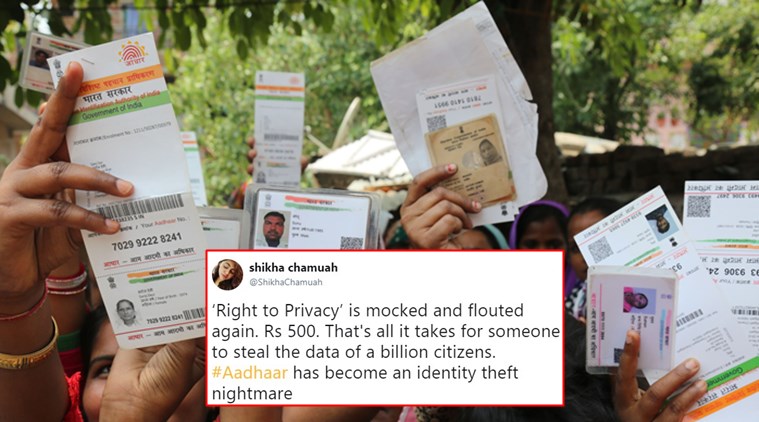
Seeking to build an identification system of unprecedented scope, India is scanning the fingerprints, eyes and faces of its 1.3 billion residents and connecting the data to everything from welfare benefits to mobile phones.
Civil libertarians are horrified, viewing the program, called Aadhaar, as Orwell’s Big Brother brought to life. To the government, it’s more like “big brother,” a term of endearment used by many Indians to address a stranger when asking for help.
For other countries, the technology could provide a model for how to track their residents. And for India’s top court, the ID system presents unique legal issues that will define what the constitutional right to privacy means in the digital age.
To Adita Jha, Aadhaar was simply a hassle. The 30-year-old environmental consultant in Delhi waited in line three times to sit in front of a computer that photographed her face, captured her fingerprints and snapped images of her irises.
Three times, the data failed to upload. The fourth attempt finally worked, and she has now been added to the 1.1 billion Indians already included in the program
Ms. Jha had little choice but to keep at it. The government has made registration mandatory for hundreds of public services and many private ones, from taking school exams to opening bank accounts.
“You almost feel like life is going to stop without an Aadhaar,” Ms. Jha said.
India’s program is in a league of its own, both in the mass collection of biometric data and in the attempt to link it to everything — traffic tickets, bank accounts, pensions, even meals for undernourished schoolchildren.
“No one has approached that scale and that ambition,” said Jacqueline Bhabha, a professor and research director of Harvard’s FXB Center for Health and Human Rights, who has studied biometric ID systems around the world. “It has been hailed, and justifiably so, as an extraordinary triumph to get everyone registered.”
Critics fear that the government will gain unprecedented insight into the lives of all Indians.

In response, Prime Minister Narendra Modi and other champions of the program say that Aadhaar is India’s ticket to the future, a universal, easy-to-use ID that will reduce this country’s endemic corruption and help bring even the most illiterate into the digital age.
“It’s the equivalent of building interstate highways,” said Nandan Nilekani, the technology billionaire who was tapped by the government in 2009 to build the Aadhaar system. “If the government invested in building a digital public utility and that is made available as a platform, then you actually can create major innovations around that.”
The potential uses — from surveillance to managing government benefit programs — have drawn interest elsewhere. Sri Lanka is planning a similar system, and Britain, Russia and the Philippines are studying it, according to the Indian government.
Aadhaar, which means “foundation” in English, was initially intended as a difficult-to-forge ID to reduce fraud and improve the delivery of government welfare programs.
But Mr. Modi, who has promoted a “digital India” vision since his party took power in 2014, has vastly expanded its ambitions.
The poor must scan their fingerprints at the ration shop to get their government allocations of rice. Retirees must do the same to get their pensions. Middle-school students cannot enter the water department’s annual painting contest until they submit their identification.
 ”
” In some cities, newborns cannot leave the hospital until their parents sign them up. Even leprosy patients, whose illness damages their fingers and eyes, have been told they must pass fingerprint or iris scans to get their benefits.
The Modi government has also ordered Indians to link their IDs to their cellphone and bank accounts. States have added their own twists, like using the data to map where people live. Some employers use the ID for background checks on job applicants.
“Aadhaar has added great strength to India’s development,” Mr. Modi said in a January speech to military cadets. Officials estimate that taxpayers have saved at least $9.4 billion from Aadhaar by weeding out “ghosts” and other improper beneficiaries of government services.
Opponents have filed at least 30 cases against the program in India’s Supreme Court. They argue that Aadhaar violates India’s Constitution — and, in particular, a unanimous court decision last year that declared for the first time that Indians had a fundamental right to privacy.
Rahul Narayan, one of the lawyers challenging the system, said the government was essentially building one giant database on its citizens. “There has been a sort of mission creep to it all along,” he said.
The court has been holding extensive hearings and is expected to make a ruling in the spring.
The government argues that the universal ID is vital in a country where hundreds of millions of people do not have widely accepted identification documents.
“The people themselves are the biggest beneficiaries,” said Ajay B. Pandey, the Minnesota-trained engineer who leads the Unique Identification Authority of India, the government agency that oversees the system. “This identity cannot be refused.”
Businesses are also using the technology to streamline transactions.

Banks once sent employees to the homes of account applicants to verify their addresses. Now, accounts can be opened online and finished with a fingerprint scan at a branch or other authorized outlet.
Reliance Jio, a telecom provider, relies on an Aadhaar fingerprint scan to conduct the government-mandated ID check for purchases of cellphone SIM cards. That allows clerks to activate service immediately instead of forcing buyers to wait a day or two.
But the Aadhar system has also raised practical and legal issues.
Although the system’s core fingerprint, iris and face database appears to have remained secure, at least 210 government websites have leaked other personal data — such as name, birth date, address, parents’ names, bank account number and Aadhaar number — for millions of Indians. Some of that data is still available with a simple Google search.
As Aadhaar has become mandatory for government benefits, parts of rural India have struggled with the internet connections necessary to make Aadhaar work. After a lifetime of manual labor, many Indians also have no readable prints, making authentication difficult.

One recent study found that 20 percent of the households in Jharkand state had failed to get their food rations under Aadhaar-based verification — five times the failure rate of ration cards.
“This is the population that is being passed off as ghosts and bogus by the government,” said Reetika Khera, an associate professor of economics at the Indian Institute of Technology Delhi, who co-wrote the study.
Seeing these problems, some local governments have scaled back the use of Aadhaar for public benefits. In February, the government for the Delhi region announced that it would stop using Aadhaar to deliver food benefits.
Dr. Pandey said that some problems were inevitable but that his agency was trying to fix them. The government is patching security holes and recently added face recognition as an alternative to fingerprint or iris scans to make it easier to verify identities.
Fears that the Indian government could use Aadhaar to turn the country into a surveillance state, he said, are overblown. “There is no central authority that has all the information,” he said.
Before Aadhaar, he said, hundreds of millions of Indians could not easily prove who they were.
“If you are not able to prove your identity, you are disenfranchised,” he said. “You have no existence.”

[Whoa – WTF???]In China, the government is rolling out ways to use facial recognition and big data to track people, aiming to inject itself further into everyday life. [2]
An artificial intelligence company touted a robot that could help doctors with diagnoses. A start-up displayed a drone designed to carry a single passenger 60 miles per hour.
And in a demonstration worthy of both wonder and worry, a Chinese facial recognition company showed how its technology could quickly identify and describe people.
If there were any doubts about China’s technological prowess, the presentations made this week at the country’s largest tech conference should put them to rest.
The event, once a setting for local tech executives and leaders of impoverished states, this year attracted top American executives like Tim Cook of Apple and Sundar Pichai of Google, as well as executives of Chinese giants like Jack Ma of Alibaba and Pony Ma of Tencent.
Yet all the advancements exhibited at the event, the World Internet Conference, in the picturesque eastern Chinese city of Wuzhen, also offered reason for caution.
The technology enabling a full techno-police state was on hand, giving a glimpse into how new advances in things like artificial intelligence and facial recognition can be used to track citizens — and how they have become widely accepted here
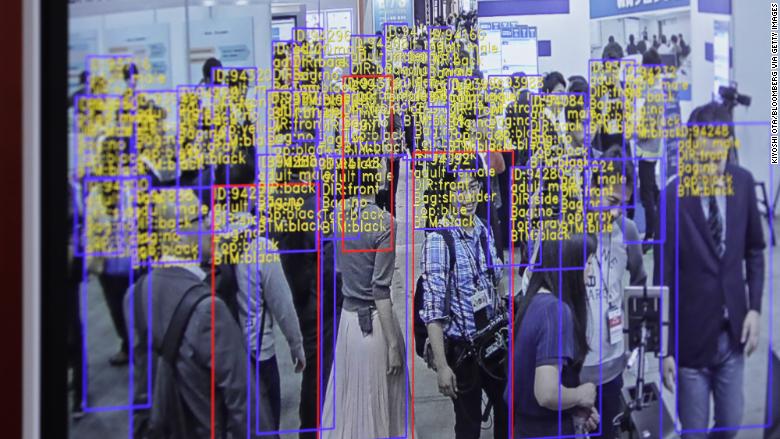
The tracking was apparent both in the design of the event, which ended on Tuesday, and in the technology on display. Tight security checkpoints made use of facial recognition. Chinese armed police patrolled. And in the dark corners of the whitewashed walls of the convention hall, the red lights of closed-circuit cameras glowed.
A fast-growing facial recognition company, Face++, turned its technology on conferencegoers. On a large screen in its booth, the software identified their gender, described their hair length and color and characterized the clothes they wore.
Other Chinese companies showed what could be done with such data. A state-run telecom company, China Unicom, featured a display with graphics breaking down the huge amounts of data the company has on its subscribers.
One map broke down the population of Beijing based on the changing layout of the city’s population as people commuted to and from work. Another showed where foreign visitors roamed on its network
The people overseeing China Unicom’s booth openly discussed the data, a sign of how widely accepted such surveillance and data collection have become in China.
In the United States, surveillance seems to be at the other end of the spectrum.
Who does not know the sad sad story of Facebook and its
creepfounder Mark Zuckerburg.Has the recent Facebook data scandal got you a little paranoid about sharing information on the internet?
I don’t blame you. After all, Facebook has access to some of your most personal information.
I’m talking about every message you’ve ever sent or been sent, every contact in your phone and even access to your computer’s camera and microphones.
Now would you like to get a lot more paranoid?
Let me introduce you to a company called In-Q-Tel
In-Q-Tel is a venture capital firm funded by the CIA.
The stated reason for In-Q-Tel existing is to expand the research and development efforts of the CIA into the private sector in order to deliver innovative technology solutions that support the missions of the CIA and broader U.S. Intelligence Community.
In-Q-Tel was launched in 1999 with former CIA Director George Tenet explaining the vision behind it as being:
We [the CIA] decided to use our limited dollars to leverage technology developed elsewhere. In 1999, we chartered… In-Q-Tel… While we pay the bills, In-Q-Tel is independent of CIA. CIA identifies pressing problems, and In-Q-Tel provides the technology to address them. The In-Q-Tel alliance has put the agency back at the leading edge of technology.
Now, the way the venture capital business works is that the venture capitalist provides capital to a startup business that is in desperate need of that cash.
There are great, revolutionary ideas out there that just need some cash to get them rolling.
These early-stage investments put the venture capitalist in on the ground floor of operations with an extremely large amount of influence over the decisions made at the firm that the venture capitalist has invested in.
What I’m trying to say is that the venture capitalist (in this case, the CIA) is going to be able to steer the future of these companies, how their technologies evolve and what they can be used for.
With that in mind, you should be interested to know that one of In-Q-Tel’s early investments was in a company called Keyhole EarthViewer. In 2004, Keyhole EarthViewer was acquired by another little startup that you may have heard of — Google.
At Google, the Keyhole EarthViewer technology that was born from CIA/In-Q-Tel funding was renamed Google Earth. Isn’t it good to know that the CIA and Google are on such close terms?
One company that happened to be very hungry for startup capital in 2005 was Facebook.
Facebook was launched in February 2004 from the Harvard dorm room of Mark Zuckerberg and friends.
The company received its first capital injection of $500,000 from Peter Thiel that summer. The next two capital injections were $12.7 million from Thiel and Accel Partners in May 2005 and then $27.5 million from an Accel-led round of financing that included Thiel, Accel and Greylock Partners in April 2006
You can see where this is going…
Meanwhile – coalition of more than 20 consumer advocacy groups is expected to file a complaint with federal officials on Monday claiming that YouTube has been violating a children’s privacy laws.
The complaint contends that YouTube, a subsidiary of Google, has been collecting and profiting from the personal information of young children on its main site, although the company says the platform is meant only for users 13 and older.
The coalition of consumer groups said YouTube failed to comply with the Children’s Online Privacy Protection Act, a federal law that requires companies to obtain consent from parents before collecting data on children younger than 13. The groups are asking for an investigation and penalties from the Federal Trade Commission, which enforces the law.
“Google has been continually growing its child-directed service in the United States and all over the world without any kind of acknowledgment of this law and its responsibilities,” said Jeffrey Chester, executive director of the Center for Digital Democracy, one of the groups leading the coalition. “It’s living in a world of online fiction and denied that it’s serving children.”
Let me close with that great song by Sting – perfect for this moment.
And remember – you are never alone…
[1] https://www.nytimes.com/2018/04/07/technology/india-id-aadhaar.html
{2] https://www.nytimes.com/2017/12/05/business/china-internet-conference-wuzhen.html
[3] https://dailyreckoning.com/revealed-facebooks-cia-connections/A Primer on Gold-Backed Currency in the 20th Century [1][2]
Alastair MacCleod / Goldmoney
Greg Canavan / The Daily Reckoning
Defining the role of gold
This article explains why another collapse is due for the dollar. It describes the errors that led to the two previous collapses in the 20th Century, and the lessons from them relevant to understanding the world monetary system today.
And just because gold is no longer officially money, it will not stop the collapse of the dollar, measured in gold, again
To modern financial commentators, there is little or no significant difference between a gold standard and a gold exchange standard.
A gold standard is commodity money, where gold is money, and monetary units are defined as a certain fixed fineness and weight of gold. The monetary authority is obliged by law to exchange without restriction gold against monetary units and vice-versa, and there are no restrictions on the ownership and movement of gold.

Only money substitutes (bank notes and token coins – gold being the money) circulate in the domestic economy. The monetary authority exchanges all imports of monetary gold and foreign currency into money substitutes for domestic circulation at the fixed gold exchange rate.
The monetary authority holds any foreign exchange which is also convertible into gold on a gold exchange standard at a fixed parity, and treats it to all extents and purposes as if it is gold.
Under a gold exchange standard, the only holder of monetary gold is the issuer of the domestic monetary unit as a substitute for gold. The monetary authority undertakes to maintain the relationship between the substitute and gold at a fixed rate.

The essential difference between a gold standard and a gold exchange standard is that with the latter, the monetary authority has added flexibility to expand the quantity of money substitutes in circulation without having to buy gold.
The gold exchange standard evolved in the 1920s as America and Britain went to the aid of European countries, struggling in the wake of the Great War. It allowed the expansion of national currencies under the guise of them being as good as gold.
It was not. In modern terms, the gold standard compared to the gold-exchange standard was as different as paper gold futures are to the possession of physical gold today.
A gold standard may start, for example, with 50% gold and 50% government bonds backing for money units, but all further issues of monetary units will require the monetary authority to purchase gold to fully cover them. This was the monetary regime in Britain and many other countries before the First World War.
As stated above, gold exchange standards evolved after the First World War, in the early 1920’s. It was the taking in of foreign currencies, also on gold exchange standards themselves, and booking them as if they were the equivalent of gold, that allowed central banks to expand the quantity of monetary units domestically.
To understand how this operated in practice requires us to work through an example between two countries on gold exchange standards. We will take the entirely hypothetical example of two countries, America and Italy, both of which have monetary gold in their reserves and operate on a gold exchange standard.
- America lends Italy dollars by crediting its central bank’s account at the Fed with the dollars loaned. But while ownership has changed to Italy, dollars never leave America. And dollars, when drawn down by the Banca d’Italia are recycled into America’s banking system.
- The economic sacrifice to America of lending money to Italy is therefore zero. America has simply created a loan out of its own currency, and in the process increased the quantity of dollars in circulation. And because in practice Italy does not encash dollars for gold, America expects to preserve its gold reserves.
- Meanwhile, The Banca d’Italia has expanded its balance sheet by the inclusion of America’s dollar loan to it as a liability, and the dollars themselves as an asset regarded as the equivalent of gold. Because dollars are not permitted to circulate in Italy’s domestic economy, they can be used by Banca d’Italia, either to settle other foreign obligations, or as a gold substitute to back the issue of further lira.
- Meanwhile, the Banca d’Italia’s dollars are reinvested in US Treasuries, which give a yield. Banca d’Italia has little incentive to exchange its dollars for physical gold, because gold yields nothing and is costs to store.
- If Banca d’Italia uses dollars to discharge a foreign obligation with another country, that third party will also end up investing the dollars gained in US Treasuries, assuming it also prefers yielding assets to physical gold.
- Alternatively, if the dollars are used by the Banca d’Italia to back an increase in the quantity of lira or to subscribe for government debt, the effect in the domestic Italian economy is an inflation of prices.
- Therefore, the effect of a gold exchange standard is the opposite of a gold standard.
A gold standard puts the requirements for the quantity of money in circulation entirely in the hands of the market, to which the central bank mechanically responds.
A gold exchange standard allows a lending central bank to inflate its money supply through inward investment, and a borrowing central bank to inflate its money supply on the presumption the monetary substitutes borrowed to back it are monetary units of gold.

Larger Picture http://lf-bc.com/wp-content/uploads/2014/03/Gold-timeline.jpgThe gold exchange standard in the 1920’s
After the First World War, both sterling and dollars were made available under the Dawes Plan of 1924, which provided non-domestic capital for Germany after her hyperinflation.
France suffered a currency crisis in July 1926, which was successfully dealt with by the Poincaré government through raising taxes. The Bank of France was then enabled to borrow dollars and sterling and to issue francs and subscribe for government debt.
To summarise, these loans bolstered the balance sheets of the Reichsbank and the Bank of France, which invested the sterling and dollars borrowed in gilts and Treasuries respectively.
If instead France and Germany had taken gold under the gold exchange provisions, they would have had an asset with no yield, though France did opt increasingly for some gold towards the end of the decade and beyond – by December 1932 she had accumulated 3,257 tonnes.
So, by lending their monetary units, the creditor nations achieved finance for their own governments, as well as providing capital for foreign central banks. It was seen to be a win-win for all the central banks involved.
The accumulation of dollars in foreign hands from 1922 onwards accompanied and fuelled bank credit expansion in the US. This gave the roaring twenties an inflationary impetus, dramatically reflected in its stock market bubble. However, the increasing quantity of dollars in foreign ownership became an accident waiting to happen.
There had been a mild thirteen-month recession from October 1926 to November 1927, after which the stock market boomed. The Fed was compelled to reverse earlier interest rate cuts and increased the discount rate from 3½% to 5% by July 1928.
French investors began to repatriate capital en-masse, and the Bank of France’s gold reserves rocketed from 711 tonnes in 1926 to 2,099 tonnes by 1930. The gold exchange standard had spectacularly failed, and redemption of dollars for gold, being deflationary, exacerbated the Wall Street Crash.
The gold exchange standard of Bretton Woods
In 1944, the monetary panjandrums of the day, led by Harry Dexter-White for the US and Lord Keynes for the UK, designed the post-war gold exchange standard of Bretton Woods. No doubt, Dexter-White fully understood the advantage to the US of forcing all countries to accept dollars with a yield, or gold with none.

When American payments abroad exceeded receipts, the difference was generally reflected in dollars issued to foreign central banks, kept on deposit in New York, or invested in US Treasuries.
Throughout the ‘fifties, America recorded a surplus on goods and services, which declined as European manufacturing recovered. But other factors, such as investment abroad and the Korean war resulted in an overall balance of payments deficit totalling $21.41bn, the equivalent of 19,024 tonnes of gold at $35 per ounce.
However, US gold reserves declined only 4,457 tonnes between 1950 and 1960, which tells us that the balance was indeed invested in US bank deposits and US Government notes and bonds.
The respective figures for the 1960s were total payment deficits of $32bn, the equivalent of 28,437 tonnes of gold, and an actual decline in gold reserves of 5,283 tonnes.
The accelerating increase of foreign ownership of dollars over these two decades meant the world, ex-America, was awash with dollars by the mid-1960s.
By the end of that decade, America’s gold reserves had declined from 20,279.3 tonnes in 1950, two-thirds of the world’s monetary gold, to 10,538.7 tonnes, 29% of the world’s monetary gold in 1970.
The effect was to remove trade settlement disciplines on net importing nations, and to cause inflation in net exporting nations, the opposite of the disciplines of a pre-WW1 gold standard on global trade. It was this effect that was central to the Triffin Dilemma, whereby dollars became wildly over-valued in gold terms through their excessive issuance.
The Triffin Dilemma
There is a fundamental incompatibility between the attainment of global economic stability and having a single national currency perform the role of the world’s reserve currency.
Belgianborn American economist Robert Triffin first highlighted this incompatibility in the 1960s. He observed that having the US dollar perform the role of the world’s reserve currency created fundamental conflicts of interest between domestic and international economic objectives.
On the one hand, the international economy needed dollars for liquidity purposes and to satisfy demand for reserve assets. But this forced, or at least made it easy, for the US to run consistently large current account deficits.
Triffin argued that such persistent deficits would eventually put pressure on the dollar and lead to the demise of the Bretton Woods system of international exchange.
The Triffin Dilemma, therefore, argued that the demands on an international currency meant that excess supply would undermine its value.
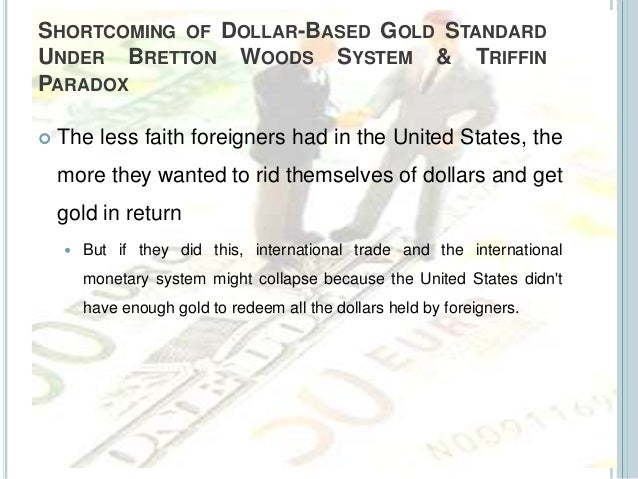
The US soon understood that Reserve Currency Status allowed them – no – required them – to run large deficits. The deficits were ‘paid’ for by issuing dollars. When the excess dollars began showing up in global central banks, they began converting their dollars into gold. This lowered the value of the US dollar in relation to gold.
The current system certainly rhymes with Triffin’s Dilemma. The export of dollars into foreign ownership was monetary magic, until it reversed at the first sign of trouble.
At first the authorities tried to manage the Dilemma. In 1961 they established the ‘London Gold Pool’ in an attempt to keep the dollar price of gold to $35 an ounce. This system worked for a while but fell apart by 1968 when France withdrew from the Pool.
The various nations then attempted to preserve the Bretton Woods system by maintaining a two-tiered gold market; one operating at the official $35 an ounce price while another traded gold at the market price, which was well above $35. Of course such a policy was completely unsustainable and it too failed.
In the mid-sixties, Washington became increasingly alarmed that foreigners weren’t playing by the assumed rule that they should take dollars and not redeem them for gold. By then, France and Germany between them had increased their gold holdings from 487.1 tonnes in 1948 to 7,089 tonnes at the time of the French PM General de Gaulle’s press conference:
Naturally, the smooth termination of the gold-exchange standard, the restoration of the gold standard, and supplemental and interim measures that might be called for, in particular with a view to organizing international credit on this new basis, will have to be deliberately agreed upon between countries, in particular those on which there devolves special responsibility by virtue of their economic and financial capabilities.”
General Charles de Gaulle, February 1965
General de Gaulle’s press conference had touched some very raw nerves.
It was clear that the dollar, with the overhang of foreign ownership, had become horribly overvalued, and so should have been devalued, perhaps to over $50 or $60 per ounce, for a gold peg to stick. A devaluation of this magnitude might have been sufficient at that time to stem the outflow of gold.
Both Washington and American public opinion were set strongly against any devaluation. Instead, the London gold pool collapsed in 1968, when France withdrew from it.
A dollar devaluation to $42 shortly after was simply not enough, and in 1971 President Nixon suspended the Bretton Woods System, and the new regime of floating exchange rates that is still with us to this day began.
The situation today : The US Federal Reserve Note
Following the Nixon shock, official monetary policy towards gold was to ignore it, and to persuade other central banks and financial markets it was irrelevant to the modern monetary system. To this day, the Fed still books the gold note from the Treasury at $42 per ounce, even though the price has risen to over $1300.

The US benefitted by paying for imports with essentially costless dollars. In turn, the US’ main trading partners enjoyed robust demand for their products, creating employment and income growth.
The huge deficits brought about by excess US consumption produced a massive amount of liquidity throughout the global economy. While Triffin’s Dilemma would have predicted a collapse of the dollar because of the glut of dollars in the system, such an outcome didn’t eventuate.
This was primarily because the beneficiaries of US consumption didn’t want it to end. So they reinvested their excess dollars back into US asset markets, notably US Government debt. Such actions supported the dollar, kept interest rates low, and perpetuated the imbalances.
The bankers have also managed to control (at least in the interim) the USD-gold pricing. The relationship is being temporarily manipulated by introducing gold futures paper contracts at the COMEX and London which set the price of the metal on international exchanges.
Banks such as JP Morgan Chase, RBS and Goldman Sachs among others take up naked short positions to sell paper contracts on the open market to drive the gold price down. Once the price drops the contracts are bought back and settled in USD and seldom is gold actually delivered.
This manipulation will collapse when sufficient physical gold contracts are settled in the metal. The China SGE is a step in this direction. The gold price will rise to its demand market value.
Furthermore, with the dollar acting as the world’s reserve currency, all other fiat currencies, which are priced with reference to it rather than gold, are to a greater or lesser extent in the same boat.
Taking a cue from our analysis of the workings of cross-border monetary flows, which allows America to have its privilege of foreigners financing its deficits, we can estimate the approximate extent of the accumulated imbalances that could lead to the dollar’s collapse.
We know that the US balance of payments deteriorated from 1992 onwards, though those figures did not include military spending abroad, which has been a significant and unrecorded addition to dollars both in cash circulation outside America, and also to estimates of the balance of payments. Official balance of payments figures are therefore understated and have been for at least a quarter of a century.

More recently, from September 2008 the Fed began expanding its balance sheet by policies designed to increase commercial bank reserves, as a response to the financial crisis. That August, they were $10.5bn, increased to $67.5bn the following month, and peaked at $2,786.9bn in August 2014, since when there has been a modest decline.
From our analysis of the run-ups to the two previous dollar crises, we know we should try to estimate how much of the increase was effectively funded from abroad. Treasury TIC Data gives us a fairly good steer to what extent this has happened.
We find that between those dates, (August 2008 – August 2014) foreign ownership of dollars increased by $6,237.7bn, over twice as much as the increase in the Fed’s record of commercial bank reserves.
This is the Triffin Dilemma at its most fast and furious. Since then, foreign ownership of dollars has increased a further $2,142.4bn to a record $18,694.1bn, even though bank reserves declined by $572bn. In other words, the accumulation of dollars in foreign hands now stands at over 105% of US GDP.
Another way of looking at it is to assess the market values of US securities held by foreigners and relate that to GDP, though this information is less timely,. This is shown in the following chart.
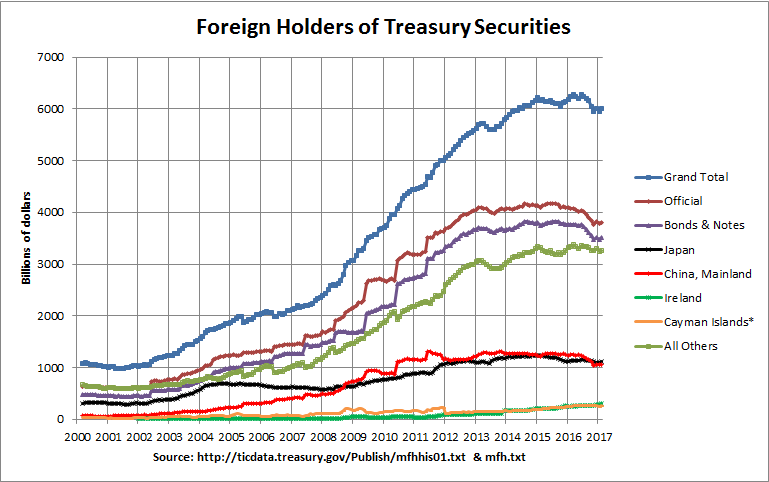
The build-up of foreign investment in America, in large measure the counterpart of dollar loans to foreigners, has been remarkable. At the time of the dot-com bubble, it had jumped to 35% of GDP, from less than 20% in the nineties and considerably less before.
At over 105% of GDP in recent years, there can be no doubt that the next financial event, whether it be derived from a rise in interest rates or a general weakness in the dollar, can be expected to trigger a substantial flight out of the dollar.
The pricing of financial assets, and today’s extraordinarily low interest rates indicate that a flight from the dollar is the last thing expected in financial markets.
If they were still alive, de Gaulle and his economic advisor, Jacques Rueff, would be instructing the ECB, as successor to the Bank of France, to dump all dollars for gold immediately.
And probably to dump all other foreign fiat currencies for gold as well. However, today, it is likely that other actors will blow the whistle on the dollar, such as the Chinese, and the Russians.
For it is clear that when the over-valuation of the dollar is corrected, the downside of a dollar collapse is far greater than it was in the early-thirties or the early-seventies.
All other fiat currencies take their value from the dollar, not gold. So, the destabilising forces on the dollar, the other unexpected side of Triffin’s Dilemma, could take down the whole fiat complex as well.
The near future : We have been here before.
The first time was in the late 1920s, which led to the dollar’s devaluation in 1934.
And the second was 1966-68, which led to the collapse of the Bretton Woods System.
Even though gold is now officially excluded from the monetary system, it does not save the dollar from a third collapse and will still be its yardstick.
With the US Federal Reserve raising interest rates and not rolling over Treasuries (Quantitative Tightening) the money supply is reducing. The risk of liquidity increases as fiat currency debt is unable to be repaid until finally the system resets.
Those of us who argue the case for a new gold standard, and not some sort of half-way house such as a gold exchange standard to address the obvious failings of the current monetary system, are in a similar position today to General de Gaulle.
Politicians and historians educated as Keynesians and monetarists do not understand the economic history of money, let alone the difference between a gold standard and a gold-exchange standard.
These similar sounding monetary systems must be defined and the differences between them noted, for anyone to have the slimmest chance of understanding this vital subject, and its relevance to the world monetary situation today.
Citations
[1] https://www.zerohedge.com/news/2018-04-06/why-dollar-collapse-inevitable
[2] https://dailyreckoning.com/the-triffin-dilemma/6th Apr Update #1 : New China US Trade War
I add the link to the original post here
/forums/topic/the-new-china-us-trade-war-a-matter-of-survival/
Trump threatens tariffs escalation to $100 billion of goods.
In his latest salvo in the trade war Trump turned his attention to the World Trade Organization, lambasting their lack of action as “unfair.”
China, which is a great economic power, is considered a Developing Nation within the World Trade Organization. They therefore get tremendous perks and advantages, especially over the U.S. Does anybody think this is fair. We were badly represented. The WTO is unfair to U.S.
Then China hits back with two press releases – this is very very rare occurrence. The content in both is even more disturbing if you understand how the Chinese use – or not use – civility in their responses
The Chinese envoy to the EU just said the European Union and China “must act together” to counter US protectionism.
“The Chinese side will follow suit to the end and at any cost, and will firmly attack, using new comprehensive countermeasures, to firmly defend the interest of the nation and its people,” the Commerce Ministry said in a statement on its website on Friday.
“We don’t want a trade war, but we are not afraid of one.”
China’s Xinhua news – unofficial mouthpiece of the Party quoted China’s Ministry of Commerce and Ministry of Foreign Affairs:
“We Chinese do disdain that Washington, which is in no position to initiate a trade war with China, persists in wielding the tariff baton. We are fully able to inflict as same losses on the US as those on China. The US will have to repay whatever loss and harm it has caused on China with huge economic and political cost.
“The White House’s latest proposal will hit Chinese exports to the US, and in response China will make a sweeping counter attack at US exports to China. China can retaliate at a wide range of areas including US goods exports to China, service exports and the US’ highly profitable investment in China.
“It takes both strength and willpower to engage in a large-scale China-US trade war. While the two countries are about evenly matched in trade power, the future is on China’s side. The trade war will cause pain for China, but in the meantime it can force China to speed up its economic transformation. What the US is losing in this process is its future. Many leading US companies will lose the Chinese market and thereby lose their edge. The US’ modern agriculture industry will be dealt a heavy blow.
“China won’t back off. The Chinese society will unite around the Party and the government to weather through the hardships, which is unparalleled for the US. More importantly, in the trade war launched by the US, China is on the righteous side safeguarding multilateral trade rules and our own rights on this basis.
“Chinese are aware that the only option now is to hit the US hard enough so that it will remember the pain. Otherwise Washington will go more recklessly and cause more losses.
“When Zhu Guangyao, China’s vice finance minister, and Wang Shouwen, vice commerce minister, announced proportionate tariffs on $50 billion US goods exported to China at a press conference on April 4, the short video got more than 2 million likes in two days. That is how Chinese people feel.
“It is not only the Chinese government’s decision, but the choice of society to firmly strike back against the US pressuring moves at any cost. Chinese society has been mad at repeated threats from the US in these years. Even if the Trump administration wants to take the trade war to the direction that bilateral trade and investment is suppressed to zero, China will meet all the challenges.
“Based on information we have received, Chinese authorities have made detailed response plan with many specific measures. Relevant Chinese government departments are fully confident in our ability to hit back at Washington, safeguard China’s interest and defend the multilateral system.
“Most Americans have their life linked with China-US trade.
“As the tensions escalate, we want to expand the trade war to all Americans so that they have to choose whether to support Trump’s unscrupulous move or to hold the president accountable.”
Civility is very important to the Chinese conducting official business. This deliberate removal of civility for Washington in the Chinese response is a deadly serious warning that the gloves will come off if need be.
Meanwhile the DJIA shows general price action of buying the dips after each tariff salvo, which saw institutional investors hedging their positions.

In the 12 hours or so since President Trump announced plans for $100 billion in additional tariffs on China, offshore yuan has tumbled 300 pips (3%). This is understood as a mini-devaluation of the yuan by the PBoC.
It is not clear if this a shot across the bow for Washington or a test case to see market reaction – or perhaps both.

This quote by the Chinese News agency before the devaluation
“If the trade war happens, China will show that it has just as many reserve plans as the US, if not more. Chinese experts suggest that China could even take actions to weaken the strength of its currency.
“Since China is the world’s largest trading economy and the largest buyer of commodities like oil products, China could use its influence to push its own currency, RMB, in global markets to reduce the dominance of the US dollar. That would be a heavy blow to Washington.”
Of course, China could still take other measures – like curbing package tours or student transfers to the U.S., or steps against American companies’ operations in China; or the final threat of ‘going nuclear’ by withdrawing from US Treasury auctions, maxi-devaluing its currency (think of the Aug 2015 turmoil), or a more petrodollar-focused retaliation.
As Petromatrix managing director Olivier Jakob wrote in a recent reports, if the trade war between U.S. and China continues “there is a risk for oil prices that China uses the bazooka option it has on U.S. crude oil exports,” which would be to curb shipments from America.
China is one of the biggest importers of U.S. crude at ~400k b/d, so any counter-tariffs on crude could become very heavy for the U.S. supply and demand picture, and would weigh on U.S. prices and spill over to global oil pricing.
Since the opening of the petro-yuan futures last week and expected petro-yuan to parallel the US petro-dollar in the later part of 2018, China has effectively neutralised possible US sanctions related to trade.
It is clear that the Chinese Government is prepared to take this trade war head – on.
Citations
[1] https://www.zerohedge.com/news/2018-04-06/stocks-tumble-china-urges-americans-rise-against-unscrupulous-president
[2] https://www.zerohedge.com/news/2018-04-06/stealth-retaliation-yuan-weakens-300-pips-trump-doubled-down-china-tariffs
[3] https://www.zerohedge.com/news/2018-04-06/tit-tat-trade-tariffs-reach-limit-will-china-go-nuclear
[4] https://www.zerohedge.com/news/2018-04-05/china-declares-trade-war-victory-warns-us-suffering-after-crushing-counterattack
AnonymousWhat follows in my open letter to the marriage industry. The text of the letter is in bold.
Dear marriage industry,
Who do you think that you’re kidding? It certainly isn’t me, not anymore that’s for sure. That makes me someone who you despise. Why? Because I’ll never contribute to any of the businesses that fall under the umbrella of your auspices. Not the conventions, not the dress manufactures, not the catalogues filled with glossy photos of young models in the recent fashions, not the self-important “wedding planners,” none of them. You see the intact family is the building block of any healthy society. You don’t car about that, you care about extracting as much money from naïve suckers only, especially women. Yeah, I know that there are those counterfeit things that queers get into, but I’m not talking about that either because that’s an entirely different animal. Let me explain myself. What follows are the primary points that comprise my abhorrence of your industry and of what marriage has become, not only here in the United Stated, but around the world. Oh, and I’ll explain that “intact family” thing too.
1. Men MUST act in a traditional manner for you to make any money. You convey that in your advertisements. Just look at how jewelers communicate the allege value of their products. Women just have to have a ring worth three months salary, oh it must be a big one too. Why? Because it’s a tradition! To put it another way you’re contributing to the commodification of men. That is, you are perpetuation the unfortunate reality that men are to be used as human ATM machines. Funny how you make things all about the woman and the man being subservient. What do the women do other than show up? According to you, NOTHING.
Remember how women are equal to men and can do anything that they can do? Why don’t you advertise for them to purchase a large ring for men? Oh wait, line number one in the paragraph above comes into play. What’s funny is that you would NEVER promote women acting in a traditional manner, EVER. Why? Because you fear the inevitable fecal storm that would arise from the ensuing backlash. Every feminist organization and two-bit hose beast would be calling for a boycott.
2. To expand upon the last part of point one, you have a vested interest exploiting and perpetuating the hypocrisy of today’s feminist movement and the entitlement complex of women. You don’t actually care about happy marriages, period. You care about the gynocentric pandering to the woman’s princess fantasy. You also know that women are vulnerable to emotional thinking. You’re a lot like a pimp in that way. I have more respect for pimps though. They provide a legitimate service for reasonable prices. You on the other hand provide unattainable dreams on the backs of unsuspecting suckers.
3. Dove tailing on the above point you encourage unbridled extravagance thereby creating large amounts of debt. Nothing exceeds like excess right? According to the following website: https://www.costofwedding.com/ The average cost of a wedding in the United States is $25,764. Think about that in context. The average median household income in 2017 was $56,516 according to the following website: https://www.cnbc.com/2017/08/24/how-much-americans-earn-at-every-age.html So when calculated, that “average cost of a wedding” statistic is 45.59 % of the median household income for one year. That’s higher than the average price of a new car which was $ 33,560 in 2015 according to the following website: https://www.usatoday.com/story/money/cars/2015/05/04/new-car-transaction-price-3-kbb-kelley-blue-book/26690191/ Here’s the catch, the average lifespan of a car is 8 years according to consumer reports and is quoted here: http://www.nbcnews.com/id/12040753/ns/business-consumer_news/t/whats-life-expectancy-my-car/#.WsVBYUxFyUk
The average length of a marriage? 8 whole years. That statistic can be found here: https://www.families.com/average-length-of-marriages
Let me summarize this point. The average wedding in America costs more than a new car and lasts the same amount of time that a new car does. Which one sounds like a better investment? I’ll take the new car every day of the week. It will get me to work everyday and will remain exactly where I left it. If someone steals it then that’s a criminal offence. Oh, I can sell my used car and put that money toward a new one. My wife screws me over? Nothing criminal about that at all! I can’t sell her either, there are laws against that.4. The divorce courts so heavily favor women in the United States that it’s not funny. With the divorce rate for 1st marriages resting between 40 % to 50 % and only growing for subsequent marriages. http://www.apa.org/topics/divorce/ That means men get screwed a lot. All based upon an outdated model that you try and keep from changing. Wouldn’t it be better for everyone involved if there where to be more transparency? How about helping people make an informed decision? I know that I’m asking for too much here. Think about this for a moment. That new car that I mentioned earlier doesn’t cost me money after I get rid of it, at all. A wife? Depending on where I live she could still be costing me money years, if not decades, into the future. Why would I want to keep paying for something I don’t use any more?
5. The cycle of broken families remains a constant. But, you wouldn’t have it any other way. Pandering dysfunctional thinking to females has made you rich. Your business model is sure to make payday loan companies or the American Mafia jealous. Why? Because that’s how crooked you are. At least the mafia is up front about what they do. If I don’t pay up then they will break my legs. I still don’t pay up? They will then kill me. It’s as simple as that. Payday loans at least have government regulations to keep them in line. You just lie, lie again, and then lie some more.
In the final analysis you’re dying. I’ve left out one key statistic until now. A very good statistic in my book. That is the marriage rate has dropped in recent decades. http://www.pewresearch.org/fact-tank/2017/09/14/as-u-s-marriage-rate-hovers-at-50-education-gap-in-marital-status-widens/
That’s great. More people, especially men, are waking up to the lies that you spout and the lie of feminism. You both feed each other. The only real choice now is to walk away, go MGTOW. I’ll invest my $ 25,000 dollars in stocks, bonds, whatever. Most likely that will grow and still be with me when I’m old, unlike a wife who most likely be gone and take many of my assets with her.Sincerely,
A Red Pilled Man
Topic: Finally MTGOW and Free
Greetings! I, like so many others, have finally found MGTOW. Unfortunately, like so many others, I found it later than I might have liked.
Also, like so many other men, I was indoctrinated from birth into “chivalry” and that overwhelming sense of duty to women. Regardless of how they treat us, we are supposed to be “gentlemen,” and we are never to raise our voices, nor our hands, to one of them. I never did. We are taught that it is our duty to care for and support women, come Hell or high water, despite and in spite of all the stupid s~~~ they do and demand. I did.
I married young, went to college, then joined the Army. We had been high school sweethearts and it seemed right. Isn’t it amazing how dramatically they change after that ring is on their finger? I was stationed overseas, but they wife decided that she didn’t want to be an Army wife; never mind that she had never actually tried it. Her mother told her so. Eventually, she demanded a divorce. During that process, she became pregnant by the security guard at work. I was overseas and lost everything, including our daughter, due to poor representation in court and a system that caters to women over men. Oh well, five years lost.
Having not learned my lesson and convinced that I had finally stumbled upon the right one, I married again. About three years into that marriage, and after we’d made two children, I discovered all of the medication she had been hiding from me, which took daily because of her mental issues. That explained the crazy. Real crazy, not this “I feel bad, so I need a Xanax” crazy. Fifteen years this marriage lasted because through most of it I still felt that overwhelming sense of duty to family and “chivalry.”
Fortunately, I had grown immensely wiser during the latter part of that fifteen years. She told me at some point that she wanted a divorce. She also told me about this plan she had where it would be uncontested and we would share the kids and part equitably, just like her boyfriend had with his wife.
Well, long story shorter, I let her believe that immense load of bulls~~~ while I prepared. I took notes, copied papers and receipts, recorded her screaming fits, and took pictures. I documented everything. Then, I called every lawyer I could find and asked which lawyer they recommended for a divorce; then I called him and retained him. Then, the kids and I moved out and we had her served at work.
All that preparation paid off. The kids hated her, so that worked to my advantage. Her attorney wanted to appoint a GAL for the kids, so my attorney suggested a well-known local family law practice. That paid off. We had the venue changed to the next county over, where the judge was a very conservative woman with nine children, who didn’t hold with married women pretending they are 22 and single. Then, the best part happened: true to form, my lying, cheating, soon-to-be-ex-wife lied in court and withheld evidence the judge demanded. She was censured, which in this state allowed my attorney what amounted to free reign; she wasn’t even allowed to speak during the final hearing.
I got the kids and the ex-wife pays ME child support. She is also responsible for half of all expenses incurred on behalf of the kids, from education to medical. She gets supervised visits once per week–supervised by me. I have full physical and legal custody. Finally, all her debts and the debts she incurred in my name were officially made her responsibility. I was lucky: I had a good attorney, kids who despised their mother and wanted to live with me, an excellent GAL, and a sympathetic judge. However, the best part was that my wife screwed herself and demonstrated in court judge what a piece of s~~~ she had become. As I explained to my attorney early on, divorce is no different from any other conflict and I had read Sun Tzu.
Glad to be here.
Do not wait to strike till the iron is hot; but make it hot by striking! -- William Butler Yeats










925069
924988
922113
921526
921524
919244
916783
915526
915524
915354
915129
914037
909862
908811
908810
908500
908465
908464
908300
907963
907895
907477
902002
901301
901106
901105
901104
901024
901017
900393
900392
900391
900390
899038
898980
896844
896798
896797
895983
895850
895848
893740
893036
891671
891670
891336
891017
890865
889894
889741
889058
888157
887960
887768
886321
886306
885519
884948
883951
881340
881339
880491
878671
878351
877678