
Home › Forums › Political Corner › India and China leading in Orwellian biometric control of citizens.
This topic contains 15 replies, has 9 voices, and was last updated by  FrostByte 1 year, 9 months ago.
- AuthorPosts
India and China leading in Orwellian biometric control of citizens.[1] [2] [3]
Technology has given governments around the world new tools to monitor their citizens. Welcome to the Brave New World of George Orwell – almost thirty five years late but almost right on time.
India and China are blazing the way forward as country-sized test facilities where the technologies are being refined – to be later used in other more resistant countries in ways which will be impossible to refuse or bypass for the masses.
Seeking to build an identification system of unprecedented scope, India is scanning the fingerprints, eyes and faces of its 1.3 billion residents and connecting the data to everything from welfare benefits to mobile phones.
Civil libertarians are horrified, viewing the program, called Aadhaar, as Orwell’s Big Brother brought to life. To the government, it’s more like “big brother,” a term of endearment used by many Indians to address a stranger when asking for help.
For other countries, the technology could provide a model for how to track their residents. And for India’s top court, the ID system presents unique legal issues that will define what the constitutional right to privacy means in the digital age.
To Adita Jha, Aadhaar was simply a hassle. The 30-year-old environmental consultant in Delhi waited in line three times to sit in front of a computer that photographed her face, captured her fingerprints and snapped images of her irises.
Three times, the data failed to upload. The fourth attempt finally worked, and she has now been added to the 1.1 billion Indians already included in the program
Ms. Jha had little choice but to keep at it. The government has made registration mandatory for hundreds of public services and many private ones, from taking school exams to opening bank accounts.
“You almost feel like life is going to stop without an Aadhaar,” Ms. Jha said.
India’s program is in a league of its own, both in the mass collection of biometric data and in the attempt to link it to everything — traffic tickets, bank accounts, pensions, even meals for undernourished schoolchildren.
“No one has approached that scale and that ambition,” said Jacqueline Bhabha, a professor and research director of Harvard’s FXB Center for Health and Human Rights, who has studied biometric ID systems around the world. “It has been hailed, and justifiably so, as an extraordinary triumph to get everyone registered.”
Critics fear that the government will gain unprecedented insight into the lives of all Indians.

In response, Prime Minister Narendra Modi and other champions of the program say that Aadhaar is India’s ticket to the future, a universal, easy-to-use ID that will reduce this country’s endemic corruption and help bring even the most illiterate into the digital age.
“It’s the equivalent of building interstate highways,” said Nandan Nilekani, the technology billionaire who was tapped by the government in 2009 to build the Aadhaar system. “If the government invested in building a digital public utility and that is made available as a platform, then you actually can create major innovations around that.”
The potential uses — from surveillance to managing government benefit programs — have drawn interest elsewhere. Sri Lanka is planning a similar system, and Britain, Russia and the Philippines are studying it, according to the Indian government.
Aadhaar, which means “foundation” in English, was initially intended as a difficult-to-forge ID to reduce fraud and improve the delivery of government welfare programs.
But Mr. Modi, who has promoted a “digital India” vision since his party took power in 2014, has vastly expanded its ambitions.
The poor must scan their fingerprints at the ration shop to get their government allocations of rice. Retirees must do the same to get their pensions. Middle-school students cannot enter the water department’s annual painting contest until they submit their identification.
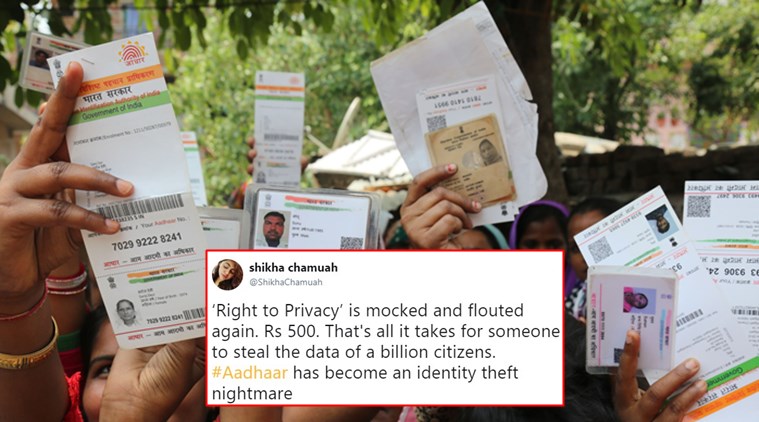 ”
” In some cities, newborns cannot leave the hospital until their parents sign them up. Even leprosy patients, whose illness damages their fingers and eyes, have been told they must pass fingerprint or iris scans to get their benefits.
The Modi government has also ordered Indians to link their IDs to their cellphone and bank accounts. States have added their own twists, like using the data to map where people live. Some employers use the ID for background checks on job applicants.
“Aadhaar has added great strength to India’s development,” Mr. Modi said in a January speech to military cadets. Officials estimate that taxpayers have saved at least $9.4 billion from Aadhaar by weeding out “ghosts” and other improper beneficiaries of government services.
Opponents have filed at least 30 cases against the program in India’s Supreme Court. They argue that Aadhaar violates India’s Constitution — and, in particular, a unanimous court decision last year that declared for the first time that Indians had a fundamental right to privacy.
Rahul Narayan, one of the lawyers challenging the system, said the government was essentially building one giant database on its citizens. “There has been a sort of mission creep to it all along,” he said.
The court has been holding extensive hearings and is expected to make a ruling in the spring.
The government argues that the universal ID is vital in a country where hundreds of millions of people do not have widely accepted identification documents.
“The people themselves are the biggest beneficiaries,” said Ajay B. Pandey, the Minnesota-trained engineer who leads the Unique Identification Authority of India, the government agency that oversees the system. “This identity cannot be refused.”
Businesses are also using the technology to streamline transactions.

Banks once sent employees to the homes of account applicants to verify their addresses. Now, accounts can be opened online and finished with a fingerprint scan at a branch or other authorized outlet.
Reliance Jio, a telecom provider, relies on an Aadhaar fingerprint scan to conduct the government-mandated ID check for purchases of cellphone SIM cards. That allows clerks to activate service immediately instead of forcing buyers to wait a day or two.
But the Aadhar system has also raised practical and legal issues.
Although the system’s core fingerprint, iris and face database appears to have remained secure, at least 210 government websites have leaked other personal data — such as name, birth date, address, parents’ names, bank account number and Aadhaar number — for millions of Indians. Some of that data is still available with a simple Google search.
As Aadhaar has become mandatory for government benefits, parts of rural India have struggled with the internet connections necessary to make Aadhaar work. After a lifetime of manual labor, many Indians also have no readable prints, making authentication difficult.

One recent study found that 20 percent of the households in Jharkand state had failed to get their food rations under Aadhaar-based verification — five times the failure rate of ration cards.
“This is the population that is being passed off as ghosts and bogus by the government,” said Reetika Khera, an associate professor of economics at the Indian Institute of Technology Delhi, who co-wrote the study.
Seeing these problems, some local governments have scaled back the use of Aadhaar for public benefits. In February, the government for the Delhi region announced that it would stop using Aadhaar to deliver food benefits.
Dr. Pandey said that some problems were inevitable but that his agency was trying to fix them. The government is patching security holes and recently added face recognition as an alternative to fingerprint or iris scans to make it easier to verify identities.
Fears that the Indian government could use Aadhaar to turn the country into a surveillance state, he said, are overblown. “There is no central authority that has all the information,” he said.
Before Aadhaar, he said, hundreds of millions of Indians could not easily prove who they were.
“If you are not able to prove your identity, you are disenfranchised,” he said. “You have no existence.”

[Whoa – WTF???]In China, the government is rolling out ways to use facial recognition and big data to track people, aiming to inject itself further into everyday life. [2]
An artificial intelligence company touted a robot that could help doctors with diagnoses. A start-up displayed a drone designed to carry a single passenger 60 miles per hour.
And in a demonstration worthy of both wonder and worry, a Chinese facial recognition company showed how its technology could quickly identify and describe people.
If there were any doubts about China’s technological prowess, the presentations made this week at the country’s largest tech conference should put them to rest.
The event, once a setting for local tech executives and leaders of impoverished states, this year attracted top American executives like Tim Cook of Apple and Sundar Pichai of Google, as well as executives of Chinese giants like Jack Ma of Alibaba and Pony Ma of Tencent.
Yet all the advancements exhibited at the event, the World Internet Conference, in the picturesque eastern Chinese city of Wuzhen, also offered reason for caution.
The technology enabling a full techno-police state was on hand, giving a glimpse into how new advances in things like artificial intelligence and facial recognition can be used to track citizens — and how they have become widely accepted here
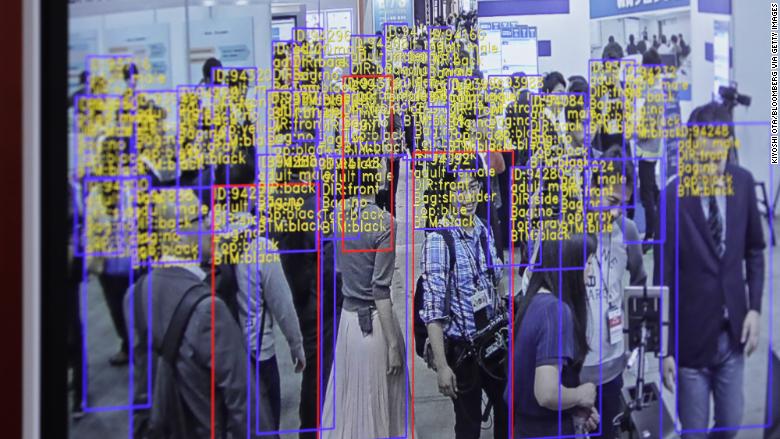
The tracking was apparent both in the design of the event, which ended on Tuesday, and in the technology on display. Tight security checkpoints made use of facial recognition. Chinese armed police patrolled. And in the dark corners of the whitewashed walls of the convention hall, the red lights of closed-circuit cameras glowed.
A fast-growing facial recognition company, Face++, turned its technology on conferencegoers. On a large screen in its booth, the software identified their gender, described their hair length and color and characterized the clothes they wore.
Other Chinese companies showed what could be done with such data. A state-run telecom company, China Unicom, featured a display with graphics breaking down the huge amounts of data the company has on its subscribers.
One map broke down the population of Beijing based on the changing layout of the city’s population as people commuted to and from work. Another showed where foreign visitors roamed on its network
The people overseeing China Unicom’s booth openly discussed the data, a sign of how widely accepted such surveillance and data collection have become in China.
In the United States, surveillance seems to be at the other end of the spectrum.
Who does not know the sad sad story of Facebook and its
creepfounder Mark Zuckerburg.Has the recent Facebook data scandal got you a little paranoid about sharing information on the internet?
I don’t blame you. After all, Facebook has access to some of your most personal information.
I’m talking about every message you’ve ever sent or been sent, every contact in your phone and even access to your computer’s camera and microphones.
Now would you like to get a lot more paranoid?
Let me introduce you to a company called In-Q-Tel
In-Q-Tel is a venture capital firm funded by the CIA.
The stated reason for In-Q-Tel existing is to expand the research and development efforts of the CIA into the private sector in order to deliver innovative technology solutions that support the missions of the CIA and broader U.S. Intelligence Community.
In-Q-Tel was launched in 1999 with former CIA Director George Tenet explaining the vision behind it as being:
We [the CIA] decided to use our limited dollars to leverage technology developed elsewhere. In 1999, we chartered… In-Q-Tel… While we pay the bills, In-Q-Tel is independent of CIA. CIA identifies pressing problems, and In-Q-Tel provides the technology to address them. The In-Q-Tel alliance has put the agency back at the leading edge of technology.
Now, the way the venture capital business works is that the venture capitalist provides capital to a startup business that is in desperate need of that cash.
There are great, revolutionary ideas out there that just need some cash to get them rolling.
These early-stage investments put the venture capitalist in on the ground floor of operations with an extremely large amount of influence over the decisions made at the firm that the venture capitalist has invested in.
What I’m trying to say is that the venture capitalist (in this case, the CIA) is going to be able to steer the future of these companies, how their technologies evolve and what they can be used for.
With that in mind, you should be interested to know that one of In-Q-Tel’s early investments was in a company called Keyhole EarthViewer. In 2004, Keyhole EarthViewer was acquired by another little startup that you may have heard of — Google.
At Google, the Keyhole EarthViewer technology that was born from CIA/In-Q-Tel funding was renamed Google Earth. Isn’t it good to know that the CIA and Google are on such close terms?
One company that happened to be very hungry for startup capital in 2005 was Facebook.
Facebook was launched in February 2004 from the Harvard dorm room of Mark Zuckerberg and friends.
The company received its first capital injection of $500,000 from Peter Thiel that summer. The next two capital injections were $12.7 million from Thiel and Accel Partners in May 2005 and then $27.5 million from an Accel-led round of financing that included Thiel, Accel and Greylock Partners in April 2006
You can see where this is going…
Meanwhile – coalition of more than 20 consumer advocacy groups is expected to file a complaint with federal officials on Monday claiming that YouTube has been violating a children’s privacy laws.
The complaint contends that YouTube, a subsidiary of Google, has been collecting and profiting from the personal information of young children on its main site, although the company says the platform is meant only for users 13 and older.
The coalition of consumer groups said YouTube failed to comply with the Children’s Online Privacy Protection Act, a federal law that requires companies to obtain consent from parents before collecting data on children younger than 13. The groups are asking for an investigation and penalties from the Federal Trade Commission, which enforces the law.
“Google has been continually growing its child-directed service in the United States and all over the world without any kind of acknowledgment of this law and its responsibilities,” said Jeffrey Chester, executive director of the Center for Digital Democracy, one of the groups leading the coalition. “It’s living in a world of online fiction and denied that it’s serving children.”
Let me close with that great song by Sting – perfect for this moment.
And remember – you are never alone…
[1] https://www.nytimes.com/2018/04/07/technology/india-id-aadhaar.html
{2] https://www.nytimes.com/2017/12/05/business/china-internet-conference-wuzhen.html
[3] https://dailyreckoning.com/revealed-facebooks-cia-connections/All the more reason to hope for a global crash.
All the more reason to hope for a global crash.
What you said
I’m an atheist, so I’m not hoping for the Second Coming of Christ; I’m hoping for the Second Coming of the Carrington Event.
▶ 0:44
All my life I've had doubts about who I am, where I belonged. Now I'm like the arrow that springs from the bow. No hesitation, no doubts. The path is clear. And what are you? Alive. Everything else is negotiable. Women have rights; men have responsibilities; MGTOW have freedom. Marriage is for chumps. If someone stands in the way of true justice, you simply walk up behind them and stab them in the heart-R'as al Ghul.
This will make political purges go faster. Target families, friends, business connects. All targeted and dealt with in the small span of a few hours.
This will make political purges go faster. Target families, friends, business connects. All targeted and dealt with in the small span of a few hours.
Wouldn’t it be great if system made them all penniless at the same time … oh wait! India already did that…
Good work on this man. I’ve always known that big brother was looking for ways to expand its sphere of control.
I just wasn’t’ aware of all the intricacies of In-Q-Tel, and how fast similar technologies were expanding globally.
This is Orwellian nightmare is unfolding right before our very eyes, and its scary stuff…
Fuck bitches... literally and metaphorically
Good work on this man. I’ve always know that big brother is always looking to expand its sphere of control
Cheers man – the Indian experience is funded by USAID and contracted to a US firm called Catalyst probably a CIA front.
I wrote about it in Jan 2017
/forums/topic/update-indian-banking-crises-part-3-end/These human control experiments are all part of the same neocon agenda. They have a plan and gun control is right in the middle of it.
Second Coming of the Carrington Event
I’m sorry but Trump put a tariff on that…
Second Coming of the Carrington Event
I’m sorry but Trump put a tariff on that…
Naw, I’m referring to the solar EMP event of 1859:
https://en.wikipedia.org/wiki/Carrington_EventAll my life I've had doubts about who I am, where I belonged. Now I'm like the arrow that springs from the bow. No hesitation, no doubts. The path is clear. And what are you? Alive. Everything else is negotiable. Women have rights; men have responsibilities; MGTOW have freedom. Marriage is for chumps. If someone stands in the way of true justice, you simply walk up behind them and stab them in the heart-R'as al Ghul.
This will make political purges go faster. Target families, friends, business connects. All targeted and dealt with in the small span of a few hours.
Wouldn’t it be great if system made them all penniless at the same time … oh wait! India already did that…
This system would make the purges in a coup or rise of a dictatorship happen much more quickly.
Naw, I’m referring to the solar EMP event of 1859:
Yes I know – Trump put a tariff on that too.
Well, glad they are going to be slaves. Someone has to be.
You are all alone. If you have been falsely accused of RAPE, DV, PLEASE let all men know about the people who did this. http://register-her.net/web/guest/home
Well, we are not actually lacking too far behind. I mean for my next passport they are not only to take finger prints but there’s also gonna be a chip integrated in it as well.
Ahh well, if it makes ’em happy … … ‘ave it!
I'd rather die a natual death with a clear MGTOW conscience somewhere off the grid than one within "modern" civilisation with a big stress mark on my forehead and a couple of dozen tubes plugged into my body. Back to the plantation..? Me..? Hey, literally: I won't ever fucking kid myself...YZERLMNTSIC
Start at 1:10 if you want look at what facial recognition can do for you.
If you rescue a damsel in distress, all you will get is a distressed damsel.
- AuthorPosts





You must be logged in to reply to this topic.
921526
921524
919244
916783
915526
915524
915354
915129
914037
909862
908811
908810
908500
908465
908464
908300
907963
907895
907477
902002
901301
901106
901105
901104
901024
901017
900393
900392
900391
900390
899038
898980
896844
896798
896797
895983
895850
895848
893740
893036
891671
891670
891336
891017
890865
889894
889741
889058
888157
887960
887768
886321
886306
885519
884948
883951
881340
881339
880491
878671
878351
877678