- Search Results
Topic: Helsinki Secrets
Helsinki Secrets [1]
Israel Shamir
Unz.com
Jul 24, 2018Israel Shamir is native of Novosibirsk , Siberia and a critically acclaimed and respected Russian-Israeli writer and journalist.
Shamir moved to Israel in 1969, served as paratrooper in the Israeli Army and fought in the 1973 Yom-Kippur war. After his discharge, he turned to journalism and writing.
From 1975, Shamir joined the BBC, lived in Japan and returned to Israel writing for the Israeli daily newspaper Haaretz, and was the Knesset spokesman for the Israel Socialist Party (Mapam). After political life he continues writing books and articles for alternative publications.
Shamir currently lives in Jaffa and spends much time in Moscow and Stockholm, and has become a leading proponent of the ‘One Man, One Vote, One State’ solution for Palestine/Israel.

Like an orange hurricane, President Trump made a stormy visit to the Old World. Usually American presidents’ visits to Europe present photo opportunities and vows of eternal love and friendship. Not this time. Since the Mongol invasion, not many visitors from outside shook Europe like he did. The US President has finally emerged from the cage built by his political adversaries, and begun to say things his voters wanted to hear.
However, his wonderful daring statements were quickly undermined and disowned by his ministers and advisers, creating the feeling that Trump speaks only for himself, while the US administration, his own appointees say the opposite. And then he also repudiated his own statements, saying he was misunderstood.
The American president increasingly resembles the hero of The Prince and The Pauper, the poor boy who accidentally became a king – and began to behave in a non-royal way: showing mercy and caring for people. His own staff disregards his commands. Trump says what people like to hear, but his administration sticks to the original course.
During the first part of his trip he acted a rebel in Wodehouse World with its feeble men and formidable women. Indeed the West is ruled by formidable aunts and elder sisters. Aunt Angela in Germany, Aunt Theresa in England, Aunt Brigitte in France. Only Aunt Hillary is missing to complete the puzzle and establish the rule of Aunties over their hen-pecked nephews.
(Hillary’s defeat didn’t derail the Aunties’ program of emasculation: #MeToo campaign goes on unabated. Men are afraid to flirt with girls. Henry (The Superman) Cavill admitted as much in an interview, saying that flirting with somebody would be like “casting myself into the fires of hell”, as a person in the public eye. “I think a woman should be wooed and chased”, he said, but it could lead to jail. He was immediately attacked for this heresy: “If Henry Cavill doesn’t want to be called a rapist then all he has to do is… not rape anyone”, implausibly they claimed. And he apologised profusely.)
Trump’s trip had been accompanied by mass protest demos. Normally I am all in favour of a good anti-American demo, but in this case, the protesters were extreme feminists and supporters of unlimited immigration. That’s people who like the Aunties, and hate Uncles. They do not mind conflict with Russia and even consider Trump as a “Russian agent”. They dislike that he does not obey Aunties.
In the second part of the tour, Trump had met with the formidable Mr Putin, a real man. Now that we have learned from our reliable sources what had happened in the palatial halls of Helsinki (excepting face-to-face private talk with Putin) we can describe Trump’s Pilgrim’s Progress and share our knowledge and conclusions with you.
In short, President Trump made the right sounds and called for right solutions, but he has been unable to insist on any. If he were a free man of his own mind, this trip would transform the world. The way things are, it will remain a sign of his honourable intentions, for everything he said has been overturned and denied by his aides.
In Brussels, Trump attacked Frau Merkel. How does she dare to buy Russian gas, if Germany faces a Russian threat? Why does it accept immigrants and refugees who undermine the European way of life? Saying that, he sided with “the populists”, the Italians, Hungarians and Austrians, whose top politicians are male and friendly to Trump and Putin.
The Brussels meeting almost came to an undoing of NATO. Trump hinted that the US would leave NATO unless they pay. They have to pay more, much more, if they want to have American protection.
Could he mean it? NATO is an instrument of American control over Europe, and Washington keeps dozens of bases in Europe, in particular – in Germany. Germany has remained under American occupation since 1945. This would seem good for America, but the occupied and controlled Western European states are tied to the Clinton camp, to Democrats and liberals. They do not accept Trump as their rightful sovereign. And Europe does not pay for its occupation, so it is costly.
Of course, it is a great honour to occupy and control the great powers of the past, England, France, the Netherlands, Spain. But it costs a lot of money for America. Likewise, in 1990 Russia discovered that it is expensive to control surly East Germany, independent Poland, sunny Georgia, tricky Armenia, populous Uzbekistan and the rainy Baltic States.
There is no certainty that the countries of Europe will agree to pay and submit to Trump’s demands. In Germany, there are growing voices demanding the Yankees be sent home, that is, to ask the American soldiers to leave Germany. It would be good if NATO were to disintegrate and disappear, like the Warsaw Treaty Organization disappeared. Trump has repeatedly said that he wants to return the American soldiers home.

Perhaps we shall witness Pax Americana without American troops in Europe, like England fictitiously claimed to belong to the Roman Empire, though Roman legions had left, and Rome lost all interest in foggy Albion.
In England, Trump confronted Mrs May. She reminded him of his school mistress, and Donald does not like school mistresses. The soft Brexit, which she intends to conclude, is a complete bummer, not a Brexit, he said. Under the proposed treaty, all prerogatives remain in Brussels. So, there can be no trade agreement between the United States and Britain.
America will negotiate directly with Brussels. And in general, it would be better if May transferred Downing Street 10 to her former Foreign Secretary, a hard-line Brexit supporter, the red-headed Bojo (as the Brits call Boris Johnson, who had just resigned, resenting the proposed plan for soft Brexit).
The European Union is an American design, too. Why, then, does the US President want to undermine it by removing the UK, his own Trojan Horse? Apparently, it means that the globalist forces have entered a state of direct confrontation with America.
This first part of Trump’s tour had been followed by the Kremlin with satisfaction. The Kremlin also believes that NATO has become obsolete, and that Brexit is the right step. Russia instinctively disapproves of mass migration, just like Trump.
Trump’s meeting with President Putin had been postponed for a year; both men were eager to meet. Trump wanted to meet another strong man, a powerful chieftain who can assist him in building a new world, instead of the one created under Obama, by media and Supreme Court Judges. President Putin wanted to solve bilateral issues and to ease American pressure upon Russia.
Their problems were very different. The main problems of Trump were Mme Clinton and Barack Obama, and the whole army of their obstinate followers who didn’t recognise Trump’s legitimacy. Putin couldn’t do much for him, with all his sympathy.
Putin’s problem is the hybrid warfare carried out by the United States against Russia. Despite accusations you hear in your media (alleged Russian ads in the Facebook and Twitter influencing voters), American pressure on Russia is very real and very painful.
American officials try to wreck every international deal Russia attempts to clinch. It is not only, or even mainly about weapons. If a country A wants to sell Russians, say, bananas, the US ambassador will come to A’s king, or his minister, and will expressly forbid him to sell bananas to godless Russians.
Otherwise, do not expect the US aid, or do not count on US favours in your disputes with your neighbours, or the US won’t buy your production, or US banks will take another long and jaundiced view at your financial transactions.
You witnessed the scene, when the crazed Nikki Haley, the US Ambassador to the UN, threatened sovereign nations with severe punishment for voting against the US desires, so you have an idea of American delicacy and caution while pushing their will through.
Russians are in a very uncomfortable seat. All their neighbours are subject to American pressure to annoy Russia, be it Georgia (once they even attacked Russia militarily being led by American and Israeli advisers) or the Ukraine (Americans arranged a coup d’état and installed extremely hostile to Russia government in Kiev).

American military bases surround Russia and NATO troops drew closer and closer to its centres. American military budget of 600 billion dollars dwarfs the Russian one, while the armaments’ race can undermine Russian finances. If Russia were a woman, she would scream: stop it!
Perhaps our colleague Mr Andrei Martyanov is right and the US can’t destroy Russia militarily; perhaps Immanuel Wallerstein is correct and American power is in decline; but meanwhile the US is perfectly able to make life hard and difficult for any state. It made life unbearably hard for North Korea, extremely hard for Iran. Russia is not doing half as good as she could do without ceaseless American meddling.
President Putin would like Trump to relent. There is no reason for this incessant picking on Russia; it is not Communist anymore; it is much smaller and less populous than the former USSR; it wants to live in peace as a member of the family of nations, not as a great alternative. The anti-Russian offensive began in earnest in the days of previous US presidents, namely Obama and Clinton; so it would make sense for Trump to stop it.
Problem is, President Trump is also actively engaged in war against Russia. Just a few days ago he pressured the German Chancellor to give up on the North Stream-2, to stop buying Russian gas. His advisers demanded that Turkey desist from buying a Russian antimissile system. The US Air Force bombed Russian troops in Syria.
Still Putin made a good try. He proposed to hold a referendum in the Donbas area of Eastern Ukraine which is presently independent though lacking international recognition. The people of Donbas had their own referendum in 2014, and voted for independence; Kiev regime and its Western sponsors denied its validity as it was done under Russian army’s protection, they claimed. Now Putin proposed a re-run under international auspices.
Trump ostensibly agreed, he said it was a good idea, and he asked for the opinion of John Bolton, his national security advisor; Bolton confirmed it was a good idea. This was in Helsinki; however, since then the idea had been rejected by the Americans, as the Kiev regime balked at it.
The regime knows well that the people of Eastern Ukraine aren’t likely to opt for their tender mercies, and Trump administration won’t push Kiev to agree to secession, or to abide by the Minsk agreements and let them re-join federal Ukraine as an autonomous unit. So this haemorrhaging wound at the western border of Russia will bleed on.
As for Syria, Putin told Trump that he agreed upon the arrangements with Mr Netanyahu to keep Iranians and their militias at some 80 km away from the disengagement (1974) lines at the Golan Heights. (Iranians are now going through a difficult stretch and they accepted this solution without a murmur.) This was acceptable to Trump, and both presidents stressed that they value Israeli security highly.
(They have differing reasons for it. Putin wants Syria to remain in peace under his protégé and ally President Bashar Assad, and for this, he needs some security arrangements with pugnacious Israel. Putin is aware of Jewish state’s ability to pull strings and he doesn’t want to antagonise it. Putin also wants Trump to be happy, and Israel is a point of huge importance for the US President, much more than for Putin.
Trump sacrifices at the altar of Israel to propitiate the Jews he is fighting in the US. Trump fights everything American Jews stand for, against all they achieved recently. He wants to have them back in the cash flow cubicle, the ‘short guys that wear yarmulkes every day’, counting his notes. They want much, much more: they wish to dominate and rule America their own way. Trump is ready to give all he can to Israel, so the American Jews will be less eager to fight him.
This ploy had been tried by the German National-Socialists in 1930s, who gave the Zionist-Socialists the most profitable Ha’avara deal to offset and overcome hostility of American Jews. It failed then, it is likely to fail again, but not before the Zionists will get all they dream of.)
For North Korea, Putin lauded Trump’s move and said he will keep playing a supportive role to American efforts.
For the bogus “Russian interference in the US elections”, Putin proposed to establish a bilateral expert group for cyber security. Let experts deal with experts, and sort out the claims, he said. Trump agreed with the idea, though his advisers were quick to repudiate it upon their return to Washington.
Putin also proposed to allow cross-examinations on the reciprocity basis: the US investigators will travel to Russia and interrogate Russian officials indicted by Mueller’s team; while Russian investigators will travel to the US and interrogate Ambassador McFaul for his participation in Browder affair.
Trump had been impressed by the generous offer; but as he returned to Washington, McFaul (falsely) claimed Trump intends to send him to the Gulag, and Trump’s advisers promptly repudiated the proposal.
Putin did not intend to arrest and detain McFaul, just to question him; likewise, he wouldn’t permit Mueller investigators to carry Russian intelligence officers to a Guantanamo of their choice, just to ask them questions. The Browder Affair grows bigger as time goes: though the rascal was not the biggest of Russian assets’ looters, he was the most outspoken and keen on hanging on the stolen goods.
The US advisers from top-league universities implanted in the Yeltsin administration in 1990s had stolen more; they also facilitated creation of the mighty oligarchs of that time.
However, Browder had more tenacity and he judiciously invested a lion share of his ill-gotten profits in bribes aiming to suborn the US administration and turn it onto relentless pursuit of Russia. Ambassador McFaul fronted for him and covered his misdeeds; while McFaul tried to interfere in Russian electoral process following the precedent established in 1996.
Thus at Helsinki, a pattern had been established, I was told by a witness. Putin would make a proposal, Trump would tentatively agree and promptly deny and repudiate on return to Washington.
From the beginning to the end, the US media was highly hostile to Trump and to his mission in Europe. They eagerly followed anti-Trump demos and exaggerated his every blunder. Google obediently trailed at the top Twitter messages of the ex-CIA boss calling Trump ‘a traitor’. All prominent Western newspapers spoke of Trump’s ‘treason’.
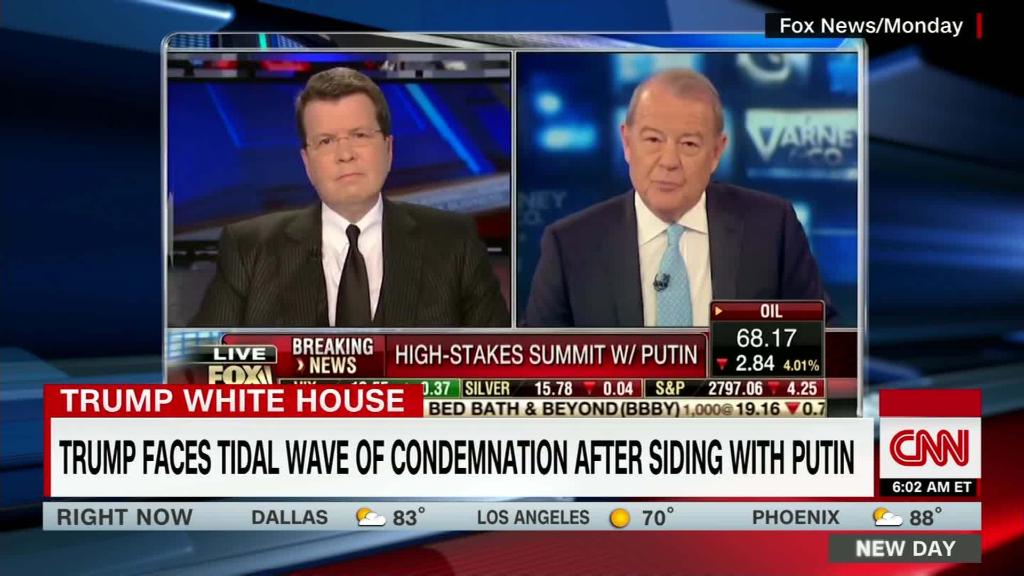
Perhaps they would be able to convince some Republicans to follow their trend, but the defeat of Rep. Mark Sanford in South Carolina primaries following Trump’s angry Twitter had brought them to their senses. A Republican leader stated the case well: “Obviously there are going to be those who are going to criticise him but they’re going to criticise him for anything that he says. This committee stands strong, stands behind him and wants to support him. We’re interested not only in the 2018 elections, we’re interested in the 2020 elections as well.”
The result of violent Trump-is-a-traitor campaign was surprising: 80% of Trump voters approved of his Helsinki shtick, notwithstanding the vehement accusations. American media had lost its silver touch. President may continue to build his power structure, and perhaps one day his word will be worth something.
Bottom line: Trump dared, and survived.
Israel Shamir can be reached at adam@israelshamir.net
This article was first published at The Unz Review.Citations
[1] http://www.unz.com/ishamir/helsinki-secrets/The FBI Hand Behind Russia-Gate
Ray McGovern
The Unz Review
January 11, 2018Ray McGovern works with Tell the Word, a publishing arm of the ecumenical Church of the Saviour in inner-city Washington. He was an Army and CIA intelligence analyst for 30 years; prepared and briefed the President’s Daily Brief for Nixon, Ford, and Reagan; and is co-founder of Veteran Intelligence Professionals for Sanity (VIPS)
- Donald Trump and Hillary Clinton in the third presidential debate in 2016, during which Clinton called Trump Vladimir Putin’s “puppet.
Russia-gate is becoming FBI-gate, thanks to the official release of unguarded text messages between loose-lipped FBI counterintelligence official Peter Strzok and his garrulous girlfriend, FBI lawyer Lisa Page. (Ten illustrative texts from their exchange appear at the end of this article.)
Despite his former job as chief of the FBI’s counterintelligence section, Strzok had the naive notion that texting on FBI phones could not be traced. Strzok must have slept through “Surity 101.” Or perhaps he was busy texting during that class. Girlfriend Page cannot be happy at being misled by his assurance that using office phones would be a secure way to conduct their affair(s).
It would have been unfortunate enough for Strzok and Page to have their adolescent-sounding texts merely exposed, revealing the reckless abandon of star-crossed lovers hiding (they thought) secrets from cuckolded spouses, office colleagues, and the rest of us. However, for the never-Trump plotters in the FBI, the official release of just a fraction (375) of almost 10,000 messages does incalculably more damage than that.
We suddenly have documentary proof that key elements of the U.S. intelligence community were trying to short-circuit the U.S. democratic process. And that puts in a new and dark context the year-long promotion of Russia-gate. It now appears that it was not the Russians trying to rig the outcome of the U.S. election, but leading officials of the U.S. intelligence community, shadowy characters sometimes called the Deep State.
More of the Strzok-Page texting dialogue is expected to be released. And the Department of Justice Inspector General reportedly has additional damaging texts from others on the team that Special Counsel Robert Mueller selected to help him investigate Russia-gate.
Besides forcing the removal of Strzok and Page, the text exposures also sounded the death knell for the career of FBI Deputy Director Andrew McCabe, in whose office some of the plotting took place and who has already announced his plans to retire soon.
But the main casualty is the FBI’s 18-month campaign to sabotage candidate-and-now-President Donald Trump by using the Obama administration’s Russia-gate intelligence “assessment,” electronic surveillance of dubious legality, and a salacious dossier that could never pass the smell test, while at the same time using equally dubious techniques to immunize Hillary Clinton and her closest advisers from crimes that include lying to the FBI and endangering secrets.
Ironically, the Strzok-Page texts provide something that the Russia-gate investigation has been sorely lacking: first-hand evidence of both corrupt intent and action. After months of breathless searching for “evidence” of Russian-Trump collusion designed to put Trump in the White House, what now exists is actual evidence that senior officials of the Obama administration colluded to keep Trump out of the White House – proof of what old-time gumshoes used to call “means, motive and opportunity.”
Even more unfortunately for Russia-gate enthusiasts, the FBI lovers’ correspondence provides factual evidence exposing much of the made-up “Resistance” narrative – the contrived storyline that The New York Times and much of the rest of the U.S. mainstream media deemed fit to print with little skepticism and few if any caveats, a scenario about brilliantly devious Russians that not only lacks actual evidence – relying on unverified hearsay and rumor – but doesn’t make sense on its face.
The Russia-gate narrative always hinged on the preposterous notion that Russian President Vladimir Putin foresaw years ago what no American political analyst considered even possible, the political ascendancy of Donald Trump. According to the narrative, the fortune-telling Putin then risked creating even worse tensions with a nuclear-armed America that would – by all odds – have been led by a vengeful President Hillary Clinton.
Besides this wildly improbable storyline, there were flat denials from WikiLeaks, which distributed the supposedly “hacked” Democratic emails, that the information came from Russia – and there was the curious inability of the National Security Agency to use its immense powers to supply any technical evidence to support the Russia-hack scenario.
The Trump Shock
But the shock of Trump’s election and the decision of many never-Trumpers to cast their lot with the Resistance led to a situation in which any prudent skepticism or demand for evidence was swept aside.
So, on Jan. 6, 2017, President Obama’s Director of National Intelligence James Clapper released an evidence-free report that he said was compiled by “hand-picked” analysts from the CIA, FBI and NSA, offering an “assessment” that Russia and President Putin were behind the release of the Democratic emails in a plot to help Trump win the presidency.
Despite the extraordinary gravity of the charge, even New York Times correspondent Scott Shane noted that proof was lacking. He wrote at the time: “What is missing from the [the Jan. 6] public report is what many Americans most eagerly anticipated: hard evidence to back up the agencies’ claims that the Russian government engineered the election attack. … Instead, the message from the agencies essentially amounts to ‘trust us.’”
But the “assessment” served a useful purpose for the never-Trumpers: it applied an official imprimatur on the case for delegitimizing Trump’s election and even raised the long-shot hope that the Electoral College might reverse the outcome and possibly install a compromise candidate, such as former Secretary of State Colin Powell, in the White House. Though the Powell ploy fizzled, the hope of somehow removing Trump from office continued to bubble, fueled by the growing hysteria around Russia-gate.
Virtually all skepticism about the evidence-free “assessment” was banned. For months, the Times and other newspapers of record repeated the lie that all 17 U.S. intelligence agencies had concurred in the conclusion about the Russian “hack.” Even when that falsehood was belatedly acknowledged, the major news outlets just shifted the phrasing slightly to say that U.S. intelligence agencies had reached the Russian “hack” conclusion. Shane’s blunt initial recognition about the lack of proof disappeared from the mainstream media’s approved narrative of Russia-gate.
Doubts about the Russian “hack” or dissident suggestions that what we were witnessing was a “soft coup” were scoffed at by leading media commentators. Other warnings from veteran U.S. intelligence professionals about the weaknesses of the Russia-gate narrative and the danger of letting politicized intelligence overturn a constitutional election were also brushed aside in pursuit of the goal of removing Trump from the White House.
It didn’t even seem to matter when new Russia-gate disclosures conflicted with the original narrative that Putin had somehow set Trump up as a Manchurian candidate. All normal journalistic skepticism was jettisoned. It was as if the Russia-gate advocates started with the conclusion that Trump must go and then made the facts fit into that mold, but anyone who noted the violations of normal investigative procedures was dismissed as a “Trump enabler” or a “Moscow stooge.”
The Text Evidence
But then came the FBI text messages, providing documentary evivdence that key FBI officials involved in the Russia-gate investigation were indeed deeply biased and out to get Trump, adding hard proof to Trump’s longstanding lament that he was the subject of a “witch hunt.”
Justified or not, Trump’s feeling of vindication could hardly be more dangerous — particularly at a time when the most urgent need is to drain some testosterone from the self-styled Stable-Genius-in-Chief and his martinet generals.
On the home front, Trump, his wealthy friends, and like-thinkers in Congress may now feel they have an even wider carte blanche to visit untold misery on the poor, the widow, the stranger and other vulnerable humans. That was always an underlying danger of the Resistance’s strategy to seize on whatever weapons were available – no matter how reckless or unfair – to “get Trump.”
Beyond that, Russia-gate has become so central to the Washington establishment’s storyline that there appears to be no room for second-thoughts or turning back. The momentum is such that some Democrats and the media never-Trumpers can’t stop stoking the smoke of Russia-gate and holding out hope against hope that it will somehow justify Trump’s impeachment.
Yet, the sordid process of using legal/investigative means to settle political scores further compromises the principle of the “rule of law” and integrity of journalism in the eyes of many Americans. After a year of Russia-gate, the “rule of law” and “pursuit of truth” appear to have been reduced to high-falutin’ phrases for political score-setttling, a process besmirched by Republicans in earlier pursuits of Democrats and now appearing to be a bipartisan method for punishing political rivals regardless of the lack of evidence.
Strzok and Page
Peter Strzok (pronounced “struck”) has an interesting pedigree with multiple tasks regarding both Mrs. Clinton and Mr. Trump. As the FBI’s chief of counterespionage during the investigation into then-Secretary of State Hillary Clinton’s unauthorized use of a personal email server for classified information, Strzok reportedly changed the words “grossly negligent” (which could have triggered legal prosecution) to the far less serious “extremely careless” in FBI Director James Comey’s depiction of Clinton’s actions. This semantic shift cleared the way for Comey to conclude just 20 days before the Democratic National Convention began in July 2016, that “no reasonable prosecutor” would bring charges against Mrs. Clinton.
Then, as Deputy Assistant Director of the Counterintelligence Division, Strzok led the FBI’s investigation into alleged Russian interference in the U.S. election of 2016. It is a safe bet that he took a strong hand in hand-picking the FBI contingent of analysts that joined “hand-picked” counterparts from CIA and NSA in preparing the evidence-free, Jan. 6, 2017 assessment accusing Russian President Vladimir Putin of interfering in the election of 2016. (Although accepted in Establishment groupthink as revealed truth, that poor excuse for analysis reflected the apogee of intelligence politicization — rivaled only by the fraudulent intelligence on “weapons of mass destruction“ in Iraq 15 years ago.)
In June and July 2017 Strzok was the top FBI official working on Special Counsel Robert Mueller’s investigation into possible links between the Trump campaign and Russia, but was taken off that job when the Justice Department IG learned of the Strzok-Page text-message exchange and told Mueller.
There is no little irony in the fact that what did in the FBI sweathearts was their visceral disdain for Mr. Trump, their cheerleading-cum-kid-gloves treatment of Mrs. Clinton and her associates, their 1950-ish, James Clapperesque attitude toward Russians as “almost genetically driven” to evil, and their (Strzok/Page) elitist conviction that they know far better what is good for the country than regular American citizens, including those “deplorables” whom Clinton said made up half of Trump’s supporters.
But Strzok/Page had no idea that their hubris, elitism and scheming would be revealed in so tangible a way. Worst of all for them, the very thing that Strzok, in particular, worked so hard to achieve — the sabotaging of Trump and immunization of Mrs. Clinton and her closest advisers is now coming apart at the seams.
Congress: Oversee? or Overlook?
At this point, the $64 question is whether the various congressional oversight committees will remain ensconced in their customarily cozy role as “overlook” committees, or whether they will have the courage to attempt to carry out their Constitutional duty.
The latter course would mean confronting a powerful Deep State and its large toolbox of well-practiced retaliatory techniques, including J. Edgar Hoover-style blackmail on steroids, enabled by electronic surveillance of just about everything and everyone. Yes, today’s technology permits blanket collection, and “Collect Everything” has become the motto.
Sen. Chuck Schumer, D-New York, with almost four decades of membership in the House and Senate, openly warned incoming President Trump in January 2017 against criticizing the U.S. intelligence community because U.S. intelligence officials have “six ways from Sunday to get back at you” if you are “dumb” enough to take them on.
Thanks to the almost 10,000 text messages between Strzok and Page, only a small fraction of which were given to Congress four weeks ago, there is now real evidentiary meat on the bones of the suspicions that there indeed was a “deep-state coup” to “correct” the outcome of the 2016 election. We now know that the supposedly apolitical FBI officials had huge political axes to grind.
The Strzok-Page exchanges drip with disdain for Trump and those deemed his smelly deplorable supporters. In one text message, Strzok expressed visceral contempt for those working-class Trump voters, writing on Aug. 26, 2016, “Just went to a southern Virginia Walmart. I could SMELL the Trump support. … it’s scary real down here.”
The texts even show Strzok warning of the need for an “insurance policy” to thwart Trump on the off-chance that his poll numbers closed in on those of Mrs. Clinton.
An Aug. 6, 2016 text message, for example, shows Page giving her knight in shining armor strong affirmation: “Maybe you’re meant to stay where you are because you’re meant to protect the country from that menace [Trump].” That text to Strzok includes a link to a David Brooks column in The New York Times, in which Brooks concludes with the clarion call: “There comes a time when neutrality and laying low become dishonorable. If you’re not in revolt, you’re in cahoots. When this period and your name are mentioned, decades hence, your grandkids will look away in shame.”
Another text message shows that other senior government officials – alarmed at the possibility of a Trump presidency – joined the discussion. In an apparent reference to an August 2016 meeting with FBI Deputy Director Andrew McCabe, Strzok wrote to Page on Aug. 15, 2016, “I want to believe the path you threw out for consideration in Andy’s office — that there’s no way he [Trump] gets elected — but I’m afraid we can’t take that risk.” Strzok added, “It’s like an insurance policy in the unlikely event that you die before you’re 40.”
Insurance Policy?
Senate Judiciary Committee chair Chuck Grassley, R-Iowa, says he will ask Strzok to explain the “insurance policy” when he calls him to testify. What seems already clear is that the celebrated “Steele Dossier” was part of the “insurance,” as was the evidence-less legend that Russia hacked the DNC’s and Clinton campaign chairman John Podesta’s emails and gave them to WikiLeaks.
If congressional investigators have been paying attention, they already know what former weapons inspector Scott Ritter shared with Veteran intelligence Professionals for Sanity (VIPS) colleagues this week; namely, that Fusion GPS’s Glenn Simpson, who commissioned the Russia dossier using Democratic Party money, said he reached out to Steele after June 17, just three days before Steele’s first report was published, drawing on seven sources.
“There is a snowball’s chance in hell that this is raw intelligence gathered by Steele; rather he seems to have drawn on a single ‘trusted intermediary’ to gather unsubstantiated rumor already in existence.”
Another VIPS colleague, Phil Giraldi, writing out of his own experience in private sector consulting, added: “The fact that you do not control your sources frequently means that they will feed you what they think you want to hear. Since they are only doing it for money, the more lurid the details the better, as it increases the apparent value of the information.
The private security firm in turn, which is also doing it for the money, will pass on the stories and even embroider them to keep the client happy and to encourage him to come back for more. When I read the Steele dossier it looked awfully familiar to me, like the scores of similar reports I had seen which combined bulls~~~ with enough credible information to make the whole product look respectable.”
It is now widely known that the Democrats ponied up the “insurance premiums,” so to speak, for former British intelligence officer Christopher Steele’s “dossier” of lurid — but largely unproven — “intelligence” on Trump and the Russians. If, as many have concluded, the dossier was used to help justify a FISA warrant to snoop on the Trump campaign, those involved will be in deep kimchi, if congressional overseers do their job.
How, you might ask, could Strzok and associates undertake these extra-legal steps with such blithe disregard for the possible consequences should they be caught? The answer is easy; Mrs. Clinton was a shoo-in, remember? This was just extra insurance with no expectation of any “death benefit” ever coming into play — save for Trump’s electoral demise in November 2016.
The attitude seemed to be that, if abuse of the FISA law should eventually be discovered — there would be little interest in a serious investigation by the editors of The New York Times and other anti-Trump publications and whatever troubles remained could be handled by President Hillary Clinton.
Sen. Lindsey Graham, R-South Carolina, who chairs the Judiciary Subcommittee of Judiciary on Crime and Terrorism, joined Sen. Grassley in signing the letter referring Christopher Steele to the Justice Department to investigate what appear to be false statements about the dossier. In signing, Graham noted the “many stop signs the Department of Justice ignored in its use of the dossier.”
The signature of committee ranking member Sen. Dianne Feinstein, D-California, however, was missing — an early sign that a highly partisan battle royale is in the offing. On Tuesday, Feinstein unilaterally released a voluminous transcript of Glenn Simpson’s earlier testimony and, as though on cue, Establishment pundits portrayed Steele as a good source and Fusion GPS’s Glenn Simpson as a victim.
The Donnybrook is now underway; the outcome uncertain.
Ray McGovern
http://raymcgovern.com/+++++++++++++
Sample text messages between Peter Strzok and Lisa Page, released to Congress and the media on December 13, 2016
++++++++++++++
03/04/2016
Strzok – God Hillary should win. 100,000,000-0.
Page – I know
++++++++++++
04/02/2016
Page – So look, you say we text on that phone when we talk about Hillary because it can’t be traced, you were just venting, bc you feel bad that you’re gone so much but that can’t be helped right now.
++++++++++
07/08/2016
Strzok – And meanwhile, we have Black Lives Matter protestors, right now, chanting “no justice no peace” around DoJ and the White House…
Page – That’s awful.
+++++++++
07/14/2016
Page – Have you read this? It’s really frightening. For Whites Sensing Decline, Donald Trump Unleashes Words of Resistance http://nyti/ms/ 29WCu5!
Strzok – I have not. But I think it’s clear he’s capturing all the white, poor voters who the mainstream republicans abandoned in all but name in the quest for the almighty $$$
Page – Yeah, it’s not good.
Strzok – Poll Finds Emails Weighing on Hillary Clinton, Now Tied With Donald Trump http://nyti.ms/29RV5gf
Page – It is
+++++++++++++
07/26/2016
Strzok – And hey. Congrats on a woman nominated for President in a major party! About damn time! Many many more returns of the day!!
Page – That’s cute. Thanks
++++++++++
08/06/2016
Page – Jesus. You should read this. And Trump should go f himself. Moment in Convention Glare Shakes Up Khans American Life http://nyti.ms/2aHulE0
Strzok – God that’s a great article. Thanks for sharing. And F TRUMP.
++++++++
08/06/2016
Page – And maybe you’re meant to stay where you are because you’re meant to protect the country from that menace. To that end comma, read this:
Page – Trump Enablers Will Finally Have to Take A Stand http://nyti.ms/2aFakry
Strzok – Thanks. It’s absolutely true that we’re both very fortunate. And of course I’ll try and approach it that way. I just know it will be tough at times. I can protect our country at many levels, not sure if that helps
++++++++++++
08/09/2016
Page – He’s not ever going to become president, right? Right?!
Strzok – OMG did you hear what Trump just said?
+++++++++++
08/26/2016
Strzok – Just went to a southern Virginia Walmart. I could SMELL the Trump support…
Page – Yep. Out to lunch with (redacted) We both hate everyone and everything.
Page – Just riffing on the hot mess that is our country.
Strzok – Yeah…it’s scary real down here
+++++++++
10/20/2016
Strzok: I am riled up. Trump is a f***ing idiot, is unable to provide a coherent answer.
Strzok – I CAN’T PULL AWAY, WHAT THE F**K HAPPENED TO OUR COUNTRY (redacted)??!?!
Page– I don’t know. But we’ll get it back. We’re America. We rock.
Strzok– Donald just said “bad hombres”
Strzok– Trump just said what the FBI did is disgraceful.
END
Citation
[1] http://www.unz.com/article/the-fbi-hand-behind-russia-gate/On the road in Afghanistan – Lies, legends and myths [1]
Andre Vltchek
The Saker
Sat, 05 Aug 2017 00:00 UTC
André Vltchek is a USSR-born American political analyst, journalist, and a filmmaker. Vltchek was born in St. Petersburg but later became a naturalized U.S. citizen. He has lived in the US, Chile, Peru, Mexico, Vietnam, Samoa and Indonesia.
He has covered armed conflicts in Peru, Kashmir, Mexico, Bosnia, Sri Lanka, Congo, India, South Africa, East Timor, Indonesia, Turkey and the Middle East. He has traveled to more than 140 countries,[3][5] and has written articles for Der Spiegel, Asahi Shimbun, The Guardian, ABC News and Lidové noviny. Since 2004, Vltchek has served as a Senior Fellow at the Oakland Institute.
[Y: This is a long post as it traces both the Russian and Western interventions in Afghanistan and what the Afghani really think of these powers and their place within their own country.
I can say I have not had a better look inside Afghanistan than through this article that gives voice to a people almost forgotten by recent history. The Afghanis shall not be forgotten.
The Soviet War in Afghanistan was a nine-year period involving the Soviet forces and the CIA-backed Mujahideen insurgents (forerunners of Al-Qaeda and the Taliban) that were fighting to overthrow Afghanistan’s Marxist People’s Democratic Party of Afghanistan (PDPA) government. The Soviet Union supported the government while the rebels found support from a variety of sources including the United States (in the context of the Cold War) and Pakistan. The conflict was a proxy war between the two super-powers, who never actually met in direct confrontation. Y]

- André Vltchek driving in Afghanistan
It often appears that “true Afghanistan” is not here in Kabul and not in Jalalabad or Heart either; not in the ancient villages, which anxiously cling to the steep mountainsides.
Many foreigners and even Afghans are now convinced that the “true” Afghanistan is only what is being shown on the television screens, depicted in magazines, or what is buried deep in the archives and libraries somewhere in London, New York or Paris.
It is tempting to think that the country could be only understood from a comfortable distance, from the safety of one’s living room or from those books and publications decorating dusty bookshelves and coffee tables all over the world.
“Afghanistan is dangerous,” they say. “It is too risky to travel there. One needs to be protected, escorted, equipped and insured in order to function in that wild and lawless country even for one single day, or just a few hours.”
When it comes to Afghanistan, conditioned Western ‘rational brains’ of tenure or emeritus professors (or call them the ‘regime’s intellectual gatekeepers’) often get engaged, even intertwined with those pathologically imaginative minds of the upper class ‘refugees’, the ‘elites’, and of course their offspring. After all, crème de la crème ‘refugees’ speak perfect English; they know the rules and nuances of the game. The results of such ‘productive interaction’ are then imprinted into countless books and reports.
Books of that kind become, in turn, what could be easily defined as the ‘official references’, a ‘certified way’ to how our world perceives a country like Afghanistan. Their content is being quoted and recycled.

How often I heard, from the old veteran opinion makers (even those from the ‘left’) – people that I actually used to respect in the past:
“The Soviet era in Afghanistan was of course terrible, but at least many girls there had access to the education…”
It is no secret that ‘many girls had access to education’ in those distant days, but was it really “terrible”, that era? Was it “of course, terrible?” Baseless clichés like this are actually shaping ‘public opinion’, and can be much more destructive than the hardcore propaganda.
Most of those old gurus never set foot in Afghanistan, during the Soviet era or before, let alone after. All their ‘experience’ is second or third-hand, constructed mainly on sponging up bitterness from those who betrayed their own country and have been collaborating with the West, or at least on the confusion and mental breakdowns of their children.
Based on such recycled unconfirmed ‘facts’, bizarre theories are born. According to them, Afghanistan is ‘officially’ wrecked; it is hopelessly corrupt; it is beyond salvation and repair. It is ‘so divided, ethnically and otherwise’, that it can never function again as one entity.
Then come liberals, and the children of corrupt Afghan diplomats and exiled ‘elites’, who commonly justify their passivity by blaming the entire world for the destruction of their nation: “every country in the world just wants to harm Afghanistan, take shamelessly advantage of it.”
Naturally, if everybody is responsible, than nobody truly is. Therefore, as expected, ‘the grand conclusion’ is – “There is absolutely no hope.” Everyone who can is trying to leave; who in his or her right mind would want to dwell in such mayhem?”
Let’s just write the entire place off! Chapter closed. One of the greatest cultures on Earth is finished. Nothing can be done about it. Goodbye, Afghanistan! Ciao, bella!
For some, especially for those who left the country and slammed the door, it is a tempting and ‘reassuring’ way of looking at the state of things. It justifies their earlier decision. If one accepts such views, than nothing has to be done, because no matter what, things would never improve, anyway.
For many, especially for those who are benefiting (even making careers) from doing absolutely nothing to save Afghanistan, such an approach and such theories are actually perfect. Very little of it matters to them, that almost all of this is total rubbish!

- The Hindu Kush Mountains of Afghanistan
I never saw any of those professors from the MIT or Cornell University anywhere near the dusty roads cutting through Samar Khel or Charikar. I never saw any reporters from the Western mass media outlets here, in the deepest villages that keep changing hands between Taliban and the government forces, either.
If they were here, I’d definitely spot them, as they tend to travel ‘in style’, like some buffoons from bygone eras: wearing ridiculous helmets, bulletproof vests, and PRESS insignias on all imaginable and unimaginable parts of their bodies, while being driven around in armored vehicles, often even with a full military escort.
It would be quite difficult to talk to Afghan people looking like that. There is not much one could actually even see from such an angle and perspective, but that’s the only one they are choosing to have, that is if they come here at all.
Let me back-track a bit: in case my readers in the West or elsewhere have never heard about Samar Khel. Well, it is a dusty town not far from Jalalabad, a former ‘grave’ for the Soviet forces and the National Afghan Army. During the “Soviet era”, the US and the Saudi-backed Mujahedeen used to fire between 500 and 1,000 missiles from here, all directly towards the city of Jalalabad, day after day.
It is very hard to imagine what went on and what went wrong in Afghanistan during the 1980’s, without feeling that 43*C heat of the desert, without chewing dust, without facing those bare, hostile mountains, and without speaking to people who used to live here during ‘those days’, as well as people who have been existing, barely surviving here now.

- Soviet soldiers direct tank traffic outside Kabul on January 7, 1980. Tank units had set up positions all around the capital city
It is also absolutely impossible to understand the Soviet Union and its ‘involvement’ in Afghanistan, without driving through the countryside and all of a sudden spotting in some ancient and god-forsaken village, a mighty and durable water duct built by Soviet engineers several decades ago, with electricity towers and high voltage wires still proudly spanning above.
By now I know that I don’t want to write another academic book. I wrote two of them, one about Indonesia and one about that enormous sprawl of water dotted with fantastic but devastated islands and atolls of the South Pacific – “Oceania”. To write academic books is time consuming and it is, in many ways, ‘selfish’.
The true story gets buried under an avalanche of tedious facts and numbers, under footnotes and recycled quotes. Once such a book is read and returned to its place on a shelf, no one is really inspired or outraged, no one is terrified and no one is ready to build barricades and fight.
But most academic books and are never even read from cover to cover.
I see no point in writing books that wouldn’t inspire people to raise flags, to fight for their country and humanity.
I don’t work in Afghanistan in order to compile indexes and footnotes. I am there because the country itself is a victim of the most brutal and ongoing imperialist destruction in modern history. As an internationalist, I’m not here only to document; I’m here to accuse and to confront the venomous Western colonialist narrative frontally.
Afghanistan is bleeding, assaulted and terribly injured. Therefore it deserves to be fought for and not just to be analyzed and described. No cold and detached historic accounts, no texts written from a safe distance, can help this beautiful country to stand on its own feet, to regain its pride and hope, and to fly as it used to in the not so distant past.
It doesn’t need more and more nihilism. On the contrary, it is thirsting for optimism, for new friends, for hope.
Not all countries are the same. Even now, Afghanistan has friends, true friends, no matter how much this fact is being obscured by the Western propagandists, no matter how much pro-Western Afghan elites are trying to prove otherwise.
This is not what you are supposed to be reading. All remembrances of the “Soviet Era” in Afghanistan have been boxed and then labeled as “negative”, even “toxic”. No discussion on the topic is allowed in ‘polite circles’, at least in the West and in Afghanistan itself.
Afghanistan is where the Soviet Union was tricked into, and Afghanistan is where the Communist superpower received its final blow. ‘The victory of capitalism over communism’, the official Western narrative shouted. A ‘temporary destruction of all progressive alternatives for our humanity’, replied others, but mostly under their breath.
After the horrific, brutal and humiliating period of Gorbachev/Yeltsin, Russia shrunk both geographically and demographically, while going through indescribable agony. It hemorrhaged; it was bathing in its own excrement, while the West celebrated its temporary victory, dancing in front of the world map, envisioning the re-conquest of its former colonies.
But in the end Russia survived, regained its bearings and dignity, and once again became one of the most important countries on Earth, directly antagonistic to the global Western imperialist designs.
Afghanistan has never recovered. After the last Soviet combat troops left the country in 1989, it bled terribly for years, consumed by a brutal civil war. Its progressive government had to face the monstrous terror of the Western and Saudi-backed Mujahedeen, with individuals like Osama bin Laden in command of the jihadi genocide.
Socialists, Communists, secularists as well as almost all of those who were educated in the former Soviet Union or Eastern Block countries, were killed, exiled, or muzzled for decades.
Most of those who settled in the West simply betrayed; went along with the official Western narrative and dogma.
Even those individuals who still claimed to be part of the left, repeated like parrots, their pre-approved fib:
- “Perhaps the Soviet Union was not as bad as the Mujahedeen, Taliban, or even the West, but it was really bad enough.”
I heard these lines in London and elsewhere, coming from several mouths of the corrupt Afghan ‘elites’ and their children. From the beginning I was doubtful. And then my work, my journeys to and through Afghanistan began. I spoke to dozens of people all over the country, doing exactly what I was discouraged to do: driving everywhere without an escort or protection, stopping in the middle of god-forsaken villages, entering fatal city slums infested with narcotics, approaching prominent intellectuals in Kabul, Jalalabad and elsewhere.
- An Afghan marketplace scene in Kabul
“Where are you from?” I was asked on many occasions.
“Russia,” I’d reply. It was a gross simplification. I was born in Leningrad, now St Petersburg, but an incredible mixture of Chinese, Russian, Czech and Austrian blood circles through my veins. Still, the name “Russia” came naturally to me, in the middle of Afghan deserts and deep gorges, especially in those places where I knew that my life was hanging on a thin thread. If I were to be allowed to utter one last word in this life, “Russia” was what I wanted it to be.
But after my declaration, the faces of the Afghan people would soften, unexpectedly and suddenly. “Welcome!” I’d hear again and again. An invitation to enter humble homes would follow: an offer to rest, to eat, or to just drink a glass of water.
‘Why?’ I often wondered. “Why?” I finally asked my driver and interpreter, Mr. Arif, who became my dear friend.
“It’s because in this country, Afghans love Russian people,” he replied simply and without any hesitation.
“Afghans love Russians?” I wondered. “Do you?”
“Yes,” he replied, smiling. “I do. Most of our people here do.”
Two days later I was sitting inside an armored UNESCO Land Cruiser, talking to a former Soviet-trained engineer, now a simple driver, Mr. Wahed Tooryalai. He allowed me to use his name; he had no fear, just accumulated anger, which he obviously wanted to get out of his system:
“When I sleep, I still sometimes see the former Soviet Union in my dreams. After that, I wake up and feel happy for one entire month. I remember everything I saw there, until now…”
I wanted to know what really made him so happy ‘there’?
Mr. Wahed did not hesitate:
“People! They are so kind. They are welcoming… Russians, Ukrainians… I felt so much at home there. Their culture is exactly like ours. Those who say that Russians ‘occupied’ Afghanistan have simply sold out. The Russians did so much for Afghanistan: they built entire housing communities like ‘Makroyan’, they built factories, even bakeries. In places such as Kandahar, people are still eating Russian bread…”
I recalled the Soviet-era water pipes that I photographed all over most of the humble Afghan countryside, as well as the elaborate water canals in and around cities like Jalalabad.

- Soviet-built water pipeline from the 1980’s
“There is so much propaganda against the Soviet Union,” I said.
“Only the Mujahedeen and the West hate Russians,” Mr. Wahed explained. “And those who are serving them.”
Then he continued:
“Almost all poor Afghan people would never say anything bad about Russians. But the government people are with the West, as well as those Afghan elites who are now living abroad: those who are buying real estate in London and Dubai, while selling their own country…those who are paid to ‘create public opinion.'”
His words flowed effortlessly; he knew precisely what he wanted to say, and they were bitter, but it was clearly what he felt:
“Before and during the Soviet era, there were Soviet doctors here, and also Soviet teachers. Now show me one doctor or teacher from the USA or UK based in the Afghan countryside! Russians were everywhere, and I still even remember some names: Lyudmila Nikolayevna… Show me one Western doctor or nurse based here now.
“Before, Russian doctors and nurses were working all over the country, and their salaries were so low… They spent half on their own living expenses, and the other half they distributed amongst our poor… Now look what the Americans and Europeans are doing: they all came here to make money!”
I recall my recent encounter with a Georgian combatant, serving under the US command at the Bagram base. Desperate, he recalled his experience to me:
“Before Bagram I served at the Leatherneck US Base, in Helmand Province. When the Americans were leaving, they even used to pull out concrete from the ground. They joked: “When we came here, there was nothing, and there will be nothing after we leave…”
“They prohibited us from giving food to local children. What we couldn’t consume, we had to destroy, but never give to local people. I still don’t understand, why? Those who come from the US or Western Europe are showing so much spite for the Afghan people!”
What a contrast!
Mr. Wahed recalled how the Soviet legacy was abruptly uprooted:
“After the Taliban era, we were all poor. There was hunger; we had nothing. Then the West came and began throwing money all around the place. Karzai and the elites kept grabbing all that they could, while repeating like parrots: “The US is good!” Diplomats serving Karzai’s government, the elites, they were building their houses in the US and UK, while people educated in the Soviet Union couldn’t get any decent jobs.
We were all blacklisted. All education had to be dictated by the West. If you were educated in the USSR, Czechoslovakia, East Germany or Bulgaria, they’d just tell you straight to your face: Out with you, Communist! At least now we are allowed to at least get some jobs… We are still pure, clean, never corrupt!”
“Do people still remember?” I wonder.
“Of course they do! Go to the streets, or to a village market. Just tell them: “How are you my dear?” in Russian. They’d immediately invite you to their homes, feed you, embrace you…”
I tried a few days later, in the middle of the market… and it worked. I tried in a provincial town, and it worked again. I finally tried in a Taliban-infiltrated village some 60 kilometers from Kabul, and there it didn’t. But I still managed to get away.
- An Afghan village market
I met Mr. Shakar Karimi in Pole Charkhi Village. A local patriarch, he used to be a district chief in Nangarhar Province.
I asked him, what the best system ever implemented in modern Afghanistan was?
First he spoke about the Khan dynasty, but then referred to a left-wing Afghan leader, who was brutally tortured and murdered by Taliban after they entered Kabul in 1996:
“If they’d let Dr. Najib govern in peace, that would have been the best for Afghanistan!”
I asked him about the Soviet invasion in 1979.
“They came because they were given wrong information. The first mistake was to enter Afghanistan. The second, fatal mistake was to leave.”
“What was the main difference between the Russians and Westerners during their engagement in Afghanistan?”
“The Russian people came predominately to serve, to help Afghanistan. The relationship between Russians and Afghans was always great. There was real friendship and people were interacting, even having parties together, visiting each other.”
I didn’t push him further; didn’t ask what was happening now. It was just too obvious. “Enormous walls and high voltage wires,” would be the answer. Drone zeppelins, weapons everywhere and an absolute lack of trust… and the shameless division between the few super rich and the great majority of the desperately poor… the most depressed country on the Asian continent.
Later I asked my comrade Arif, whether all this was really true?
“Of course!” He shouted, passionately. “100% true. The Russians built roads, they built homes for our people, and they treated Afghans so well, like their brothers. The Americans never did anything for Afghanistan, almost nothing. They only care about their own benefits.”
“If there would be a referendum right now, on a simple question: ‘do you want Afghanistan to be with Russia or with the United States, the great majority would vote for Russia, never for the US or Europe. And you know why? I’m Afghan: when my country is good, then I’m happy. If my country is doing bad, then I suffer! Most people here, unless they are brainwashed or corrupted by the Westerners, know perfectly well what Russia did for this country. And they know how the West injured our land.”
- After the West intervened….
Of course this is not what every single Afghan person thinks, but most of them definitely do. Just go and drive to each and every corner of the country, and ask. You are not supposed to, of course. You are told to be scared to come here, to roam through this “lawless” land.
“And you are not supposed to go directly to the people. Instead you are expected to recycle the writings of toothless, cowardly academics, as well as servile mass media reports. If you are liberal, you are at least expected to say: “there is no hope, no solution, no future.”
At Goga Manda village, the fighting between the Taliban and government troops is still raging. All around the area, the remnants of rusty Soviet military hardware can be found, as well as old destroyed houses from the “Soviet era” battles.
The Taliban is positioned right behind the hills. Its fighters attack the armed forces of Afghanistan at least once a month.
Almost 16 years after the NATO invasion and consequent occupation of the country, this village, as thousands of other villages in Afghanistan, has no access to electricity, and to drinking water. There is no school within walking distance, and even a small and badly equipped medical post is far from here, some 5 kilometers away. Here, an average family of 6 has to survive on US$130 dollars per month, and that’s only if some members are actually working in the city.
I ask Mr. Rahmat Gul, who used to be a teacher in a nearby town, whether the “Russian times” were better.
He hesitated for almost one minute, and then replied vaguely:
“When the Russians were here, there was lots of shooting… It was real war… People used to die. During the jihad period, the Mujahedeen were positioned over there… they were shooting from those hills, while Soviet tanks were stationed near the river. Many civilians were caught in the crossfire.”
As I got ready to ask him more questions, my interpreter began to panic:
“Let’s go! Taliban is coming.”
He’s always calm. When he gets nervous, I know it is really time to run. We ran; just stepping on the accelerator and driving at breakneck speed towards the main road.
Before we parted, Mr. Wahed Tooryalai grabbed my hand. I knew he wanted to say something essential. I waited for him to formulate it. Then it came, in rusty but still excellent Russian:
“Sometimes I feel so hurt, so angry. Why did Gorbachev abandon us? Why? We were doing just fine. Why did he leave us? If he hadn’t betrayed us, life in Afghanistan would be great. I wouldn’t have to be a UN driver… I used to be the deputy director of an enormous bread factory, with 300 people working there: we were building our beloved country, feeding it. I hope Putin will not leave us.”
- Band-e Sardeh Dam built by the USSR
[Y: Soviet-built projects helped bring about development and social change in Afghanistan in the 1960s and 70s. Many of these infrastructure projects have survived war and are still operational Y]
Then he looked at me, straight into my eyes, and suddenly I got goose bumps as he spoke, and my glasses got foggy:
“Please tell Mr. Putin: do hold our hand, as I’m now holding yours. Tell him what you saw in my country; tell him that we Afghans, or at least many of us, are still straight, strong and honest people. All this will end, and we will send the Americans and Europeans packing. It will happen very soon. Then please come and stand by us, by true Afghan patriots! We are here, ready and waiting. Come back, please.”
A son of the super elite Afghan ‘exiles’ living in London, once ‘shouted’ at me, via Whatsapp, after I dared to criticize one of the officially-recognized gurus of the Western anti-communist left, who happened to be his religiously admired deity:
- “I’m completely amazed that you’d do such a thing. Then again, you’re Russian… And Russians held a strange superiority complex about dominating the whole Asian and African continents – even when nobody invited or asked them to. Historical examples are plenty… Don’t go to a country to report about what’s actually going on when you can’t even speak the language!”
This was his tough verdict on Russia and on my work; a verdict of ‘Afghan man in London’, who never even touched work in his entire life, being fully sustained by his morally corrupted family. He never traveled much, except when his father took him on one of the official diplomatic visits.
He has been drinking, taking drugs and hating everything that fights, that defies the Empire. From President Duterte in the Philippines, to Maduro in Venezuela, and Assad in Syria. After he was taken out of Afghanistan at an extremely early age, he never set foot on its soil.
All of his knowledge was accumulated ‘second-hand’, but he is quick to pass endless moral judgments, and he is actually taken seriously by one of the most influential and famous ‘opposition’ figures in the West.
It is because he is an Afghan, after all, and because he has a perfect English accent, and his ‘conclusions’ are ‘reasonable’, at least to some extent acceptable by the regime, and therefore trustworthy. He and others like him know perfectly well when to administer the required dose of anti-Soviet and anti-Russian sentiments, or when to choose well-tolerated anarcho-syndicalism over true revolutionary fervor.
Again in London, a lady from an Afghan diplomatic circle, who still takes pride in being somehow left-leaning (despite her recent history of serving the West), recalled with nostalgia and boasting pride:
“Once when I got sick, I travelled with my husband from Kabul to Prague, for medical treatment. It was in 80’s, and we took with us 5,000 dollars. You know, in those days in Czechoslovakia this was so much money! Our friends there never saw so much cash in their lives. We really had great time there.”
I listened politely and thought: ‘Damn, in those days, my two Czech uncles were building sugar mills, steel factories and turbines for developing countries like Syria, Egypt, Lebanon. I’m not sure whether they also worked in Afghanistan, but I wouldn’t be surprised if they did. It was their internationalist duty and they were hardly making US$500 per month. The salary of my father, a leading nuclear scientist, who was in charge of the safety of VVR power plant reactors, was at that time (and at the real exchange) well under US$200 a month.
These were very honest, hard-working people, doing their duty towards humanity. And then someone came from Kabul, from the capital of one of the poorest countries in Asia, recipient of aid and internationalist help from basically all Soviet Block countries, and blows 5.000 bomb in just a few days!’
In those days, socialist Czechoslovakia was helping intensively, various revolutionary and anti-colonialist movements, all over the world. Even Ernesto Che Guevara was treated there, between his campaign in Congo, and his final engagement in Bolivia.
But the lady did not finish, yet:
“Once we crossed the border and travelled to the Soviet Union by land. You cannot imagine the misery we encountered in the villages, across the border! Life was much tougher there than on our side. Of course Moscow was different: Moscow was the capital, full of lights, truly impressive…”
Was that really so? Or was this official narrative that has been injected through the treasonous elites into the psyche of both Afghans and foreigners?
I listened, politely. I like stories, no matter from which direction they are coming. I took mental notes.
Then, back in Afghanistan, I asked Mr. Shakar Karimi point blank:
“You were travelling back and forth, between Afghanistan and the former Soviet Union. Was life in the Afghan countryside better than in Uzbekistan and Tajikistan?”
He stared at me, shocked. When my question finally fully sank into his brain, he began laughing:
“Soviet villages were so much richer, there could not be any comparison. They had all necessary facilities there, from electricity to water, schools and medical posts, even public transportation: either train or at least a bus. No one could deny this, unless they’d be totally blind or someone would pay them not to see!
Of course Tashkent, capital of Uzbekistan, was totally different story: it was a huge and very important Soviet city, with theaters, museums, parks, hospitals and universities. But even the villages were, for us, shockingly wealthy. Culture at both sides of the border was, however, similar. And while the Soviets were engaged here in Afghanistan, things began developing at our side of the border, too.”
But who would listen to Mr. Shakar Karimi from Pole Charkhi Village, on the outskirts of Kabul. He hardly spoke English, and he had no idea how to be diplomatic and ‘acceptable’ to Londoners or New Yorkers. And what he was saying was not what was expected from the Afghans to say.
During my previous trip to Afghanistan, over the phone from Kabul, I suggested to my friend, another ‘elite’ Afghan exile, that the next time she should come with me, at least for a few days, in order to reconnect, to breath the air of the city that she has been claiming she missed so desperately, for so many years. Reply was curt, but somehow predictable:
“Me, coming back like this; incognito? You don’t understand, my family is so important! When I finally go back, it will be a big, big deal!”
It is very strange, but Afghans that I know from Afghanistan are totally different from those I meet in Europe and North America. So are Afghans who are going back, regularly, to their beloved country, and who are ‘connected’, even engaged.
In Rome, I met Afghan Princess Soraya. I was invited to Italy by several left-wing MP’s representing 5 Stelli (‘5 Star Movement’) and during our lunch together, when learning about my engagement in Afghanistan, they exclaimed: “You have to meet ‘our’ Afghan Princess!”
They called her on a mobile phone. She was in her 60s, but immediately she jumped on her bicycle and pedaled to the Parliament area in order to meet me. She was shockingly unpretentious, and endlessly kind. With her, nothing was a ‘big deal’. “Come meet me in the evening in the old Jewish Ghetto,” she suggested. “There will be an opening of a very interesting art exhibition there, in one of the galleries.”
- Princess Soraya of Afghanistan
We met again, in the evening. She was very critical of the occupation of her country by the NATO forces. She had no fear, nothing to hide. She had no need to play political games.
“I’m going back to Kandahar, in couple of weeks. Please let me know when you are going back to my country. I’ll arrange things for you. We’ll show you around Kandahar.”
In the meantime, I got used to Afghanistan; to its terrain, its stunning beauty, to its bitter cold in the winter and stifling heat of the summers, to its curtness, its exaggerated politeness and even to its hardly bearable roughness, which always surfaces at least once in a while.
But I never got used to all of those upper-class ‘refugees’, people who have left Afghanistan permanently; to those who later betrayed, and then betrayed again, spreading false information about their country, serving Western media/propaganda outlets or as diplomats of the puppet state abroad, making a lucrative living out of their treason and out of the misery of their own people. I don’t think that I will ever get used to them. In a way, they are even worse than NATO, or at least equally as bad, and more deadly and venomous than the Taliban.
There are many ways how one can betray his or her country. There are also countless reasons and justifications for treason. Historically, Western colonialists developed entire networks of local, “native” collaborators, all over the world. These people have been ready and willing to run down their devastated countries, on behalf of the European and later, US imperialists, in exchange for prominent positions, titles and ‘respect’. Unfortunately, Afghanistan is not an exception.
On 21 January 2010, even Kabul Press had apparently enough, and it published damning article “Afghan UN Ambassador’s $4.2 million Manhattan apartment” (https://www.kabulpress.org/article4590.html), referring to the super-luxury residence of then Afghan UN Ambassador, Zahir Tanin:
- “Among the billions of dollars being spent propping up the Karzai government are some choice bits of New York City real estate. Number 1 is a 2,400 sq. ft. 3-bedroom corner apartment in the Trump World Tower, one of the world’s most expensive addresses. It was chosen by Zahir Tanin, Afghanistan’s Ambassador to the United Nations, who lives there with his wife.”
- “According to Kabul press sources, eight other diplomats working in the Mission’s offices live about one hour away. The average rent for them is over $20,000 per month-extremely pricey even for Manhattan real estate. The previous Ambassador, Mr. Farhadi paid only $7,000 per month for all rent and expenses.”
- “Other ambassadors, like Taib Jawad (Afghan Abmassador to the U.S.) are living in luxury residences, why not me?” our source quotes Tanin as saying.”
So many Afghans have left, many betrayed, but others are refusing to bend, remaining proud and honest.
During my previous visit to the country, I worked along the road separating the districts 3 and 5 in Kabul, photographing literally decomposing bodies of drug-users.
In June 2017 I returned, but this time I dared to film the people living under the bridges, and in deep infested hovels. Later I walked on the riverbank, trying to gain some perspective and to film from various angles.

- One of the ways of filming in Afghanistan
Someone was making threatening gestures from the distance; someone else aimed a gun at me. I ducked for cover.
“Not very welcoming place, is it?” I heard loud laughter behind my back. Someone spoke perfect English.
I turned back. A well-dressed man approached me. We exchanged a few words. I explained what I was doing here and he understood immediately.
“Here is my card,” he said. Muhammad Maroof (Sarwan), Vice-President of the Duniya Construction Company,” it read. He continued:
“I came to this warehouse here to deliver my products, and I saw you filming. You’re lucky you were not hit by a bullet.”
“I want to talk,” he said, pointing his hand at the bridge. “Don’t film me, just take notes. You can quote me, even use my name.”
He explained that he used to work for the US military, as an interpreter.
Then he began speaking, clearly and coherently:
“The biggest mafias here are directly linked to both UK and US. The West lies that they want to stop trade with drugs in Afghanistan; they never will allow it to stop.”
“My brother is a writer and he has images of the U.S. army giving water pumps, studs and other basic stuff, for the growth of poppies. The biggest supporter of drugs production in Afghanistan, and the export, is the UK government. They are dealing directly with the locals, even giving them money…
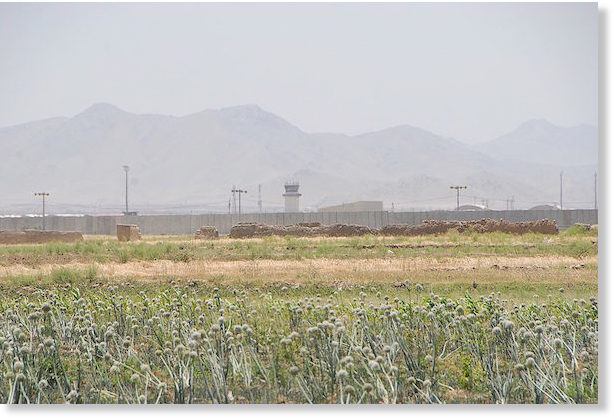
- Poppy growing next to US airforce base in Bagram, Afghanistan
The UK is also the major market for the export. Helmand, Kandahar, you name it, from there, directly, transport planes are taking off and going straight towards Europe, even the US. The Westerners are people who physically put drugs into the airplane at our airports.”
“My relative was an interpreter for the British… He was killed by them, after he had been witnessing and interpreting at a meeting between the UK officials, and the local drug mafias.”
I was wondering whether he was certain he wanted to speak on the record. My interpreter was standing by, apparently impressed by what he was witnessing. Mr. Maroof did not hesitate:
“I have nothing to hide. They are destroying my country right in front of my eyes. What could be more horrifying than that? The Western occupation is ruining Afghanistan. I want the world to be aware of it, and I don’t care what could happen to me!”
Not all the opposition to the present regime in Kabul is fighting for true independence and progressive ideals. Some have close links with the West, or/and with the Mujahedeen.
In Kabul, in June 2017, inside a makeshift camp built near the site of a devastating explosion which in May killed at least 90 people, injuring 400, I met with Ramish Noori, the spokesperson of Haji Zahir Qadir’s “Uprising for Change”. The powerful “Uprising” counts on at least a 1,000-men strong militia, one which is locked in brutal combat with ISIS (Daesh), and which has already beheaded several terrorist fighters in ‘retaliatory’ actions.
Mr. Noory clearly indicated that the goal of his group is to force the present government to resign, even if that would have to happen with the help of foreign countries:
“We were shot at in Kabul and 6 protesters were killed, 21 injured. Professional Special Forces of Ashraf Ghani shot those who were killed point blank, in the face. Instead of killing terrorists, this government is killing innocent protesters; people who came to demand security after that barbaric terrorist attack which took lives of 90 people. We actually believe that many government officials are responsible for the killings. We also think that the government is helping to coordinate attacks of the terrorists.”
Mr. Samir, one of the protesters, began shouting in anger:
“The government is killing its own people, and so we want both Ghani and Abdullah Abdullah to resign. We want an entire reset of the Afghan system. Look what is happening all around the country: killings, bomb blasts and unbridled corruption!”
But when I press them hard, I feel that behind their words there is no sound ideology, just geographically swappable ‘civil society talk’. And perhaps some power struggle as well.
I don’t know who is supporting them, who is behind them, but I feel that someone definitely is. What they say is right, but it is how they say it that worries me.
I ask Ramish Noori about the NATO occupation of Afghanistan, and suddenly there is a long pause. Then a brief answer in a slightly uncomfortable tone of voice:
“We are ready to work with any country that is supporting our position.”
“Can I stop by later today?” I ask.
“Of course. Anytime. We’ll be here till the morning. We are expecting the Mujahedeen to join us in the early hours.”
“Mujahedeen?”
Next time I will investigate further.
I visited the British Cemetery in Kabul. Not out of some perverse curiosity, but because, during my last visit, I was given this tip by a Russian cultural attaché:
“See how patient, how tolerant Afghan people are… After all that has been done to them…”
I’m glad that I went. The cemetery puts the events of the last 2 centuries into clear perspective. To a clear British perspective…
Full of patriotic sentimentality, The Telegraph once described this place as: “Afghanistan: The corner of Kabul that is forever England.”
There was no repentance, no soul-searching, no questions asked, like: What was England doing here, thousands of miles away from its shores, again and again… and again?”
Above the names of fallen English soldiers, there was a sober but unrepentant dedication:
“This memorial is dedicated to all those British officers and soldiers who gave their lives in the Afghan wars of the 19th and 20th Century. Renovated by the officers and soldiers of the British Contingent of the International Security Assistance Force in Kabul. February 2002. “We Shall Remember Them””
- British Cemetary in Kabul
The cemetery is well kept. There is no vandalism and no graffiti. In Afghanistan, the death of Englishmen, Spaniards and other foreigners is respected.
Unfortunately, the death of Afghan people is not even worth commemorating, anymore.
How many Afghans did those British troops massacre, in two long centuries? Shouldn’t there be a monument, somewhere in Kabul, to those thousands of victims of British imperialism? Perhaps there will be… one day, but not anytime soon.
Again I drove to Bagram, filming the monstrous walls of the US military and air force base.
Again I saw children with toy guns, running and imitating landing combat helicopters.
Again I saw misery, right next to the gates of the base; poor women covered by burkas, babies in their arms, sitting in stifling heat on speed bumps, begging.
I saw amputees, empty stares of poor local people.
All this destitution, just a few steps away from tens of billions of dollars wasted on high-tech military equipment, which has succeeded in breaking the spirit of millions of Afghan people, but never in ‘liberating the country from terrorism’, or poverty.
I drove to the village of Dashtak, in Panjshir Valley, to hear more stories about those jihadi cadres who were based here during the war with the Soviet Union.
I was stopped, detained, interrogated, on several occasions, sometimes ten times per day: On the Afghan-Pakistani border which has recently experienced fighting between two countries, in Kabul, Jalalabad, Bargam. I lost track of who was who: police, army, security forces, local security forces, or militias?
In front of Jalalabad Airport I tried to film an enormous US blimp drone, on its final approach before landing. I asked my driver to make a U-turn, my drift HD camera ready. One minute later, the military stopped the car, aiming its guns at us. I had to get out, put my hands on a wall, and surrender my mobile phones. After our identity was verified from Kabul, one of the soldiers explained:
“Yesterday, exactly the same Toyota Corolla drove by, made the same U-turn and then blew itself up, next to this wall…”
In Jalalabad, I spoke to a police officer wounded at the national Radio Television Afghanistan (RTA) station, during a terrorist attack.
It all felt surreal. The entire country seems to be dissolving; yet it is refusing to fall, to collapse. It is still standing. And despite rubble, fighting and the insane cynicism of the elites, there is still hope, and even some optimism left.
I’m trying to understand.
“Afghans living abroad keep spreading false rumors that we are finished, that everybody wants to leave,” explains Arif, my driver and interpreter. “But it’s not true. More and more people want to stay home, to improve things, to rebuild our motherland. She is beautiful, isn’t she?”
We are passing through a winding road, enormous mountains on both sides, and a river with crystal-clear water just a few meters away.
“She is,” I say. “Of course she is.”
We stopped near a small mosque, almost clinging to a cliff. It was the month of Ramadan. Arif was diligent; he went to pray. I also left the car and went to look into a deep and stunning ravine. Another car arrived; an off-roader, most likely an armored vehicle. The driver killed the engine. Three heavily armed men descended. They left their machine guns near the entrance to the mosque, washed their feet, and then went inside to pray.
Before they entered, we all nodded at each other, politely.
Surprisingly, I did not feel threatened. I never did, in Afghanistan.
The scenery reminded me of South America, most likely of Chile – tremendous peaks, a deep valley, serpentines and powerful river down below.
I felt strong and alive in Afghanistan. Many things have gone wrong in this country, but almost everything was clear, hardly any bulls~~~. Mountains were mountains, rivers were rivers, misery was misery and fighters were fighters, good or bad. I liked that. I liked that very much.
“Arif,” I asked, sipping Argentinian jerba mate from my elaborate metal straw, as we were gradually approaching Kabul. It was Malta Cruz, a common, harsh mate, but a decent one.
“Do you think I can get Afghan citizenship if we kick out Yanks and Europeans, defeat Taliban and Daesh, and rebuild socialist paradise here?”
I was joking, just joking, after a long and exhausting day of work around Jalalabad.
However, Arif looked suddenly very serious. He slowed the car down.
“You like? You like Afghanistan that much?”
“Hmmm,” I nodded.
“I think, if we win, they’ll make sure to give you Afghan nationality,” he finally concluded.
We were still very far from winning. After returning me to my hotel, he categorically refused to take money for his work. I insisted, but he kept refusing.
It all felt somehow familiar and good. Back in my hotel room, exhausted, I collapsed onto the bed, fully dressed. I fell asleep immediately.
Then, late at night, there were two loud explosions right under the hill.
Afghanistan is here. You love it or hate it, or anything in between. But you cannot cheat: you are here and if you know how to see and feel, then you slowly begin to know. Or you are not here, and you cannot understand or judge it at all. No book can describe Afghanistan, and I’m wondering whether even films can. Maybe poetry can, maybe a theatre play or a novel can, but I’m not sure, yet.
All I know is that it is alive, far from being finished. Its heart is pulsating; its body is warm. If someone tells you that it is finished, don’t trust him.
Come and see for yourself; just watch and listen.
Andre Vltchek
http://andrevltchek.weebly.com/Citations
[1] http://www.vineyardsaker.co.nz/2017/08/05/afghanistan-is-right-here-lies-myths-and-legends-by-andre-vltchek/Second time posting due to filters?
The video is good sure.
But This is what made me go whoa.. This GEM was hidden in the comment section. And it’s not like me to just leave something like this at ZERO F~~~ING LIKES after 4 months? Seems a little Odd.
So let me share with you..
Rey Dicuori
4 months ago (On the day of July 6th 2018)MGTOW
18 THINGS THAT FEMINISM HAS DESTROYED.1. Freedom of speech
2. Marriage.
3. The American legal system – Equal protection under the law.
4. Chivalry.
5. Your sex life.
6. Good old fashioned manners.
7. Nice guys.
8. Love.
9. Romance.
10. Women
11. THE FAMILY.
12. Real human men.
13. Campus ~courtship~.
14. The ability to cook in one’s home.
15. Masculinity and femininity.
16. The middle class.
17. The environment.
18. And finally, civilisation itself.WHY FEMINISM WANTS TO DISMANTLE THE FAMILY (long)
Like many isms before it (Communism, religions, cults), feminism seeks to dismantle the traditional family unit for its own gain. Why? To the ism, old loyalties are like bad habits interfering with an individual’s ability to pledge unwavering allegiance. Isms want control, but families tend to put family members and their needs before the demands of the ism, reducing the ism’s power and influence and therefore undermining its control.
Throughout history, the family has been “the ultimate and only consistently subversive organization… the enduring permanent enemy of all hierarchies, churches and ideologies,” notes Ferdinand Mount, author of The Subversive Family.Mount describes the sequence past isms have followed once they “have hardened into orthodoxies:”
First, hostility and propaganda to devalue family. The family is a source of trouble. It could distract apostles or potential apostles from following the new idea. The family is second-best, pedestrian, material, selfish.
Alternative families are promoted — communes, party cadres, kibbutzes, monasteries.
Feminist icons have not tried to hide their antipathy for the family unit:
Gloria Steinem described marriage as “an arrangement for one and a half people.”
Andrea Dworkin wrote, “How can anyone love someone who is less than a full person, unless love itself is domination per se?”
Kate Millett wrote, “so long as every female, simply by virtue of her anatomy, is obliged, even forced, to be the sole or primary caretaker of childhood, she is prevented from being a free human being.”
Betty Friedan wrote, “women who ‘adjust’ as housewives, who grow up wanting to be ‘just a housewife,’ are in as much danger as the millions who walked to their own death in the concentration camps… they are suffering a slow death of mind and spirit.”
Linda Gordon said, “the nuclear family must be destroyed… Whatever its ultimate meaning, the break-up of families now is an objectively revolutionary process.”
Robin Morgan said “We can’t destroy the inequities between men and women until we destroy marriage.”
Mary Jo Bane said, “in order to raise children with equality, we must take them away from families and communally raise them.”
Vivian Gornick said, “being a housewife is an illegitimate profession… The choice to serve and be protected and plan towards being a family maker is a choice that shouldn’t be. The heart of radical feminism is to change that.”Helen Sullinger said, “We must work to destroy [marriage]… The end of the institution of marriage is a necessary condition for the liberation of women. Therefore it is important for us to encourage women to leave their husbands and not to live individually with men… All of history must be rewritten in terms of oppression of women.”
You’d think women seeking high-powered careers would be glad to enjoy less competition from other potential workers…
“Not if you understand the feminist ideology,” say Suzanne Venker and the late Phyllis Schlafly, authors of The Flipside of Feminism.Key Points!
1. Feminists realize all too well that they can never achieve a level playing field in the marketplace as long as their male competitors have the advantage of homemaker wives…
2. Women on the left know that in order to get ahead more easily, they must deprive men of their advantage in having stay-at-home wives.
3. The desire to eliminate the full-time homemaker has been feminists’ goal all along.
4. The need for a second income was never the goal.
MGTOW…Real Men Going Their Own Way…SLAVEMENT BEGINS WITH “I-DO”>>>FEMINISM IS CANCER…
Marriages & Girlfriends Are Detrimental To Your Financial, Physical & Mental Health…
WAKE UP & Open Your Eyes Manginas>>>There Is A War On Men & The Safest Way Is To Go MGTOW…
The Fight Against Feminism Is A Fight For Humanity…
HURT FEMINISM BY DOING NOTHING:
· Don’t Help Women’s.
· Don’t Fix Things For Women’s.
· Don’t Support Women’s Issues.
· Don’t Come To Women Defense.
· Don’t Speak For Women’s.
· Don’t Value Women’s Feelings.
· Don’t Portray Women As Victims.
· Don’t Protect Women.
· Avoid Feminism Where It Can Be Helped.
· Don’t Work With Feminist.
· Don’t Befriend Feminist.
· Don’t Engage With Feminist Under Any Circumstances.
· Don’t Give Them Money.
· Don’t Donate Money That Support Feminist Causes.WITHOUT WHITE KNIGHTS FEMINISM WOULD END TODAY…
THE FEMINIST LIE WAS NEVER ABOUT EQUALITY..
(Damn this sounds like ****** Almost smells like Tacos…
You are all alone. If you have been falsely accused of RAPE, DV, PLEASE let all men know about the people who did this. http://register-her.net/web/guest/home
The video is good sure.
But This is what made me go whoa.. This GEM was hidden in the comment section. And it’s not like me to just leave something like this at ZERO F~~~ING LIKES after 4 months? Seems a little Odd.
So let me share with you..
Rey Dicuori
4 months ago (On the day of July 6th 2018)MGTOW
18 THINGS THAT FEMINISM HAS DESTROYED.1. Freedom of speech
2. Marriage.
3. The American legal system – Equal protection under the law.
4. Chivalry.
5. Your sex life.
6. Good old fashioned manners.
7. Nice guys.
8. Love.
9. Romance.
10. Women
11. THE FAMILY.
12. Real human men.
13. Campus ~courtship~.
14. The ability to cook in one’s home.
15. Masculinity and femininity.
16. The middle class.
17. The environment.
18. And finally, civilisation itself.WHY FEMINISM WANTS TO DISMANTLE THE FAMILY (long)
Like many isms before it (Communism, religions, cults), feminism seeks to dismantle the traditional family unit for its own gain. Why? To the ism, old loyalties are like bad habits interfering with an individual’s ability to pledge unwavering allegiance. Isms want control, but families tend to put family members and their needs before the demands of the ism, reducing the ism’s power and influence and therefore undermining its control.
Throughout history, the family has been “the ultimate and only consistently subversive organization… the enduring permanent enemy of all hierarchies, churches and ideologies,” notes Ferdinand Mount, author of The Subversive Family.Mount describes the sequence past isms have followed once they “have hardened into orthodoxies:”
First, hostility and propaganda to devalue family. The family is a source of trouble. It could distract apostles or potential apostles from following the new idea. The family is second-best, pedestrian, material, selfish.
Alternative families are promoted — communes, party cadres, kibbutzes, monasteries.
Feminist icons have not tried to hide their antipathy for the family unit:
Gloria Steinem described marriage as “an arrangement for one and a half people.”
Andrea Dworkin wrote, “How can anyone love someone who is less than a full person, unless love itself is domination per se?”
Kate Millett wrote, “so long as every female, simply by virtue of her anatomy, is obliged, even forced, to be the sole or primary caretaker of childhood, she is prevented from being a free human being.”
Betty Friedan wrote, “women who ‘adjust’ as housewives, who grow up wanting to be ‘just a housewife,’ are in as much danger as the millions who walked to their own death in the concentration camps… they are suffering a slow death of mind and spirit.”
Linda Gordon said, “the nuclear family must be destroyed… Whatever its ultimate meaning, the break-up of families now is an objectively revolutionary process.”
Robin Morgan said “We can’t destroy the inequities between men and women until we destroy marriage.”
Mary Jo Bane said, “in order to raise children with equality, we must take them away from families and communally raise them.”
Vivian Gornick said, “being a housewife is an illegitimate profession… The choice to serve and be protected and plan towards being a family maker is a choice that shouldn’t be. The heart of radical feminism is to change that.”Helen Sullinger said, “We must work to destroy [marriage]… The end of the institution of marriage is a necessary condition for the liberation of women. Therefore it is important for us to encourage women to leave their husbands and not to live individually with men… All of history must be rewritten in terms of oppression of women.”
You’d think women seeking high-powered careers would be glad to enjoy less competition from other potential workers…
“Not if you understand the feminist ideology,” say Suzanne Venker and the late Phyllis Schlafly, authors of The Flipside of Feminism.Key Points!
1. Feminists realize all too well that they can never achieve a level playing field in the marketplace as long as their male competitors have the advantage of homemaker wives…
2. Women on the left know that in order to get ahead more easily, they must deprive men of their advantage in having stay-at-home wives.
3. The desire to eliminate the full-time homemaker has been feminists’ goal all along.
4. The need for a second income was never the goal.
MGTOW…Real Men Going Their Own Way…SLAVEMENT BEGINS WITH “I-DO”>>>FEMINISM IS CANCER…
Marriages & Girlfriends Are Detrimental To Your Financial, Physical & Mental Health…
WAKE UP & Open Your Eyes Manginas>>>There Is A War On Men & The Safest Way Is To Go MGTOW…
The Fight Against Feminism Is A Fight For Humanity…
HURT FEMINISM BY DOING NOTHING:
· Don’t Help Women’s.
· Don’t Fix Things For Women’s.
· Don’t Support Women’s Issues.
· Don’t Come To Women Defense.
· Don’t Speak For Women’s.
· Don’t Value Women’s Feelings.
· Don’t Portray Women As Victims.
· Don’t Protect Women.
· Avoid Feminism Where It Can Be Helped.
· Don’t Work With Feminist.
· Don’t Befriend Feminist.
· Don’t Engage With Feminist Under Any Circumstances.
· Don’t Give Them Money.
· Don’t Donate Money That Support Feminist Causes.WITHOUT WHITE KNIGHTS FEMINISM WOULD END TODAY…
THE FEMINIST LIE WAS NEVER ABOUT EQUALITY..
(Damn this sounds like ****** Almost smells like Tacos…
You are all alone. If you have been falsely accused of RAPE, DV, PLEASE let all men know about the people who did this. http://register-her.net/web/guest/home
http://www.businessinsider.com/businesses-attack-uk-government-over-handling-of-brexit-2018-7
Airbus. Siemens. BMW. Rolls-Royce. Jaguar Land Rover.
What do they all have in common? All have publicly spoken out against the government’s handling of Brexit in recent weeks.
All are also large-scale manufacturers, which is not incidental. Together they employ over 70,000 people in the UK. They have collectively warned that many of those jobs may be under threat.
“It’s undeniable that there’s been a big shift in businesses coming out to talk about Brexit, to warn against the dangers of no deal or a hard Brexit
With the March 2019 deadline for Britain to leave the EU fast approaching and little palpable progress made, businesses are going public with fears that we could be heading off an economic cliff.
——-Some more in the article. May and Co. have made a mess of an easy situation. Now companies want to know what is going on so plans can be made.
mgtow is its own worst enemy- https://www.campusreform.org/





925069
924988
922113
921526
921524
919244
916783
915526
915524
915354
915129
914037
909862
908811
908810
908500
908465
908464
908300
907963
907895
907477
902002
901301
901106
901105
901104
901024
901017
900393
900392
900391
900390
899038
898980
896844
896798
896797
895983
895850
895848
893740
893036
891671
891670
891336
891017
890865
889894
889741
889058
888157
887960
887768
886321
886306
885519
884948
883951
881340
881339
880491
878671
878351
877678