- Search Results
Russian Foreign Minister Sergei Lavrov interviewed by Channel 4, Moscow, June 29, 2018 [1]
Sergey Viktorovich Lavrov is a Russian diplomat and politician. He graduated from the Moscow State Institute of International Relations (MGIMO) in 1972. He is currently the Foreign Minister of Russia, in office since 2004. Prior to this he was the Russian Representative to the UN, serving from 1994 to 2004.
Lavrov was initially employed in the Soviet embassy in Sri Lanka. In 1976 he returned to Moscow as a third and then second secretary in the Section for the International Economic Relations of the USSR. In 1981, he was the senior adviser to the Soviet mission at the United Nations in New York City. In 1988 Lavrov returned to Moscow and was named Deputy Chief of the Section of the International Economic Relations of the USSR. Between 1990 and 1992 he worked as Director of the International Organization of the Soviet Foreign Ministry.
On 9 March 2004, President Vladimir Putin appointed Lavrov to the post of Minister of Foreign Affairs. He succeeded Igor Ivanov in the post. On 21 May 2012, Lavrov was reappointed foreign minister to the cabinet led by prime minister Dimitri Medvedev.
Lavrov is regarded as a brilliant diplomat but a civil servant rather than a politician. A Russian foreign policy expert at London’s pro-Western Chatham House, has described him as “a tough, reliable, extremely sophisticated negotiator”, but adds that “he’s not part of Putin’s inner sanctum” and that the toughening of Russian foreign policy has got very little to do with him.

Question: Foreign Minister, the summit is happening in Helsinki. Russian President V.Putin and US President D.Trump together. Is this the post-West world order that you have talked of in the past? Has it now arrived?
S.Lavrov: Well, I think that we are in the post-West world order, but this order is being shaped and it will take a long time.
It is a historical epoch, if you want. Certainly, after five or so centuries of domination of the collective West, as it were, it is not very easy to adjust to new realities that there are other powerhouses economically, financially and politically, China, India, Brazil. African countries are going to be very much on the rise, as soon as they resolve at least some of the conflicts, which are there on the continent.
Well, Russia certainly would like to be an independent world player. Independent in the sense that we do not want to violate and international law and norms, but the decisions, which we would be taking on the basis of international law, would not be influenced by pressure, money, sanctions, threats or anything else.
Question: Russia is shaping this world order that is clear.
S.Lavrov: It is not Russia is shaping this world order, its history. It’s the development itself. You cannot really hope to contain this new powerful, economically and financially, countries. You cannot really ignore their role in world trade and world economy.
Attempts are being made to slow down this process by new tariffs, new sanctions for good or bad reasons in violation of the WTO principles and so on. But I think it is a logical reaction: trying to slow down something, which is objective and does not depend on any single administration in any country.
Question: But Europe has something to fear from that world order that you have just mapped out there?
S.Lavrov: What was that?
Question: Well the world order that you have mapped out involved all sorts of countries. You did not mention whether the EU fits into that. Do they need to worry about that new world order?
S.Lavrov: Well, the EU is of course part of the collective West with the addition of new members from Eastern Europe. But the European Union is certainly a very important pillar of any world order. As for the Russian Federation, it is our biggest trade partner in spite of the fact that after the unfortunate developments and the wrongly understood interpretation of what the coup d’état is.
The volume of trade since 2014 between Russia and the European Union went down 50%, but it is still more than $250bn and it is our number one trading partner, as a collective, as a Union. But the European Union certainly is now fighting to make sure that it is not lost in this new world order that is being shaped. It is not easy, because the reliance on the United States is something, which quite a number of the EU members want to keep.
There are some other EU members, who believe that they should be a bit more self-sufficient in military matters for example. The initiative of President F.Macron and Germany to consider some kind of European defence capabilities being beefed up is a manifestation of this case.
I am watching the EU summit, which is going on right now, and the discussion on migration brought an interesting thought to my head, namely it is about the relations between NATO and EU. NATO bombed Libya, turned Libya into a black hole through which waves of migrants, illegal migrants, rushed to Europe. Now EU is cleaning the broken china for NATO.
Question: You talk about NATO’s involvement in Libya, but then there is Russia’s involvement in Syria and that has also created millions of refugees.S.Lavrov: Yes, but I would challenge you that the Russian involvement in Syria on the basis of legitimate request from the legitimate government, recognized by all as the representative of Syria in the United Nations, took place in September 2015, four years and a half into the Arab spring embracing Syria. The bulk of the refugees already was outside Syria by the time that we came to the rescue of the legitimate government.
Question: Well you talk of the legitimate government that is also the government responsible for killing of hundreds of thousands of its own citizens, making millions homeless. “A gas killing animal”, as President D.Trump, your ally, puts it. Do you rest easy being allied with that kind of government?
S.Lavrov: Well, I would not go into the names, which President D.Trump used to describe some of the world leaders. It is not something done in concrete, it might change. What I want to say is: it is a war. It is the war, which was started by mistakes made on the part of everyone, including the Syrian government. I believe these disturbances could have been handled politically at an earlier stage.
But we have now on our hands what is the result of outside forces having tried to use the situation in order to reshape the map of the Middle East and Northern Africa by trying to get into Syria without any invitation and trying to promote their own agenda there.
So, the efforts, which we are now undertaking together with Turkey and Iran, and both of them are present on the ground, Turkey without invitation, Iran with the invitation from the government, but we managed pragmatically to create what we call Astana Process, Astana Format.
The Syrian government, given the fact that Russia, Iran cooperate with Turkey on the basis of decisions, which lead to de-escalation, accepted Astana Process as such. It is part of the process together with the armed opposition, they regularly meet, and try to create conditions for the resolution of UN Security Council 2254 to be implemented.
Question: Let me ask again about Syrian President B.Assad. A lot of people would like to know what is there to like about President B.Assad?
S.Lavrov: We do not like anybody. The diplomacy and politics are not about liking or disliking, it is for human beings as individuals to use this terminology. President Assad is protecting the sovereignty of his country. He is protecting his country and in a broader sense the region from terrorism, which was really about a couple of weeks from taking over Damascus in September 2015.
We did not want the repetition of tragedies, which happened during last couple of decades through the “adventures”. Maybe even more than a couple of decades. It started closer to the end last century in Afghanistan, when the US decided to support militarily, financially and otherwise mujahedeen, who were fighting the Soviet troops.
I would not dwell upon why the Soviet troops were there. By the way USSR was also invited legally by the government, which was recognized legitimate. The US decided to use the mujahedeen to fight the Soviet troops, hoping that after the job is done, they could handle those mujahedeen.
That is how Al Qaeda appeared and the US lost total control of this beast, whom they had created basically. Then there was an adventure in Iraq on the very false pretence. Now everybody knows this, even Tony Blair admitted that this was a mistake.
But the fact of the matter is just like Al Qaeda was born in Afghanistan, ISIL/Daesh was born after the intervention in Iraq. After Libya was invaded in gross violation of the Security Council Resolution, and Syria is now, there is another beast that was born – Jabhat al Nusra, which changes names, but is another terrorist organization. Whatever the civilized West is trying to bring to the Middle East and North Africa turns out to be in favour of terrorists.
Question: That is a very impressive whistle-stop tour of history, but I want to ask about the present though and about President Assad. You said that it is not about liking President Assad. Does that mean that Russia would be prepared to see him go? Do the job, finish the war and then he goes?
S.Lavrov: It is the position, which is not Russian position, it is the position of the Security Council, endorsed by each and every country on Earth, that the future of Syria must be decided by the Syrian people themselves.
That there must be a new constitution. On the basis of the new constitution there must be elections. Elections should be free, fair, monitored by the UN and all Syrian citizens, wherever they are, should be eligible to vote.
Question: So, it is irrelevant to you whether he stays or goes, that is for the Syrian people?
S.Lavrov: Yes, that is for them to decide. I believe that this view, which was rejected for quite some time after the Syrian crisis began, is now shared by more and more countries.
Question: When Russia withdraws from Syria? President V.Putin first raised the prospect in March 2016, he said that Russia had largely achieved her objectives there. Again, December 2017. By the end of this year can we expect Russia to be out of Syria?
S.Lavrov: No. I do not think that this is something, which we can intelligently discuss. We do not like artificial deadlines, but we have been consistently reducing our military presence in Syria. The last reduction took place a few of days ago. More than 1,000 troops have come back to Russia, some aircraft and other equipment as well.
It depends on what is the actual situation on the ground. Yes, we managed together with our colleagues, with Syrian Army, with the help of opposition, which I would call “patriotic opposition” not to allow plans to create a caliphate by ISIL happen. But some remnants of ISIL are very much there. Jabhat al Nusra is still there.
They are now preventing the deal on the southern Syrian de-escalation area to be implemented fully. So there are some leftovers. Besides, we do have, not actually full-fledged bases, but two places where our naval ships and our aircraft are located in Syria and they might be usefully kept for quite some time.
Question: Clearly, Syria will be on the agenda at the summit. Just want to talk about some other things that might be. For example, you have mentioned sanctions. Do you think that sanctions will be lifted, given that the EU has just talked about extending them? Do you think you can get President D.Trump to commit to that?
S.Lavrov: Actually, I have mentioned sanctions only in the context of the deterioration of relations. We are not pleading to remove them. It is not our business, it is for those, who introduced sanction, to decide whether they want to continue or whether common sense would prevail.
Question: Well, your President has very recently said that he would like them lifted.S.Lavrov: Yes, absolutely. We would not mind them lifted, but we would not mind also using the spirit to build up our own capacity in key sectors of economy, security and other areas on which an independent state depends. In the recent years, we have learned a lot, including the fact that in these issues you cannot rely on the West.
You cannot rely on Western technologies, because they can be abruptly stopped at any moment. You cannot rely on the items, which are essential for the day-to-day living of the population, coming from the West, because this could also be stopped. So we are certainly drawing lessons. But we certainly would not be against sanctions being lifted and we would reciprocate, because we do have some countermeasures in place.
Question: What are you prepared to give in this Summit? For example, if D.Trump says he wants NSA whistle-blower Edward Snowden back in the US, is that something that you would consider? Is this something that you can put on the table?
S.Lavrov: I have never discussed Edward Snowden with this Administration. President V.Putin addressed the issue some years ago. When he was asked the question, he said this is for Edward Snowden do decide. We respect his rights, as an individual.
That is why we were not in the position to expel him against his will, because he found himself in Russia even without the US passport, which was discontinued as he was flying from Hong Kong.
Question: So that is not going to be up for discussion?
S.Lavrov: I do not know why people would start asking this particular question in relation to the Summit. Edward Snowden is the master of his own destiny.
Question: Given that the US intelligence believes that the presidential elections were meddled with, can Russian President V.Putin give D.Trump any assurances that the upcoming mid-term elections in a few months’ time would not be meddled with by Russia?
S.Lavrov: We would prefer some facts. We cannot intelligently discuss something, which is based on “highly likely”.
Question: Well, it is more than highly likely, is not it?
S.Lavrov: No. The investigation in the US has been going on for how long? A year and a half now?
Question: Well, Robert Mueller indicted the Internet Research Agency, the Russian “troll factory”.
S.Lavrov: Indictment is something, which requires a trial and I understand that they have submitted their own case and they have challenged quite a number of things, which were used for the indictment.
So let’s not jump the gun. I love Lewis Carrol, but I do not think that the logic of the queen, who said “sentence first, verdict later”, is going to prevail.
So far, you take the presidential election in the US, take Brexit, take the Salisbury case, take the tragedy with the Malaysian Boeing MH17 flight, it is all based on “investigation continues, but you are guilty already”. It cannot work this way.
Question: But is Russia frightened of the truth? Because it just seems whenever the authority whether it is the UN or the chemical weapons watch dog OPCW, whenever they try to get to the facts, Russia objects.
S.Lavrov: No, I believe that the public and respected journalists like you have been misinformed. The OPCW must operate on the basis of the Chemical Weapons Convention, which says bluntly that there is only one procedure when you want to establish facts.
First, experts of the OPCW must themselves without delegating this authority to anyone go to the place of the alleged incident. They must themselves with their own hands and with their own equipment take samples. They must continue holding the substances in their hands until they have reached a certified laboratory.
In the recent cases, especially in the infamous case of Khan Shaykhun April last year, when the Syrian government was accused of using aerial bombs to deliver chemical weapons to Khan Shaykhun, the OPCW never visited the place, they never took samples themselves. When we asked where did they get samples they said: “the Brits and the French gave it to us”. We asked why do not you go there?
Question: Have you lost faith in the OPCW?
S.Lavrov: Wait a second, that is important information. Let’s not speak slogans, let’s speak facts. So they did not go there. But they said that “we got the samples”. We asked “where from?”.
They said “well the British and the French got it for us”. “Why do not you go?”, we asked. “Why it is not very safe.” We told them if the Brits and the French made it there or rather they know people who can get there safely, why do not you ask Paris and London to ensure safety for your own inspectors to get there.
We told the same to the French and to the British, they said: “no, it is something, which we cannot share with you, how we got hold of this”. So, no procedures, regarding the taking of the samples, and the chain of custody, meaning that the inspectors themselves cannot delegate to anyone the delivery of samples to laboratory.
These procedures, embodied and enshrined in the Convention, were violated. The Report on this Khan Shaykhun case, submitted by this Joint Investigating Mechanism last fall was full of “highly likely”, “by all probability”, “we have good reasons to believe” and so on and so forth. We invited the authors of the Report to the Security Council, trying to get some credible information from them.
Impossible, they were stonewalled, they refused to talk. We said: “guys, if you want to work on the basis of violation of the Convention’s procedures, this cannot continue”. We did not extend their mandate, but we suggested a new mechanism, insisting that this new mechanism must not violate the procedures embodied in the Convention.
Question: Do you still have faith in the OPCW?
S.Lavrov: Until recently we did. But the organization was grossly manipulated a couple of days ago, when the Brits and others convened the special sessions of the state parties to the Convention.
They passed a decision by vote, which basically violates the Convention in all its provisions, giving the Technical Secretariat the right to establish guilt. I think that this is a step, which was not thought through very thoroughly, because it is very dangerous.
Question: Well, it is dangerous potentially for Russia, because now the chemical weapons watchdog can apportion blame to the likes of Russia. Are you fearful of the truth?
S.Lavrov: No, I am fearful of the future of the OPCW and the Chemical Weapons Convention.
Question: Will you withdraw from the OPCW?
S.Lavrov: Well, if people prefer to violate the Convention, if they say that this is the “will of the majority”. When they convened this conference, all kinds of tricks were used, including mobilizing small countries, who do not have any representation in the Hague, paying for their travel expenses, paying for their hotel bills.
We know all this and they know all this. So, when the Convention is grossly violated, I do not think that you can really avoid raising concern. We will try to repair the situation, because this decision will go to the regular conference of the state parties. But if this is not repaired, I believe that the days of the OPCW will be counted, at least it would not remain as a universal organization.
Question: The OPCW has also investigated the case of the Skripals. I wanted to ask you, do you think that using a nerve agent to poison a former spy and his child, a policeman on the streets of a cathedral city in Britain is an act of a rational state?
S.Lavrov: Rational state? Not at all. It is an act of crime. We from the very beginning suggested that we investigate this together, because it is our citizen. At least the daughter is our citizen. The father, I think, has a dual citizenship, he is a Russian citizen and a British subject. From the very beginning we suggested a joint investigation.
We asked so many questions, including the questions related to the Chemical Weapons Convention’s procedures. In response, we were told that the British side does not want to listen, because we have to tell them only one thing. “Did V.Putin order this or did V.Putin lose control over the people who did?”.
That’s all that the Brits wanted to discuss. The inconsistences in the situation with the Skripals are very troubling. We never managed to get consular access to our citizen in violation of all international conventions on diplomatic and consular relations. We never got any credible explanation why the cousin of Yulia Skripal has not been given visa, she wants to visit the UK and see her cousin. And many other things related to the act itself.
Question: But why would Britain give consular access to the country suspected of being behind this attack?
S.Lavrov: You know that the investigation continues. The Scotland Yard said that it would take a few more months. UK Foreign Secretary B.Johnson recently mentioned that the place is being disinfected four months after the incident. The policeman became miraculously fine. The Skripals became miraculously fine. People now talk about levelling the house, where they lived, levelling the house of the policeman.
It all looks like a consistent physical extermination of the evidence, like the benches of the park were removed immediately and, of course, the video images, when the policemen or special forces in special attire go to take a look at this bench, while people without any protection are moving around. It looks very weird.
Question: Mr. Lavrov are accusing the British state of a cover-up of this whole incident?
S.Lavrov: I do not exclude this, as long as they do not give us information. You know that about 10 Russian citizens have died in London during the past years. All 10 cases have been investigated in the secret format. We do not understand why. One of the wise guys said: “who is to benefit?”
Certainly, the UK benefited politically from what is going. Come to think of it, it is an interesting situation, thereby the country, which is leaving the European Union, is determining the EU policy on Russia. When they were running through all capitals of the European Union, saying “you must expel the Russian diplomats, you must expel them”. So they did.
Most of them, some did not. Then we privately asked those, who decided to join Britain in this action whether any proof was given in addition to what was said publicly. They said no. But they said that “we were promised that later, as investigation proceeds, we would be given more facts”. Do you think it is ok?
Question: But you ask who benefits and there are many in the West, who say that the chaos whether it is Brexit, whether it is the Skripals, whether it is D.Trump in the White House…
S.Lavrov: You forgot Catalonia and you forgot the forthcoming elections in Sweden, as the Prime Minister said. Macedonia, Montenegro…
Question: Ok, we will include that later. But answer me this: does the chaos benefit Russia, as some in the West say?
S.Lavrov: You have to be within the historical and chronological framework. You mean the chaos benefits Russia couple of weeks before the presidential elections and months before the World Cup. What do you think?
Question: I am asking you. Does chaos benefit Russia?S.Lavrov: I want to clarify the issue. Does chaos benefit Russia couple of days before the presidential elections and couple of days before the World Cup? Is it the question?
Question: Well you talked about the new world order that you are hoping that Russia will help shape. Much easier to shape that world order if the EU is in chaos, you are holding the ring in the Middle East, if you are calling the shots in Syria. Russia potentially benefits.
S.Lavrov: No, this is absolutely wrong. It is misreading what I have said. I did not say that Russia wants to shape the new order. I said that Russia must be one of the players on the equal basis, discussing how the objective reality of multipolarity, being developed in front of our eyes, could be managed the way, which would be acceptable to all.
That is what I have said. The interests of those, who determine the Russophobic policy in the West, are absolutely diametrically different. Their interest is to punish Russia, to downgrade Russia.
Question: Why, do you think?
S.Lavrov: Because it is very painful to lose half millennium of domination in the world affairs. In a nutshell this is the answer. This is not the criticism, this is a statement of fact. I understand when people used to call the shots in India, Africa, Asia, elsewhere and now they understand that this time has passed.
Question: Is Brexit good for Britain? Is it good for Russia?
S.Lavrov: This is for the UK subjects to discuss.
Question: Good for Russia, though?
S.Lavrov: I do not understand why we should be thinking in this way. It is something that the Brits decided. It is something, which they still discuss with the EU: the divorce, the problems inside the country. We also know, of course we follow the news, that the Parliament has one position, some public activists want rethinking.
Question: Does it look like chaos to you in Theresa May’s Britain?
S.Lavrov: Look, it is something, which happened by developments inside the UK. We only want clarity. What will be the basis on which we continue to work with the European Union. What will be the basis on which we might someday restore the relations with the UK, when they take some reasonable course and not overly ideologised, “highly likely” attitude.
I believe that this must be must be very much understood by those in the West, especially by the liberals, who keep saying that the “rule of law must prevail”. In my view, rule of law means that unless proven guilty you cannot sentence people. That is what is happening with Skripal, MH17, with the OPCW being an instrument of those, who would like to make this “highly likely” the order of the day in Syria.
Question: Just returning to the Summit for a couple of final questions. Does it help Russia in her dealings with D.Trump that so many people think that you have compromising materials, so-called “kompromat”, on him?
S.Lavrov: Look, I hear this for the first time that we have the compromising material on D.Trump. That’s what the Special Counsel R.Mueller is trying to dig. Actually, I stopped reading the news from this investigation.
You know that when R. Tillerson was Secretary of State, he once stated publicly that they have an “undeniable proof”. Then, during our contact, I said: “Rex, can you give this undeniable proof to us? Because we want to understand what is going on. Maybe this is something that we can explain”.
He said: “well, we cannot give it to you, we cannot compromise our sources and besides, your special services, your security people know everything – ask them”. Is it the way to handle serious things? It is a matter, which is used to ruin the Russian-American relations. To answer the way, in which he did, I believe that it is not mature. It is very childish, I think.
I think that the people, who are trying to dig something to prove that we have decided the future of the greatest country on Earth through some Internet agency, are ridiculous. I understand that the Democrats in the US are really quite nervous. I understand that the UK is nervous. There were leaks in the Times, saying that the Cabinet members are nervous that D.Trump and V.Putin might get along.
Question: So you do read the papers?
S.Lavrov: I read the extracts, which my people give me. I love reading papers with a cup of coffee, but do not always have time.
Question: Finally, on that point of kompromat. The ex-FBI Director J.Comey has said and I quote “it is possible that the current President of the United States was with prostitutes, peeing on each other in Moscow in 2013”. Do you think that this is possible?
S.Lavrov: Well, he said that this is possible, ask him.
Question: Do you think that this is possible? It has happened in Moscow allegedly.
S.Lavrov: I do not know what people can invent again. I think that I have read this story a couple of years ago, when all this started. Again, if people base the real policies vis-à-vis a country, state-to-state policies on the basis of “it is “possible”, on the basis of “highly likely”, this is shameful.
I believe that what is being done in the context of the Russiagate in the US, as President V.Putin has repeatedly said, is the manifestation of deep domestic controversy, because the losers do not have the guts to accept that they have lost the elections.
Question: Foreign Minister, thank you very much.
S.Lavrov: Thank you.
Citation
[1] http://www.mid.ru/en/foreign_policy/news/-/asset_publisher/cKNonkJE02Bw/content/id/3285972I know I haven’t posted an intro yet. I’ll try to do that tomorrow. This is the best I can do right now…
I don’t know if I have it in me to type out all the huge long list of reasons and explanations as to why I (43) finally broke down and asked my wife (44) for a divorce Friday night. Together 11 yrs, married 7. She had been out of the home at her daughters for about two weeks and announced she was coming back home and setting up a bedroom in an unused room upstairs. That was last Tuesday. Next day on Wednesday she showed up with a used bed she came up with from somewhere and I helped her haul it upstairs and put it together. I was mostly acting like she wasn’t even there. I didn’t ask her what she wanted for dinner (I always cook for her) like I usually would. That night she asked if she could please sleep in our bed with me. I was like ok, fine. No sex or anything went on. Next night, Thursday night, she was really acting like things were normal.For my part I ended kind of ‘caving’ a little bit and I was like “ok, since I’m going to be in here cooking anyway, this is what I’m making, do you want some?” that sort of thing. Well that night, she wanted to stay in our bed again. I had had several drinks that night and she initiated sex. Against my better judgement, but because I was fairly buzzed up, we ended up having sex.
The next night, this last Friday, after we were done working for the day, I knew I had to tell her I wanted a divorce and I did. We talked for a while, no fighting or anything, and at that point she was like “well, I’m going to need at least six months before I can move out”. I didn’t really respond, but didn’t argue with her about it, I was just like “Hey, we’ll figure it out”, that sort of thing. That night she ended up staying in the spare room upstairs and I stayed in our bedroom. We each had the door closed. The next morning, about 8:00AM, I hear her come down the stairs and leave. I didn’t hear from her the whole day. Then last night I get a text from her that says she’s decided to stay at her daughters for good until she can get her own place and wants me to get the couple utilities that are in her name switched over to mine and get her off our lease asap. She says she’s going to come by tomorrow (which was today) and get her stuff and that the kids (hers) would be coming along to help and they didn’t want to see me. So I left for about three hours and came back after they were gone.
I come back after being gone, and while there is some of her stuff here, 90% of all of her stuff is gone.
Where I’m having a hard time is I have been on an emotional roller coaster all day. Since as soon as I woke up, I’ll be sitting there and I will have this thought of “oh my god, what if I’m making a mistake” and I get hit with a panic attack kind of, and my heart is going all fast and whatnot, and then over the next few minutes I’m like “no, I’m doing the right thing, this is the right thing to do” and I calm down some. Then 20 minutes later, again with the second thoughts and the panic attack following be the clearer thinking that I’m making the right decision. And I just keep going back and forth.
Of course everyone acts like since I initiated this that I’m just all happy and fine, and that I’m having no problem dealing with this. Nothing could be further from the truth. I was talking to a friend and said “well, I guess I should start boxing up all her stuff that she left” and they were like “yeah, but only do what you can do. If you start to do it and it’s too hard just stop and come back to it later. And then they said this… “you can only say goodbye so fast”. I just instantly started bawling. Like this whole thing is so f~~~ing sad and terrible and scary and lonely and empty and it’s just completely awful…. To me the fact that I initiated this is almost irrelevant, at least to me. I feel entirely freaking destroyed and wrecked and don’t know what to do with myself. I went to the grocery store and walked around the store trying not to cry trying to figure out how I do food for just me now and stuff…
Like this is so awful, I really don’t get why her and everyone on ‘her side’ think I should just be right as rain and deserve no consideration whatsoever. I even had to block my oldest step daughter because she kept sending me really awful texts. I kept trying to ignore them but she just kept on until I finally blocked her… like I get that everyone is upset, but this is NOT my fault. Because I finally was beat down so hard for so long for so many years and finally broke doesn’t mean this is all my fault… I know I haven’t given details on background, this is more about where I am right now I guess… and it’s so SO SO BAD………………
43, two marriages, second divorce kicked off 6/22/18. Wife already moved out... I was the best white knight I've ever seen and I still wasn't enough.
Seven Against Eight or 2+2=3 : The G7 v The Shanghai Cooperative Organisation[1][2]
by Rostislav Ishchenko
@ alternatio.org
Translated by Ollie Richardson and Angelina Siard
Rostislav Ishchenko was born in Kiev, Ukraine and is a honours graduate of the Faculty of History at the Kiev State University. He was recruited by the Ukrainian Diplomatic Service (1992-1994) and worked in the Presidential Administration of Ukraine (1994-1998), advising the Deputy Prime Minister (2008-2010) in the capital.In 2009, he headed the Center for System Analysis and Forecasting. He subsequently took up Russian citizenship after the Ukronazi coup in Kiev and now lives in Russian Federation. He is probably the foremost expert on Ukrainian political thought and Russian current affairs.
- [Y Thank you all for responding to my recent posts – which I am only being to join in intermittently as I am on the move in Asia and my internet time is limited. These are topics that are critical to understanding the current course of the markets and world economies and I hope to address these at length when I have more time. Again thanks for reading Y]

- Larger Picture https://1.bp.blogspot.com/-DOAwGplCuhk/V2vtAJCA_kI/AAAAAAACINQ/4IN1eAXh39sgtnYTydynY-yWNtDZWWWZgCKgB/s1600/1.jpg
On June 9th-10th, the G7 summit was held in Quebec and the Shanghai Cooperation Organization (SCO) summit simultaneously took place in Qingdao. For the first time in Qingdao, the SCO was represented by eight participants.
India and Pakistan, which were added to the SCO at the last summit, were included in this summit. Another ten States with the status of observer countries and country-partners stand in the queue for dialogue. And another 10 (including, by the way, Ukraine) applied for observer status, but have not yet received any official status.
For us, 20 candidates for membership and candidates for candidacy are important only from the point of view that this demonstrates the significant potential of the organisation.
As our “partners” from the EU and NATO said, explaining the inclusion in their structures of former members of the Warsaw Treaty Organisation and Comecon, “countries are fleeing from unpromising organisations to promising ones”. Judging by the queue for entrance, the SCO is a very promising organisation.
This is not surprising. As was stated at the last summit, it has already overtaken the G7 countries in terms of total GDP, and the gap in terms of GDP per capita is rapidly decreasing.
Taking into account that in the SCO countries half the world’s population lives on 60% of the earth’s land, the potential for further growth of their economies is beyond doubt. There isn’t a more capacious and promising market on the planet, and there will not be.
However, the past summit was also characterised by the fact that if earlier the SCO countries were limited to discussing financial-economic problems, occasionally touching upon regional political issues, then this time they made policy program statements on issues that formally aren’t related to the SCO’s interests.
The SCO countries called for compliance by all parties with their obligations concerning the Iranian nuclear deal, welcomed the contacts between the DPRK and China, reaffirmed the lack of an alternative to the political settlement of the Syrian crisis on the basis of the Astana agreements (they called for the implementation of the agreement on areas of de-escalation), and also the political settlement of the Ukrainian crisis based on the Minsk Agreements.
Let me remind you that the SCO is the #1 economy in the world today. And the world’s #1 economy has unanimously determined its global political priorities.
Now everyone will be obliged to reckon with this. The fact is that everyone who has been following the rise of Russia and China in recent decades and the gradual reformatting of the global political space could have noticed that the Euro-Asian association has never been in a hurry to say something or threaten someone.
Unlike the Euro-Atlantic alliance – which flailed around in constant hysterics, before making specific political statements or taking concrete steps in the international arena, both Moscow and Beijing accumulated forces, attracted allies, or at least transferred potential opponents to the status of neutrals, and only then acted.
It is precisely this that allowed them to outplay the much more militarily and economically strong collective West.
The West’s military advantage was buried during Putin’s demonstration of the latest Russian weapons during his annual address to the Federal Assembly. Its economic superiority has also been in question for a long time, and suddenly on June 9th-10th at the SCO summit it was also finally buried.


- Larger figure : https://cdn3.img.sputniknews.com/images/15521/55/155215529.jpg
Now it’s not just the United States that is ceding the title of the #1 economy in the world to China, but the collective West also lost its economic superiority, being squeezed out from 1st place by the SCO.
Let me remind you that the SCO consists of 8 members. I.e., the volume of the economy of the 8 SCO member States exceeded the volume of the economies of the 7 most developed Western countries.
I think that it is precisely for this reason that, having eliminated the superiority of the West in the military-political and economic sphere, the SCO started to make political statements only now. Now the SCO countries can back up their desires with real actions.
The West itself destroyed the rules of world trade, having started, contrary to the rules of the WTO, to impose sanctions against anyone they want for political reasons.
The Eurasian Union is not as greedy for applying sanctions as the Euro-Atlantic is, and does not impose them so quickly. But if it does impose them, it really hurts.
On June 10th, 2018 in a joint declaration, the SCO expressed its will, its vision of the prospects for solving current crises, and the rules for building a future world. What was the collective West able to respond with? Nothing. It would have been better if they hadn’t gathered for their G7. Then there wouldn’t be such a contrast.
Actually, Western countries had two main bullet points: how to avoid a trade war, caused by US prohibitive duties on basic European, Canadian and Japanese commodity exports, as well as what to do with Russia, without which the West found itself not being able to solve any current problems in international relations.
Concerning the first question, the “6” tried to organise a collective attack on Trump, in response to which the American President – in his usual free manner, without equivocation – stated that the “6” are used to enriching themselves at the expense of the US, but it won’t be able to do this anymore. The issue of the economic unity of the West was closed on this.
Now the dear Europeans need to think whether to accept the challenge of the United States and start an economic war or to shamefully capitulate without even trying to resist.
Given the fact that Trump has also personally managed to offend almost each of the participants of the meeting, the chances of making a choose in favor of war has dramatically increased.
In this regard, the course of the discussion about the second (Russian) issue is interesting.
Firstly, it is Trump that took the bull by the horns and proposed to return Russia to the “8” – i.e., to expand the format of the G7 to the G8. He was enthusiastically supported by the Italian Prime Minister, but everyone else rejected such a radical change of policy.
Then a completely empty statement was signed that once again called on Russia to show good will and to appease the West by abandoning its own position concerning all topical issues of the global agenda. But Trump managed to withdraw the US’ signature from it already on the way to Singapore.
By the way, the fact that the US President’s schedule was drawn up in such a way that he had to give up the final stage of the G7 meeting for the sake of the meeting with Kim Jong-un, which took place under Chinese mediation, is also very significant. The leader of the West left his main allies in order not to be late for the meeting with the leader of the DPRK, who the West only a couple years ago didn’t notice in general.
It should be kept in mind that the meeting with Kim Jong-un was planned when the date and protocol of the G7 meeting were known at least a few months prior. If the US had insisted on the meeting in Singapore taking place a day or two later, then neither China nor North Korea would’ve gotten worked up.
But the Americans did not insist. Trump, by all accounts, was not averse to getting away from his rebellious allies much earlier by using a plausible excuse.
It is necessary to understand that Donald Trump is not an urban crazy but the US President, relying on the support of a large part of the political elite and has a good chance of being re-elected. Otherwise he would have been consigned to the dustbin of history by impeachment.
I.e., his astonishing, disdainful behavior towards European allies is not the personal position of a businessman who lost his marbles (as he is sometimes presented as). This is the position of people who control the power in the US today and plan to control it for at least another six years, and this is the position that was supported by most voters.
Long ago I wrote that over the past decade we have seen the frantic attempts of the American elites to find the missing resources for carrying out a hegemonic policy.
After the failure of the attempt to quickly loot Russia and China – turning them into secondary political entities that pursue a foreign and economic policy that is favorable to Washington – the Euro-Atlantic and Pacific allies of the United States, which were proposed to sign the TTIP and TTP quickly and without asking further questions, had to become the donors of the necessary resources.
But the allies dug their heels in and the Obama administration was able to push forward these two “partnerships” in the right form.
Trump immediately refused to continue negotiations over the TTIP and withdrew from the already signed TTP. This marked a new American policy towards allies. If with their help it wasn’t succeeded to suppress Russia and to milk from them the resources needed to continue the American fight, then it is necessary to throw them from the ship as extra ballast.
Of course, all of this doesn’t happen in just one day. But the United States is quite clearly trying to abandon any support for allies and any trade relations that are profitable for them, while maintaining its trade and economic interests in Europe.
In fact, if before it was proposed to the EU to relax and grab its ankles, then now the US switched to direct violence. At the same time, there is iron Western logic in the words and actions of Trump.
The West as a united front was against Russia and China, but the US was its main force and carried the costs, while the others were mostly just counting the profits. The US has spent too much and can no longer provide resources for the collective policy of the West.
It will be honest if the EU, Japan, Canada, and other allies tighten their belts and help the hegemon financially. Well, and if they do not want to do this, then the US has the great right of a hegemon to take away from its vassals everything that it needs, without asking the opinion of the vassals themselves.
It is clear that Washington can no longer carry out its hegemony in general without its allies, but it is not ready for an equal partnership and is trying to find a new junior partner (instead of the too expensive, too clumsy, and inefficient EU). Such a partner for Washington can be either Russia or China. Hence the policy of Trump in relation to Moscow and Beijing.
Sanctions haven’t been lifted, new ones are even being introduced, but a desire for a timely solution of complicated and irritating political issues is being demonstrated. Especially if a compromise can be found at the expense of the interests of already unneeded allies (regardless of whether it is the EU or South Korea and Japan).
The United States would like to play in a pair, but so far they don’t know with who. That’s why they are trying to drag Russia into the G8. The calculation is simple: if you can play on the slowness of European politicians and institutions that are unable to quickly rebuild, then you can try within the framework of the G8 to oppose the “6” together with Putin. So then the impudent Europe will be punished, but the Russian-European rapprochement will come under attack.
At the same time, since a united Eurasia is the main project bringing Moscow and Beijing together, Russia’s game on the side of the US and against the EU, even if it is within the framework of the G8, can cause irritation in China.
And in the Chinese direction Trump also creates platforms of common interests – for example, he launches a long negotiating process with Kim Jong-un in which the US clearly benefits from if they can convince the DPRK to abandon its nuclear weapons, and they will pay for it at the expensive of the interests of Japan, South Korea, and even China.
Nuclear disarmament of the North in exchange for ending the state of war and withdrawing American troops from South Korea dramatically reduces the security of Seoul and Tokyo, and the unification of Korea placed on the agenda does not meet the interests of China and Japan.
Thus, Trump is trying to create for the US a new platform for trade, to close political formats that don’t leave Washington any room for manoeuvre, and to open new ones that allow to actively manoeuvre promising unions. Washington is trying to replace the losing format of 8 (SCO) against 7 (G7) with the format of 2 (Russia and the US) against 2 (the US and China), which in total involves only three countries.
Of course, Trump’s manoeuvring is extremely risky. But it rests on the slowness and clumsiness of the European Union, which simply will not have the time (due to the length of its procedures and the complexity of the agreements) to swap a pro-American policy for an anti-American one.
He also hopes that Japan and South Korea have nowhere to go from under the American umbrella and will hope for the best until the last moment, and that their possible intrigues against the US are possible only with Russia, which also should arouse suspicion in China and close the Beijing direction off to Moscow.
After all, he has no options anyway. He is obliged to sacrifice piece after piece in order to win the race and as a result to try while exhaling at the last moment to overtake the opponent and to save the lost game. “Whoever doesn’t risk doesn’t drink champagne!” is the slogan of pure and non-turbid business.
But Trump is indeed a businessman, and all American policies in the era of their success were pure and non-turbid business. And then the ideologised neocons came and ruined everything. Trump was push forward for the presidency in order to try to return to the old-good schemes in the context of a geopolitical zugzwang – where every new move worsens the situation.
And it must be said that he found an interesting, although not winning continuation. However, he stands a chance only if the enemy makes gross errors, otherwise there is no chance at all. And there a lot of opponents, maybe someone will make a mistake.
In general, the group of 7 was sacrificed at the summit, and it was shown that they are ready to sacrifice the EU, special relations with Canada, a trusting partnership with the UK, and much more for the sake of preserving the freedom of hands in the global game.
So far, they are not ready to sacrifice only their military presence on the territories of allies, and only because they want to keep this trump card for further geopolitical exchange.
Now the ball is in the EU’s court. Germany has long tried to reorientate critically important economic ties with the US towards other partners, including Russia, but the process is far from over. Similarly, the process of creating a single European army to replace NATO is not completed (it just started).
Trump put his European friends in a very difficult situation – where it is impossible not to respond to his rudeness, but there still isn’t anything to respond with. Let’s see whether the savvy Europeans will find an effective move that can beat the Danaë sacrifices of Trump.
Ростислав Ищенко
специально для
14 Июня 2018[1] http://alternatio.org/articles/articles/item/60178-semyorka-protiv-vosmyorki-ili-2-2-3
[2] http://www.stalkerzone.org/rostislav-ishchenko-seven-against-eight-or-223/Here it is – time flies.
10 months ago I was still living in financial shackles. Misery. A lying selfish money suck was my prison guard and I saw no way out.
I was scared of divorce rape (rightly so), but the benefits of divorce have clearly outweighed the negatives of staying married.
1) How about your happiness – not passing in the hallway a lying, manipulative money suck every day and instead living in peace and doing what you want when you want.
2) Knowing that now the court documents are signed and filed the financial stuff is cut and dry. No more being bamboozeled for paying for this, that, etc and having no recourse. The selfish one spent all of her money on herself and all of mine went to mortgage, utilities, insurance, cars etc. NOW I WRITE ONE CHECK and she is bitching because it isn’t enough. Suck it: the agreement is signed, bitch.
3) Not begging for sex, acting nice to a total c~~~ so she might feel amorous and dole out some Tang. Ha!! I get more tail in one week now then I used to get in a month – no begging involved and no financial ties.
4) Better relationship with my kids: Seeing two parents in a miserable relationship is horrible for kids. I walk around with a perpetual smile. My kids and I do more together and have a blast. I get 50/50 and there’s a chance I may be getting 80% soon (thats for another post).
5) Cash Flow is better. Granted I lost a s~~~ ton of 401(k) my monthly cash flow is way better. My female lawyer addressed that right off the bat. “Uh, no. This changes today. Her money is hers and yours is hers – no longer the case”. My fem lawyer grew to hate my STBX. I ended up paying HALF of what the ex wanted in child support, kept my pension and bought her out of the house at an absurdly low valuation of the home.
6) Finally how about the freedom from her little “surprises” like, finding out at tax time she defaulted on a loan against her 401(k) and now I’m paying the penalties? How about discovering that back up credit card for a rainy day was taken from your wallet and has been used for nail spa and clothes without you knowing for the past month? Or when she got veneers on her teeth and just sends you the bill? Bwahahahahah. NO MORE OF THIS S~~~.
If you are still living with a selfish entitled womanchild then GET THE F~~~ OFF THE PLANTATION. LEAVE.
Life on the outside is better. Get your ducks in a row, be stealthy and see a lawyer.
Everyone I spoke to who has been through divorce kept telling me that this year would be HELL. It hasn’t been. Maybe I was expecting much worse, but I was pretty damn happy the minute I walked into my new apartment. Other than scraping by when paying lawyer fees and the barrage of hateful texts and phone calls in the middle of the night cussing me out, its been great.
Don’t wait as long as I did. Get out.
What does Putin want? A major analysis by Rostislav Ishchenko [1][2]
Actualcomment.ru
February 11, 2015
Translated from the Russian by Denis, Gideon, and Robin for the TheSakerblog.com
Rostislav Ishchenko was born in Kiev, Ukraine and is a honours graduate of the Faculty of History at the Kiev State University. He was recruited by the Ukrainian Diplomatic Service (1992-1994) and worked in the Presidential Administration of Ukraine (1994-1998), advising the Deputy Prime Minister (2008-2010) in the capital.In 2009, he headed the Center for System Analysis and Forecasting. He subsequently took up Russian citizenship after the Ukronazi coup in Kiev and now lives in Russian Federation as probably the foremost expert on Ukrainian political thought and current affairs.

- Foreword by the Saker:
- The analysis below is, by far, the best I have seen since the beginning of the conflict in the Ukraine. I have regularly posted analyses by Ishchenko on this blog before, because I considered him as one of the best analysts in Russia. This time, however, Ishchenko has truly produced a masterpiece: a comprehensive analysis of the geostrategic position of Russia and a clear and, I believe, absolutely accurate analysis of the entire “Putin strategy” for the Ukraine.
- I have always said that this conflict is not about the Ukraine but about the future of the planet and that there is no “Novorussian” or even “Ukrainian” solution, but that the only possible outcome is a strategic victory of either Russia or the USA which will affect the entire planet. Ishchenko does a superb overview of the risks and options for both sides and offers the first comprehensive “key” to the apparently incomprehensible behavior of Russia in this conflict.
- Finally, Ishchenko also fully understands the complex and subtle dynamics inside Russian society. When he writes “Russian power is authoritative, rather than authoritarian” he is spot on, and explains more in seven words than what you would get by reading the billions of useless words written by so-called “experts” trying to describe the Russian reality.
- We all owe a huge debt of gratitude to Denis, Gideon and Robin for translating this seminal text, which was very difficult to translate. The only reason why we can read it in such a good English is because the innumerable hours spent by these volunteers to produce the high quality translation this analysis deserves.
- I strongly recommend that you all read this text very carefully. Twice. It is well worth it.
- The Saker
- [Y: It is not often a political analysis as exceptional as the one below could be written and still stand the test of time. Although three years have passed since this article first appeared, the content is still as valid now as then.
- Few in thee west realise the Ukraine is the de-facto future flashpoint of an undeclared war started by Washington and the EU with Russia.
- The CIA-run coup of the democratically elected Ukrainian government and replacement by a neo-nazi regime run by Poroshenko is a very real threat to Russia and the EU itself. As options for other wars wind down in the Middle East and Asia, the Ukraine question will be revisited earnestly by the world powers.
- Again thanks for reading. Y]
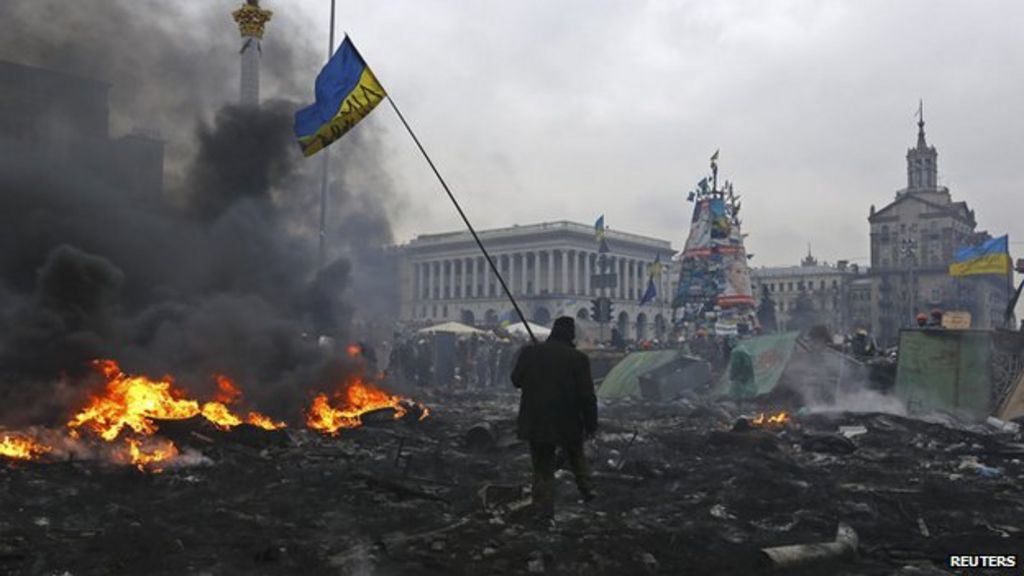
It’s gratifying that “patriots” did not instantly blame Putin for the failure to achieve a full-scale rout of Ukrainian troops in Donbass in January and February [2015], or for Moscow’s consultations with Merkel and Hollande.
Even so, they are still impatient for a victory. The most radical are convinced that Putin will “surrender Novorossiya” just the same. And the moderates are afraid that he will as soon as the next truce is signed (if that happens) out of the need to regroup and replenish Novorossiya’s army (which actually could have been done without disengagement from military operations), to come to terms with the new circumstances on the international front, and to get ready for new diplomatic battles.
In fact, despite all the attention that political and/or military dilettantes (the Talleyrands and the Bonapartes of the Internet) are paying to the situation in Donbass and the Ukraine in general, it is only one point on a global front: the outcome of the war is being decided not at the Donetsk airport or in the hills outside Debaltsevo, but at offices on Staraya Square [Moscow street where the headquarters of the Presidential Administration of Russia is located] and Smolenskaya Square,[Moscow square where Russia’s Ministry of Foreign Affairs is located.] at offices in Paris, Brussels and Berlin. Because military action is only one of the many components of the political quarrel.
It is the harshest and the final component, which carries great risk, but the matter doesn’t start with war and it doesn’t end with war. War is only an intermediate step signifying the impossibility of compromise. Its purpose is to create new conditions whereby compromise is possible or to show that there is no longer any need for it, with the disappearance of one side of the conflict.
When it is time for compromise, when the fighting is over and the troops go back to their barracks and the generals begin writing their memoirs and preparing for the next war, that is when the real outcome of the confrontation is determined by politicians and diplomats at the negotiating table.
Political decisions are not often understood by the general population or the military. For example, during the Austro-Prussian War of 1866, Prussian Chancellor Otto Von Bismarck (later Chancellor of the German Empire) disregarded the persistent requests of King Wilhelm I (the future German Emperor) and the demands of the Prussian generals to take Vienna, and he was absolutely correct to do so. ‘In that way he accelerated peace on Prussia’s terms and also ensured that Austro-Hungary forever (well, until its dismemberment in 1918) became a junior partner for Prussia and later the German Empire.
To understand how, when and on what conditions military activity can end, we need to know what the politicians want and how they see the conditions of the postwar compromise. Then it will become clear why military action turned into a low-intensity civil war with occasional truces, not only in the Ukraine but also in Syria.
Obviously, the views of Kiev politicians are of no interest to us because they don’t decide anything. The fact that outsiders govern the Ukraine is no longer concealed. It doesn’t matter whether the cabinet ministers are Estonian or Georgian; they are Americans just the same.
It would also be a big mistake to take an interest in how the leaders of the Donetsk People’s Republic (DPR) and the Lugansk People’s Republic (LNR) see the future. The republics exist only with Russian support, and as long as Russia supports them, Russia’s interests have to be protected, even from independent decisions and initiatives. There is too much at stake to allow [Alexander] Zakharchenko or [Igor] Plotnitzky, or anyone else for that matter, to make independent decisions.
Nor are we interested in the European Union’s position. Much depended on the EU until the summer of last year [2014], when the war could have been prevented or stopped at the outset. A tough, principled antiwar stance by the EU was needed. It could have blocked U.S. initiatives to start the war and would have turned the EU into a significant independent geopolitical player. The EU passed on that opportunity and instead behaved like a faithful vassal of the United States.
As a result, Europe stands on the brink of frightful internal upheaval. In the coming years, it has every chance of suffering the same fate as the Ukraine, only with a great roar, great bloodshed and less chance that in the near future things will settle down – in other words, that someone will show up and put things in order.
In fact, today the EU can choose whether to remain a tool of the United States or to move closer to Russia. Depending on its choice, Europe can get off with a slight scare, such as a breakup of parts of its periphery and possible fragmentation of some countries, or it could collapse completely. Judging by the European elites’ reluctance to break openly with the United States, collapse is almost inevitable.
What should interest us is the opinions of the two main players that determine the configuration of the geopolitical front and in fact are fighting for victory in the new generation of war – the network-centric Third World War. These players are the United States and Russia.
The U.S. position is clear and transparent. In the second half of the 1990s, Washington missed its only opportunity to reform the Cold War economy without any obstacles and thereby avoid the looming crisis in a system whose development is limited by the finite nature of planet Earth and its resources, including human ones, which conflicts with the need to endlessly print dollars.
After that, the United States could prolong the death throes of the system only by plundering the rest of the world. At first, it went after Third World countries. Then it went for potential competitors. Then for allies and even close friends. Such plundering could continue only as long as the United States remained the world’s undisputed hegemon.
Thus when Russia asserted its right to make independent political decisions – decisions of not global but regional import, a clash with the United States became inevitable. This clash cannot end in a compromise peace.
For the United States, a compromise with Russia would mean a voluntary renunciation of its hegemony, leading to a quick, systemic catastrophe – not only a political and economic crisis but also a paralysis of state institutions and the inability of the government to function. In other words, its inevitable disintegration.
But if the United States wins, then it is Russia that will experience systemic catastrophe. After a certain type of “rebellion,” Russia’s ruling classes would be punished with asset liquidation and confiscation as well as imprisonment. The state would be fragmented, substantial territories would be annexed, and the country’s military might would be destroyed.
So the war will last until one side wins. Any interim agreement should be viewed only as a temporary truce – a needed respite to regroup, to mobilize new resources and to find (i.e., to poach) additional allies.
To complete the picture of the situation, we only need Russia’s position. It is essential to understand what the Russian leadership wants to achieve, particularly the president, Vladimir Putin. We are talking about the key role that Putin plays in the organization of the Russian power structure.
This system is not authoritarian, as many assert, but rather authoritative – meaning it is based not on legislative consolidation of autocracy but on the authority of the person who created the system and, as the head of it, makes it work effectively.
During Putin’s 15 years in power, despite the difficult internal and external situation, he has tried to maximize the role of the government, the legislative assembly, and even the local authorities. These are entirely logical steps that should have given the system completeness, stability, and continuity. Because no politician can rule forever, political continuity, regardless of who comes to power, is the key to a stable system.
Unfortunately, fully autonomous control, namely the ability to function without the president’s oversight, hasn’t been achieved. Putin remains the key component of the system because the people put their trust in him personally. They have far less trust in the system, as represented by public authorities and individual agencies.
Thus Putin’s opinions and political plans become the decisive factor in areas such as Russia’s foreign policy. If the phrase “without Putin, there is no Russia” is an exaggeration, then the phrase “what Putin wants, Russia also wants” reflects the situation quite accurately in my opinion.
First, let’s note that the man who for 15 years has carefully guided Russia to its revival has done so in conditions of U.S. hegemony in world politics along with significant opportunities for Washington to influence Russia’s internal politics. He had to understand the nature of the fight and his opponent. Otherwise, he wouldn’t have lasted so long.
The level of confrontation that Russia allowed itself to get into with the United States grew very slowly and up to a certain point went unnoticed. For example, Russia did not react at all to the first attempt at a color revolution in the Ukraine in 2000-2002 (the Gongadze case, [Georgiy Gongadze was a Georgian-born Ukrainian journalist and film director who was kidnapped and murdered in 2000] the Cassette Scandal, [The Cassette Scandal erupted in 2000 with the release of audiotapes on which Leonid Kuchma allegedly discussed the need to silence Gongadze for reporting on high-level corruption] and the Ukraine without Kuchma protest [As a result of the Cassette Scandal, a mass anti-Kuchma protest took place in the Ukraine in 2000-2001]).
Russia took an opposing position but did not actively intervene in the coups that took place from November 2003 to January 2004 in Georgia and from November 2004 to January 2005 in the Ukraine. In 2008, in Ossetia and Abkhazia, Russia used its troops against Georgia, a U.S. ally. In 2012, in Syria, the Russian fleet demonstrated its readiness to confront the United States and its NATO allies.
In 2013, Russia began taking economic measures against [Victor] Yanukovych’s regime, which contributed to his realization of the harmfulness of signing an association agreement [with the EU].
Moscow could not have saved the Ukraine from the coup because of the baseness, cowardice, and stupidity of the Ukraine’s leaders – not only Yanukovych but all of them without exception. After the armed coup in Kiev in February 2014, Russia entered into open confrontation with Washington.
Before that, the conflicts were interspersed with improved relations, but at the beginning of 2014 relations between Russia and the United States deteriorated swiftly and almost immediately reached the point where war would have been declared automatically in the prenuclear era.
Thus at any given time Putin engaged in precisely the level of confrontation with the United States that Russia could handle. If Russia isn’t limiting the level of confrontation now, it means Putin believes that, in the war of sanctions, the war of nerves, the information war, the civil war in the Ukraine, and the economic war, Russia can win.
This is the first important conclusion about what Putin wants and what he expects. He expects to win. And considering that he takes a meticulous approach and strives to anticipate any surprises, you can be sure that when the decision was made not to back down under pressure from the United States, but to respond, the Russian leadership had a double, if not a triple, guarantee of victory.
I would like to point out that the decision to enter into a conflict with Washington was not made in 2014, nor was it made in 2013. The war of August 8, 2008, was a challenge that the United States could not leave unpunished. After that, every further stage of the confrontation only raised the stakes. From 2008 to 2010, the United States’ capability – not just military or economic but its overall capability – has declined, whereas Russia’s has improved significantly.
So the main objective was to raise the stakes slowly rather than in explosive fashion. In other words, an open confrontation in which all pretenses are dropped and everyone understands that a war is going on had to be delayed as long as possible. But it would have been even better to avoid it altogether.
With every passing year, the United States became weaker while Russia became stronger. This process was natural and impossible to arrest, and we could have projected with a high degree of certainty that by 2020 to 2025, without any confrontation, the period of U.S. hegemony would have ended, and the United States would then be best advised to think about not how to rule the world, but how to stave off its own precipitous internal decline.
Thus Putin’s second desire is clear: to keep the peace or the appearance of peace as long as possible. Peace is advantageous for Russia because in conditions of peace, without enormous expense, it obtains the same political result but in a much better geopolitical situation. That is why Russia continually extends the olive branch.
Just as the Kiev junta will collapse in conditions of peace in Donbass, in conditions of world peace, the military-industrial complex and the global financial system created by the United States are doomed to self-destruct. In this way, Russia’s actions are aptly described by Sun Tzu’s maxim “The greatest victory is that which requires no battle.”
It is clear that Washington is not run by idiots, no matter what is said on Russian talk shows or written on blogs. The United States understands precisely the situation it is in. Moreover, they also understand that Russia has no plans to destroy them and is really prepared to cooperate as an equal.
Even so, because of the political and socioeconomic situation in the United States, such cooperation is not acceptable to them. An economic collapse and a social explosion are likely to occur before Washington (even with the support of Moscow and Beijing) has time to introduce the necessary reforms, especially when we consider that the EU will have to undergo reform at the same time.
Moreover, the political elite who have emerged in the United States in the past 25 years have become accustomed to their status as the owners of the world. They sincerely don’t understand how anyone can challenge them.
For the ruling elite in the United States (not so much the business class but the government bureaucracy), to go from being a country that decides of the fate of inferior peoples to one that negotiates with them on an equal footing is intolerable.
It is probably tantamount to offering Gladstone or Disraeli the post of prime minister of the Zulu Kingdom under Cetshwayo kaMpande. And so, unlike Russia, which needs peace to develop, the United States regards war as vital.
In principle, any war is a struggle for resources. Typically, the winner is the one that has more resources and can ultimately mobilize more troops and build more tanks, ships, and planes. Even so, sometimes those who are strategically disadvantaged can turn the situation around with a tactical victory on the battlefield. Examples include the wars of Alexander the Great and Frederick the Great, as well as Hitler’s campaign of 1939-1940.
Nuclear powers cannot confront each other directly. Therefore, their resource base is of paramount importance. That is exactly why Russia and the United States have been in a desperate competition for allies over the past year.
Russia has won this competition. The United States can count only the EU, Canada, Australia, and Japan as allies (and not always unconditionally so), but Russia has managed to mobilize support from the BRICS, to gain a firm foothold in Latin America, and to begin displacing the United States in Asia and North Africa.
Of course, it’s not patently obvious, but if we consider the results of votes at the UN, assuming that a lack of official support for the United States means dissent and thus support for Russia, it turns out that the countries aligned with Russia together control about 60% of the world’s GDP, have more than two-thirds of its population, and cover more than three-quarters of its surface. Thus Russia has been able to mobilize more resources.
In this regard, the United States had two tactical options. The first seemed to have great potential and was employed by it from the early days of the Ukrainian crisis.
It was an attempt to force Russia to choose between a bad situation and an even worse one. Russia would be compelled to accept a Nazi state on its borders and therefore a dramatic loss of international authority and of the trust and support of its allies, and after a short time would become vulnerable to internal and external pro-U.S. forces, with no chance of survival.
Or else it could send its army into the Ukraine, sweep out the junta before it got organized, and restore the legitimate government of Yanukovych. That, however, would have brought an accusation of aggression against an independent state and of suppression of the people’s revolution.
Such a situation would have resulted in a high degree of disapproval on the part of Ukrainians and the need to constantly expend significant military, political, economic, and diplomatic resources to maintain a puppet regime in Kiev, because no other government would have been possible under such conditions.
Russia avoided that dilemma. There was no direct invasion. It is Donbass that is fighting Kiev. It is the Americans who have to devote scarce resources to the doomed puppet regime in Kiev, while Russia can remain on the sidelines making peace proposals.
So now the United States is employing the second option. It’s as old as the hills.
That which cannot be held, and will be taken by the enemy, must be damaged as much as possible so that the enemy’s victory is more costly than defeat, as all its resources are used to reconstruct the destroyed territory.
The United States has therefore ceased to assist the Ukraine with anything more than political rhetoric while encouraging Kiev to spread civil war throughout the country.
The Ukrainian land must burn, not only in Donetsk and Lugansk but also in Kiev and Lvov. The task is simple: to destroy the social infrastructure as much as possible and to leave the population at the very edge of survival. Then the population of the Ukraine will consist of millions of starving, desperate and heavily armed people who will kill one another for food.
The only way to stop this bloodbath would be massive international military intervention in the Ukraine (the militia on its own will not be sufficient) and massive injections of funds to feed the population and to reconstruct the economy until the Ukraine can begin to feed itself.
It is clear that all these costs would fall on Russia. Putin correctly believes that not only the budget, but also public resources in general, including the military, would in this case be overstretched and possibly insufficient.
Therefore, the objective is not to allow the Ukraine to explode before the militia can bring the situation under control. It is crucial to minimize casualties and destruction and to salvage as much of the economy as possible and the infrastructure of the large cities so that the population somehow survives and then the Ukrainians themselves will take care of the Nazi thugs.
At this point an ally appears for Putin in the form of the EU. Because the United States always tried to use European resources in its struggle with Russia, the EU, which was already weakened, reaches the point of exhaustion and has to deal with its own long-festering problems.
If Europe now has on its eastern border a completely destroyed Ukraine, from which millions of armed people will flee not only to Russia but also to the EU, taking with them delightful pastimes such as drug trafficking, gunrunning, and terrorism, the EU will not survive. The people’s republics of Novorossiya will serve as a buffer for Russia, however.
Europe cannot confront the United States, but it is deathly afraid of a destroyed Ukraine. Therefore, for the first time in the conflict, Hollande and Merkel are not just trying to sabotage the U.S. demands (by imposing sanctions but not going too far), but they are also undertaking limited independent action with the aim of achieving a compromise – maybe not peace but at least a truce in the Ukraine.
If the Ukraine catches fire, it will burn quickly, and if the EU has become an unreliable partner that is ready if not to move into Russia’s camp then at least to take a neutral position, Washington, faithful to its strategy, would be obliged to set fire to Europe.
It is clear that a series of civil and interstate wars on a continent packed with all sorts of weapons, where more than half a billion people live, is far worse than a civil war in the Ukraine. The Atlantic separates the United States from Europe. Even Britain could hope to sit it out across the Channel. But Russia and the EU share a very long border.
It is not at all in Russia’s interests to have a conflagration stretching from the Atlantic to the Carpathian Mountains when the territory from the Carpathians to the Dnieper is still smoldering. Therefore, Putin’s other objective is, to the extent possible, to prevent the most negative effects of a conflagration in the Ukraine and a conflagration in Europe. Because it is impossible to completely prevent such an outcome (if the United States wants to ignite the fire, it will), it is necessary to be able to extinguish it quickly to save what is most valuable.
Thus, to protect Russia’s legitimate interests, Putin considers peace to be of vital importance, because it is peace that will make it possible to achieve this goal with maximum effect at minimum cost. But because peace is no longer possible, and the truces are becoming more theoretical and fragile, Putin needs the war to end as quickly as possible.
But I do want to stress that if a compromise could have been reached a year ago on the most favorable terms for the West (Russia would have still obtained its goals, but later – a minor concession), it is no longer possible, and the conditions are progressively worsening.
Ostensibly, the situation remains the same; peace on almost any conditions is still beneficial for Russia. Only one thing has changed, but it is of the utmost importance: public opinion. Russian society longs for victory and retribution. As I pointed out above, Russian power is authoritative, rather than authoritarian; therefore, public opinion matters in Russia, in contrast to the “traditional democracies.”
Putin can maintain his role as the linchpin of the system only as long as he has the support of the majority of the population. If he loses this support, because no figures of his stature have emerged from Russia’s political elite, the system will lose its stability. But power can maintain its authority only as long as it successfully embodies the wishes of the masses.
Thus the defeat of Nazism in the Ukraine, even if it is diplomatic, must be clear and indisputable – only under such conditions is a Russian compromise possible.
Thus, regardless of Putin’s wishes and Russia’s interests, given the overall balance of power, as well as the protagonists’ priorities and capabilities, a war that should have ended last year within the borders of the Ukraine will almost certainly spill over into Europe. One can only guess who will be more effective – the Americans with their gas can or the Russians with their fire extinguisher?
But one thing is absolutely clear: the peace initiatives of the Russian leaders will be limited not by their wishes but their actual capabilities. It is futile to fight either the wishes of the people or the course of history; but when they coincide, the only thing a wise politician can do is to understand the wishes of the people and the direction of the historical process and try to support it at all costs.
The circumstances described above make it extremely unlikely that the proponents of an independent state of Novorossiya will see their wishes fulfilled. Given the scale of the coming conflagration, determining the fate of the Ukraine as a whole is not excessively complicated but, at the same time, it will not come cheap.
It is only logical that the Russian people should ask: if Russians, whom we rescued from the Nazis, live in Novorossiya, why do they have to live in a separate state? If they want to live in a separate state, why should Russia rebuild their cities and factories?
To these questions there is only one reasonable answer: Novorossiya should become part of Russia (especially since it has enough fighters, although the governing class is problematic). Well, if part of the Ukraine can join Russia, why not all of it? Especially as in all likelihood by the time this question is on the agenda, the European Union will no longer be an alternative to the Eurasian Union [for the Ukraine].
Consequently, the decision to rejoin Russia will be made by a united federated Ukraine and not by some entity without a clear status. I think that it is premature to redraw the political map. Most likely the conflict in the Ukraine will be concluded by the end of the year. But if the United States manages to extend the conflict to the EU (and it will try), the final resolution of territorial issues will take at least a couple of years and maybe more.
In any situation we benefit from peace. In conditions of peace, as Russia’s resource base grows, as new allies (former partners of the United States) go over to its side, and as Washington becomes progressively marginalized, territorial restructuring will become far simpler and temporarily less significant, especially for those being restructured.
Ростислав Ищенко,
Актуальные комментарии
11 Февраля 2015Citations
[1] http://actualcomment.ru/chego-khochet-putin.html
[2] http://thesaker.is/what-does-putin-want-a-major-analysis-by-rostislav-ishchenko-must-read/#sdfootnote1ancCan the EU become a partner with Russia? [1]
The Saker
Unz Review
June 15, 2018‘The Saker’ is the nom-de-guerre for an ex-Nato geopolitical-military analyst who lives in Florida, USA. He is considered as one of the most respected in his fields of expertise and has published works in major online alternative news sites and has a massive following especially with ex-US military.
[Y: Prologue
In May of 2018 Vladimir Putin was re-elected by a large majority to the Presidency of the Russian Federation. However his choice of Medvedev as the Prime Minister and selection of other state appointees was met with disappointment by those who support him.
The consensus of the masses was that these appointees served the Fifth Column and were intent on a re-approachment with the west on its terms. The reasons for this unpopular and surprising move by Putin are still debated hotly and very much unknown.
The practical and political outcome of his choices is a strong ‘pro-Western’ movement within the Russian government – similar in principle to the Deep State within Washington. These individuals are also tied to the oligarchs and Russian Mafia. Therefore this constitutes a powerful group of people Putin cannot ignore.
One theory is that there are favours owed and Putin needs their support for any kind of foreign or domestic policy initiative. Another is that these individuals have significant contacts in the west to smooth over economic and administrative red tape. A third (unlikely) opinion is that Putin himself is an oligarch and profits from the corruption.
Whatever the reasons, Putin’s last term as the President of Russia will not only oversee the direction of Russia’s geopolitical strategy for the next few decades, but also cement the type of successor that he intends to transition his power to in the next few years.
The Saker provides an analysis of the current EU-Russia policies and whether the future re-approachment of Russia and the EU can be achieved and under what conditions.
Again, thank you for reading Y]

The re-nomination (albeit somewhat reshuffled) of the “economic block” of the Medvedev government has elicited many explanations, some better than others.
Today I want to look at one specific hypothesis which can be summed up like this: Putin decided against purging the (unpopular) “economic block” from the Russian government because he wanted to present the EU with “known faces” and partners EU politicians would trust.
Right now, with Trump’s insane behavior openly alienating most European leaders, this is the perfect time to add a Russian “pull” to the US “push” and help bring the EU closer to Russia.
By re-appointing Russian “liberals” (that is a euphemism for WTO/WB/IMF/etc types) Putin made Russia look as attractive to the EU as possible. In fact, the huge success of the Saint Petersburg summit and the Parliamentary Forum is proof that this strategy is working.
This hypothesis is predicated on one crucial assumption: that the EU, under the right conditions, could become a partner for Russia.
But is that assumption warranted? I personally don’t believe that it is, and I will try to lay out the reasons for my skepticism:
First, there is no “EU”, at least not in political terms. More crucially, there is no “EU foreign policy”.
Yes, there are EU member states, who have political leaders, there is a big business community in the EU and there are many EU organizations, but as such, the “EU” does not exist, especially not in terms of foreign policy. The best proof of that is how clueless the so-called “EU” has been in the Ukraine, then with the anti-Russian sanctions, in dealing with an invasion of illegal immigrants, and now with Trump.
At best, the EU can be considered a US protectorate/colony, with some subjects “more equal than others” (say, the UK versus Greece). Most (all?) EU member states are abjectly obedient to the USA, and this is no surprise considering that even the so-called “EU leader” or “EU heavyweight” – Germany – only has very limited sovereignty.
The EU leaders are nothing but a comprador elite which doesn’t give a damn about the opinions and interests of the people of Europe. The undeniable fact is that the so-called “EU foreign policy” has gone against the vital interests of the people of Europe for decades and that phenomenon is only getting worse.
Second, the single most powerful and unified organization in Europe is not even an EU organization, but NATO. And NATO, in real terms, is no less than 80% USA.
Forget about those fierce looking European armies, they are all a joke. Not only do they represent no credible force (being too small, too poorly trained, under-equipped and poorly commanded), but they are completely dependent on the USA for a long list of critical capabilities and “force multipliers“[2]: command, control, communications, intelligence, networking, surveillance, reconnaissance, target acquisition, logistics, etc.
Furthermore, in terms of training, force planning, weapon systems procurement, deployment and maintenance, EU states are also totally dependent on the USA. The reason? The US military budget totally dwarfs anything individual EU states can spend, so they all depend on Uncle Sam.
Of sure, the NATO figurehead – the Secretary General – is usually a non-entity which makes loud statements and is European (I think of that clown Stoltenberg as the prefect example), but NATO is not run by the NATO Secretary General.
In reality, it is run by the Supreme Allied Commander Europe (SACEUR), who is the head of the Supreme Headquarters Allied Powers Europe (SHAPE) and these guys are as red, white an blue as it gets.
Forget about the “Eurocorps” or any other so-called “European armies” – it’s all hot air, like Trudeau’s recent outburst at Trump. In reality in the EU, as in Canada, they all know who is boss.
And here is the single most important fact: NATO desperately needs Russia as justification for its own existence: if relations with Russia improve, then NATO would have no more reason to exist.
Do you really think that anybody will let that happen? I sure don’t! And right now, the Europeans are busy asking for more US troops [3] on their soil, not less and they are all pretending to be terrified by a Russian invasion [4] , hence the need for more and bigger military exercises close to the Russian border [5]. And just to cover all its bases, NATO is now gradually expanding into Latin America [6].

Third, there is a long list of EU governments which vitally need further bad relationships with Russia. They include:
1. Unpopular governments which need to explain their own failures by the nefarious actions of an external bogyman. A good example is how the Spanish authorities blamed Russia for the crisis in Catalonia.
Or the British with their “Brexit”. The Swedes are doing even better, they are already preparing their public opinion [7] for a “Russian interference” in case the election results don’t turn out to be what they need.
2. Governments whose rhetoric has been so hysterically anti-Russian that they cannot possibly back down from it. Best examples: the UK and Merkel. But since most (but not all) EU states did act on the Skripal false-flag on the basis of the British “highly likely” and in the name of “solidarity”, they are now all stuck as accomplices of this policy. There is *no way* they are simply going to admit that they were conned by the Brits.
3. EU prostitutes: states whose only policy is to serve the USA against Russia. These states compete against each other in the most abject way to see who can out-brown-nose each other for the position of “most faithful and willing loyal servant of the USA”.
The best examples are, of course, the three Baltic statelets, but the #1 position has to go to the “fiercely patriotic Poles” who are now willing to actually pay Uncle Sam to be militarily occupied (even though the very same Uncle Sam is trying to racketeer them for billions of dollars) [8].
True, now that EU subsidies are running out, the situation of these states is becoming even more dire, and they know that the only place where they can still get money is the USA. So don’t expect them to change their tune anytime soon (even if Bulgaria has already realized that nobody in the West gives a damn about it). [9]
4. Governments who want to crack down on internal dissent by accusing any patriotic or independent political party/movement to be “paid by the Kremlin” and representing Russian interests. The best example is France and how it treated the National Front.
I would argue that most EU states are, in one way or another, working on creating a “national security state” because they do realize (correctly) that the European people are deeply frustrated and oppose EU policies (hence all the anti-EU referendums lost by the ruling elites).
Contrary to a very often repeated myth, European business interests do not represent a powerful anti-russophobic force. Why? Just look at Germany: for all the involvement of Germany (and Merkel personally) in the Ukraine, for all the stupid rhetoric about “Russia being an aggressor” which “does not comply with the Mink Agreements”, North Stream is going ahead!
Yes, money talks, and the truth is that while anti-Russian sanctions have cost Europe billions, the big financial interests (say the French company Total) have found ways to ignore/bypass these sanctions.
Oh sure, there is a pro-trade lobby with Russian interest in Europe. It is real, but it simply does not have anywhere near the power the anti-Russian forces in the EU have.
This is why for *years* now various EU politicians and public figures have made noises about lifting the sanctions, but when it came to the vote – they all voted as told by the real bosses.
Not all EU Russophobia is US-generated, by the way. We have clearly seen that these days when Trump suggested that the G7 (or, more accurately, the G6+1) needed to re-invite Russia, it was the Europeans who said “nope!”. To the extend that there is a “EU position” (even a very demure and weak one), it is mostly anti-Russian, especially in the northern part of Europe.
So when Uncle Sam tells the Europeans to obey and engage in the usual Russia-bashing, they all quickly fall in line, but in the rare case when the US does not push a rabidly anti-Russian agenda, EU politicians suddenly find enough willpower to say “no”.
By the way, for all the Trump’s statements about re-inviting Russia into the G6+1 the US is still busy slapping more sanctions on Russia. [10]
The current mini-wars between the US and the EU (on trade, on Iran, on Jerusalem) do not at all mean that Russia automatically can benefit from this. Again, the best example of this is the disastrous G6+1 summit in which Trump basically alienated everybody only to have the G6 reiterate its anti-Russian position even though the G6+1 needs Russia far more than Russia needs the G7 (she really doesn’t!).
Just like the US and Israeli leaders can disagree and, on occasion, fight each other, that does not at all mean that somehow they are not fundamentally joined at the hip. Just think of mob “families” who can even have “wars” against each other, but that does not at all mean that this will benefit the rest of the population whom all mobsters prey upon.

The Ukrainian crisis will only benefit anti-Russian forces in Europe. There is a very high probability that in the near future the Ukronazi regime will try to reconquer Novorussia (DNR/LRN). I submit that the outcome of such an attack is not in doubt – the Ukronazis will lose. The only question is this: to whom will they lose:
Option one: they lose to the combined forces of the DNR and LNR.This is probably the most likely outcome. Should this happen, there is a very high probability of a Novorussian counter attack to liberate most of the Donetsk and Lugansk regions, especially the cities of Slaviansk and Mariupol.
Since past behavior is the best predictor of future behavior, we can be pretty darn sure of what the reaction in Kiev and in the West will be: Russia will be blamed for it all.
The AngloZionists will *never* admit that the Ukronazi regime lost a civil war to its own people because the Novorussians will never accept a Nazi regime ruling over them. Thus, a Novorussian victory will result in more hysterical Russophobia.
Option two: the Ukronazis succeed in their attack and threaten to overrun Donetsk, Lugansk and the rest of Novorussia.
Putin simply cannot allow this to happen. He has made that promise many times and he has recently repeated it during his “open line” with the Russian people. If the Russians are forced to intervene, this will not be a massive ground invasion – there is no need for that.
Russia has the firepower needed in the form of missile and artillery strikes to destroy the attacking Urkonazi forces and to impose a no-fly zone over all of Novorussia. If Kiev pushes on and launches a full-scale attack on Russia proper, the Ukrainian armed forces will be totally disorganized and cease combat in about 48 hours.
This scenario is what I call the “Neocon dream” since such a Russian intervention will not be imaginary, but quite real and the Kremlin will even confirm it all very publicly and probably recognize the two Novorussian Republics just like what happened in 08.08.08 when Saakashvili decided to invade South Ossetia.
So, AngloZionists will (finally!) have the “proof” that Russia is the aggressor, the Poles and Balts will prepare for an “imminent” Russian invasion and I think that there is a pretty good chance that NATO forces will move into the Western Ukraine to “stop the Russians”, even if the said Russians will have absolutely no desire (or even possible motive) to want to invade the rest of the Ukraine or, even less so, Poland, Sweden or the Baltic statelets.
I will admit that there is still a small possibility that a Ukronazi attack might not happen. Maybe Poroshenko & Co. will get cold feet (they know the real condition of the Ukie military and “dobrobat” death squads) and maybe Putin’s recent not-so-veiled threat about “grave consequences for the Ukrainian statehood” [11] will have the needed effect.
But what will happen even if this attack does not take place? The EU leaders and the Ukronazi regime in Kiev will still blame Russia for the Ukraine now clearly being a failed state. Whatever scenario you find more likely for the Ukraine, things there will only get worse and everybody will blame Russia.

The crisis in Syria will only benefit anti-Russian forces in Europe. It is becoming pretty clear that the USA is now attempting a reconquista of Syria or, at least, a break-up of Syria into several zones, including US-controlled ones. Right now, the USA and the “good terrorists” have lost the war, but that does not stop them from re-igniting a new one, mostly by reorganizing, retraining, redeploying and, most importantly, re-branding the surviving “bad terrorists” into “good ones”. This plan is backed by Saudi money and Israeli firepower.
Furthermore, Russia is now reporting that US Special Forces [12] are already working with the (new) “good terrorists” to – you guessed it – prepare yet another fake chemical attack and blame it on the Syrians. And why not? It worked perfectly already several times, why not do that again? At the very least, it would give the USA another try at getting their Tomahawks to show their effectiveness (even if they fail again, facts don’t matter here).
And make no mistake, a US “victory” in Syria (or in Venezuela) would be a disaster not only for the region, but for every country wanting to become sovereign (see Andre Vltchek’s excellent article on this topic here). And, again, Russia will be blamed for it all and, with certifiable nutcasts like Bolton, Russian forces might even be attacked.
As I wrote already many times, this is far from over [13]. Just as in the Ukrainian case, some deal might be made (at least US and Russian military officials are still talking to each other) but my personal opinion is that making any kind of deal with Trump is as futile as making deals with Netanyahu: neither of them can be trusted and they both will break any and all promises in a blink of an eye.
And if all hell breaks loose in Syria and/or Iran, NATO will make sure that the Europeans all quickly and obediently fall in line (“solidarity”, remember?).
The bottom line is this: currently, the EU is most unlikely to become a viable partner for Russia and the future does look rather bleak.
One objection to my pessimism is the undeniable success of the recent Saint Petersburg summit and the Parliamentary Forum.
However, I believe that neither of these events was really centered around Europe at all, but about the world at large (see excellent report by Gilbert Doctorow on this topic [14]).
Yes, Russia is doing great and while the AngloZionist media loves to speak about the “isolation” of Russia, the truth is that it is the Empire which is isolated, while Russia and China are having a tremendous success [15] building the multi-polar world they want to replace the Empire with.
So while it is true that the western leaders might prefer to see a liberal “economic block” in the new Russian government, the rest of the world has no such desire at all (especially considering how many countries out there have suffered terrible hardships at the hands of the WTO/WB/IMF/etc types).
Conclusion:
The AngloZionist Empire is not based in the USA, or in the EU, or Israel, or anywhere else on the planet. It is a trans-national entity with regional variations and which includes different interest groups under its umbrella.
You can think of it as a gigantic criminal gang racketeering the entire planet for “protection”. To think that by presenting a “liberal” face to these thugs will gain you their support is extremely naive as these guys don’t care about your face: what they want is your submission.
Vladimir Putin put it best when he said “They do not want to humiliate us, they want to subdue us, solve their problems at our expense”.
However, if the EU is, for all practical purposes, non-existent, Russia can, and will, engage with individual EU member states. There is a huge difference between, say, Poland and Italy, or the UK and Austria. Furthermore, the EU is not only dysfunctional, it is also non-viable.
Russia would immensely benefit from the current EU either falling apart or being deeply reformed because the current EU is a pure creation of the US-backed Bilderberger types and not the kind of Europe the European people need. In fact, I would even argue that the EU is the single biggest danger for the people of the European continent.
Thus Russia should use her resources to foster bi-lateral cooperation with individual EU member states and never take any action which would strengthen (or even legitimize) EU-derived organizations such as the EU Parliament, the European Court of Human Rights, etc.
These are all entities which seek to undermine the sovereignty of all its members, including Russia. Again, Putin put it best when he recently declared that “either Russia is a sovereign country, or there is no Russia“.[16]
Whatever the ideology and slogans, all empires are inherently evil and inherently dangerous to any country wanting to be truly sovereign. If Russia (and China) want to create a multi-polar world, they need to gradually disengage from those trans-national bodies which are totally controlled by the Empire, it is really that simple.
Instead, Russia needs to engage those countries, political parties and forces who advocate for what de Gaulle called “the Europe of fatherlands“ [17]. Both the AngloZionist Empire and the EU are undergoing the most profound crisis in their history and the writing is on the wall. Sooner rather than later, one by one, European countries will recover their sovereignty, as will Russia.
Only if the people of Europe succeed in recovering their sovereignty could Russia look for real partnerships in the West, if only because the gradually developing and integrating Eurasian landmass offer tremendous economic opportunities which could be most beneficial to the nations of Europe.
A prosperous Europe “from the Atlantic to the Urals” [18] is still a possibility, but that will happen only when the current European Union and NATO are replaced by truly European institutions and the current European elites replaced by sovereignists.
The people of Russia, EU and, I would argue, the United States all have the same goal and the same enemy: they want to recover their sovereignty, get rid of their corrupt and, frankly, treacherous elites and liberates themselves from the hegemony of the AngloZionist Empire.
This is why pushing the issue of “true sovereignty” (and national traditional values) is, I believe, the most unifying and powerful political idea to defeat the Empire. This will be a long struggle but the outcome is not in doubt.
The Saker
Unz ReviewCitations
[1] http://thesaker.is/can-the-eu-become-a-partner-for-russia/
[2] https://www.militaryfactory.com/dictionary/military-terms-defined.asp?term_id=2165
[3] https://www.rt.com/news/429533-us-norway-nato-marines/
[4] https://www.wearethemighty.com/articles/russia-war-ukraine-latvia-estonia-poland-prepare
[5] https://www.rt.com/news/402919-sweden-military-exercise-russia/
[6] https://russia-insider.com/en/politics/desperate-reason-exist-nato-installs-itself-latin-america/ri23758
[7] https://www.bbc.com/news/world-44070469
[8] https://stopacthr1226.org/the-polish-american-congress-does-not-want-the-just-act-of-2017-applied-to-poland/
[9] https://sputniknews.com/europe/201805211064645953-bulgaria-south-stream-revived/
[10] https://www.rt.com/usa/429406-us-issues-more-russia-sanctions/
[11] https://maps.southfront.org/putin-kiev-forces-advance-in-donbass-region-would-have-grave-consequences-for-ukrainian-statehood/
[12] https://www.rt.com/news/429408-syria-rebels-chlorine-provocation/
[13] https://www.unz.com/tsaker/each-click-brings-us-one-step-closer-to-the-bang/
[14] https://russia-insider.com/en/politics/russia-just-displayed-serious-soft-power-moscow-parliamentary-forum-its-more-important-you
[15] http://thesaker.is/putin-and-xi-top-the-g61/
[16] https://www.rt.com/news/428846-russia-putin-sovereignty-sanctions/
[17] https://www.opendemocracy.net/charles-grant/europes-choice-monnet-vs-de-gaulle
[18] http://tass.com/russia/747633






925069
924988
922113
921526
921524
919244
916783
915526
915524
915354
915129
914037
909862
908811
908810
908500
908465
908464
908300
907963
907895
907477
902002
901301
901106
901105
901104
901024
901017
900393
900392
900391
900390
899038
898980
896844
896798
896797
895983
895850
895848
893740
893036
891671
891670
891336
891017
890865
889894
889741
889058
888157
887960
887768
886321
886306
885519
884948
883951
881340
881339
880491
878671
878351
877678