- Search Results

http://www.leavemeansleave.eu
Topic: Russia's Real Endgame
Russia’s Real Endgame [1][2]
James G Rickards
The Daily Reckoning[Y : This is a composite piece edited for brevity from the citations list. Thanks for reading. – Y]

James G. Rickards is the editor of Strategic Intelligence. He is an American lawyer, economist, and investment banker with 35 years of experience working in capital markets on Wall Street.
His work is regularly featured in the Financial Times, Evening Standard, New York Times, The Telegraph, and Washington Post, and he is frequently a guest on BBC, RTE Irish National Radio, CNN, NPR, CSPAN, CNBC, Bloomberg, Fox, and The Wall Street Journal.
He has contributed as an advisor on capital markets to the U.S. intelligence community, and at the Office of the Secretary of Defense in the Pentagon. Rickards is the author of The New Case for Gold (April 2016), and three New York Times best sellers, The Death of Money (2014), Currency Wars (2011), The Road to Ruin (2016) from Penguin Random House.
Russia’s Putin has never taken his eye off the ball.
His ambition is not global hegemony or European conquest. Putin seeks what Russia has always sought: regional hegemony and a set of buffer states in eastern Europe and central Asia that can add to Russia’s strategic depth.
In Syria, Russia has the warm water port of Tartus – which is important when you consider that most Russian ports are ice-bound for months of the year.
It is strategic depth — the capacity to suffer massive invasions and still survive due to an ability to retreat to a core position and stretch enemy supply lines – that enabled Russia to defeat both Napoleon and Hitler. Putin also wants the modicum of respect that would normally accompany that geostrategic goal.
Understanding Putin is not much more complicated than that.
In the twenty-first century, a Russian sphere of influence is not achieved by conquest or subordination in the old Imperial or Communist style.
It is achieved by close financial ties, direct foreign investment, free trade zones, treaties, security alliances, and a network of associations that resemble earlier versions of the EU.
Russian military intervention in Crimea and eastern Ukraine is best understood not as a Russian initiative, but as a Russian reaction.
It was a response to U.S. and U.K. efforts to attack Russia by pushing aggressively and prematurely for Ukraine membership in NATO. This was done by deposing a Putin ally in Kiev in early 2014.
The Russian-Ukraine situation is a subset of the broader U.S.-Russian relationship. Here, the opposition comes not just from domestic opponents but from the globalist elite.
Globalization emerged in the 1990s as a consequences of the end of the Cold War and the reunification of Germany.
For the first time since 1914, Russia, China and their respective empires could join the U.S., Western Europe and their former colonies in Latin America and Africa in a single global market.
Globalization relied on open borders, free trade, telecommunications, global finance, extended supply chains, cheap labor and freedom of the seas.
Globalization as it existed from 1990 to 2007 made steady progress under the Bush-Clinton duopoly of power in the U.S. and like-minded leaders elsewhere. The enemy of globalization was nationalism, but nationalism was nowhere in sight.

Larger picture: https://i0.wp.com/www.armenpogharian.com/wp-content/uploads/2015/08/map-of-most-valuable-exports-by-country.jpgThe financial crisis of 2007–2008, caused by the elites’ own greed and inability to grasp the statistical properties of risk, put an end to the easy gains from globalization.
Ironically, globalization gained in the short-run despite financial calamity. The same elites who created disaster were empowered to “fix” the situation under the auspices of the G20 Leaders’ Summit. This global rescue began with the first G20 summit hastily organized by George W. Bush and Nicolas Sarkozy, then the President of France, in November 2008.
Despite the financial bailouts and central bank easy money of the decade following the crisis, robust self-sustaining growth in line with pre-crisis trends has never really returned. Instead the world has suffered through a ten-year depression (defined as depressed below-trend growth), which continues to this day.
What little growth emerged was captured mostly by the wealthy, which led to the greatest income inequality levels seen in over 80 years.
Discontent was palpable in middle-class and working class populations in the world’s major developed economies. This discontent morphed into political action. The result was the U.K. decision to leave the EU, called “Brexit,” the election of Donald Trump, and the rise of politicians such as Geert Wilders in the Netherlands and Marine Le Pen in France, among others
What unites these politicians and political movements is nationalism. This can be defined as a desire to put national interests ahead of globalization.
Nationalism can mean closing borders, restricting free trade to help local employment, fighting back against cheap labor and dumping with tariffs and trade adjustment assistance, and rejecting multilateral trade deals in favor of bilateral negotiations.
This brings us to the crux of the U.S.-Russia relationship.
Simply put, Putin and Trump are the two most powerful nationalists in the world. Any rapprochement between Russia and the U.S. is an existential threat to the globalist agenda.
This explains the vitriolic, hysterical, and relentless attacks on Trump and Putin.
The globalists have to keep Trump and Putin separated in order to have any hope of reviving the globalist agenda.
Just as Trump and Putin are the champions of nationalism, President Xi Jinping of China and Chancellor Angela Merkel of Germany have emerged as the champions of the globalist camp.
Understanding this dynamic requires consideration of the paradoxical roles of Xi and Merkel.
Xi positions himself as the leading advocate of globalization. The truth is more complex.
President Xi is the most nationalist of all major leaders. He continually puts China’s long-term interests first without particular regard for the well-being of the rest of the world.
But, China’s relative military and economic weakness, and potential social instability, require it to cooperate with the rest of the world on trade, climate change, and supply-chain logistics in order to grow. Xi is in a paradoxical position of being nationalist to the core, yet wearing a globalist veneer in order to pursue the nationalist long game.
Angela Merkel, Chancellor of Germany is also in a paradoxical position — but the opposite of Xi’s role. Merkel knows Germany must embrace globalism both because of its unique historical burden of being the source of three major wars (Franco-Prussian, World War I, and World War II), and the necessity of German integration with the EU and Eurozone.
At the same time, Merkel has advanced her globalist agenda by promoting German interests through exports and cheap foreign labor.
For the globalists, the world breaks down into Manichean struggle between the nationalists, Trump and Putin, and the globalists, Xi and Merkel.
Globalists may be playing a two-sided game of nationalists versus globalists, but they need to widen the lens to see that the world today is really a three-party game.
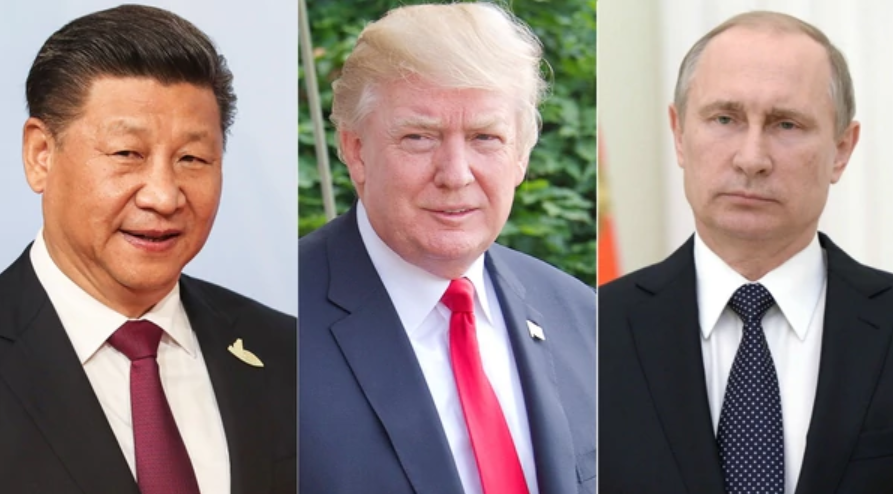
There are really only three superpowers in the world today — Russia, China and the U.S. All other nations are secondary or tertiary powers who may be aligned with a superpower, neutral or independent, but who otherwise lack the ability to impose their will on others.
In any three-party dynamic, whether it’s a poker game or a struggle for global control, the dynamic is simple. Two of the powers align explicitly or implicitly against the third. The two-aligned powers refrain from using their power against each other in order to conserve it for use against the third power.
Meanwhile, the third power, the “odd man out,” suffers from having to expend military and economic resources to fend off adventurism by both of its opponents with no help from either.
China is the greatest geopolitical threat to the U.S. because of its economic and technological advances and its ambition to push the U.S. out of the Western Pacific sphere of influence.
Russia may be a threat to some of its neighbors, but it is far less of a threat to U.S. strategic interests.
Therefore, a logical balance of power in the world would be for the U.S. and Russia to find common ground in the containment of China and to jointly pursue the reduction of Chinese power.
Instead, the opposite seems to be happening. China and Russia are forging stronger ties while the U.S. finds itself at odds with both Russia and China over different issues. This two-against-one strategic alignment of China and Russia against the U.S. is a strategic blunder by the U.S.
Some analysts may be surprised to see Russia on the superpower list, but the facts are indisputable.
Russia is the twelfth largest economy in the world, is one of the three largest energy producers, has abundant natural resources other than oil, has advanced weapons and space technology, an educated workforce and, of course, has the largest arsenal of nuclear weapons of any country.

Russia has enormous problems including adverse demographics, limited access to oceans, harsh weather, and limited fertile soil. Yet, none of these problems negate Russia’s native strengths.
Russia is also the world’s largest oil producer, with output of 10.6 million barrels per day, larger than both Saudi Arabia (10.5 million barrels) and the United States (9 million barrels).
Russia has the largest landmass of any country in the world and a population of 144 million people, the ninth largest of any country. Russia is also the third-largest gold-producing nation in the world, with total production of 250 tons per year, about 8% of total global output and solidly ahead of the U.S., Canada and South Africa.
Contrary to many analysts’ perceptions, Russia is on a sound financial footing. Russia’s government debt-to-GDP ratio is 12.6%, which is trivial compared with 253% for Japan, 105% for the United States and 68% for Germany.
Russia’s external dollar-denominated debt is also quite low compared with the huge dollar-debt burdens of other emerging-market economies such as Turkey, Indonesia and China.
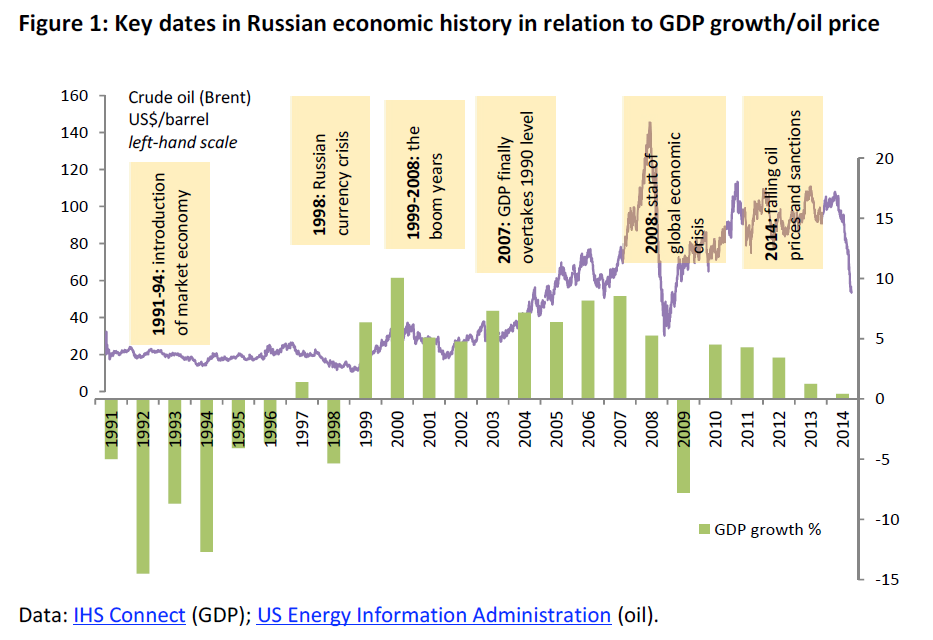
Under the steady leadership of central bank head Elvira Nabiullina, the Central Bank of Russia has rebuilt its hard currency reserves to $455 billion after those reserves were severely depleted in 2015 following the collapse in oil prices that began in 2014.
Even as Russia’s foreign exchange reserves dropped from $525 billion in late 2013 to $355 billion in mid-2015, Nabiullina never stopped acquiring gold for the central bank.
Total gold reserves rose from 1,275 tons in July 2015 to almost 1,900 tons today. Russia’s gold-to-GDP ratio is the highest in the world and more than double those of the U.S. and China.
Russia’s exports are not highly diversified, consisting mostly of oil and natural gas. Still, Russia is highly competitive in the export of nuclear power plants, advanced weaponry and agricultural products.
This export sector produces a positive balance of trade for Russia, currently running at over $16 billion per month. Russia has not had a trade deficit in over 20 years.
More to the point, Russia is a nuclear superpower on par with the United States and well ahead of China, France, the U.K. and other nuclear powers.
With this economic and geopolitical backdrop in mind, what are my predictive analytic models saying about the prospects for the Russian economy and its markets in the months ahead?
Right now, the Russian economy is poised for strong growth, which will be reflected both in higher Russian stock prices and a stronger Russian ruble.
The biggest single factor leading to this conclusion is the high level of real interest rates in Russia.Right now, the central bank policy rate in Russia is 7.25%. Inflation is only 2.20%, slightly higher than in the U.S. and Europe but rock-bottom compared with many past inflationary episodes in Russia.
As a result, the real interest rate in Russia is 5.05% (7.25% policy rate minus 2.20% inflation equals 5.05% real rate).
By way of comparison, the real rate in the U.S. is only 0.15% (1.75% policy rate minus 1.6% core inflation equals 0.15% real rate).
This high real rate gives the Central Bank of Russia enormous ammunition to stimulate the Russian economy with a series of rate cuts.
At a time when other major central banks such as those in the U.S., U.K., Japan and Europe are taking steps to tighten monetary policy through rate hikes, forward guidance or asset purchase tapers, Russia will be the only player that can actually produce monetary ease.
[Y
This is important in the case of a geopolitical event or global liquidity collapse, Russian government bonds will still be liquid and may be used to reliquify Russian assets and also possibly its partners just like the US Federal Reserve did to Wall Street in 2008. Russian bonds (and the ruble) would in this scenario be backed by gold and non-convertible to useless paper currencies. This will give it enormous clout in the new world economy.
-Y]Also, Russia’s success in working with OPEC, especially Saudi Arabia, to maintain oil production quotas has put a floor under oil prices for the time being.
This means that Russia’s reserve position will continue to grow. This gives the Central Bank of Russia room to cut interest rates without having to worry about capital outflows and a weak ruble.
This coming policy ease and stimulus from the Central Bank of Russia will be a major catalyst for capital inflows and a much higher Russian stock market.
Notwithstanding the prospect of improved relations, Putin remains the geopolitical chess master he has always been.
His long game involves the accumulation of gold, development of alternative payments systems, and ultimate demise of the dollar as the dominant global reserve currency
Jim Rickards
The Daily ReckoningCitations
[1] https://www.zerohedge.com/news/2018-04-12/russias-real-endgame
[2] https://dailyreckoning.com/u-s-reaching-russia-not-risking-war/Just heard that on the news.
I was like, WTF?
I didn’t know that things had got so bad that there was a travel ban on Chad.
I’m assuming it was part of the neo-conservative attempt at keeping Chad from traveling too much and/or banging chicks on vacation.
Now that the Chad travel ban has been lifted – Chad c~~~ is clear to roam freely.
For some time i wanted to get this off my chest, i will keep everyone anonymous obviously, i think this is the best place to do just that.
So in South Flo the life can be very easy to get by, Rent is very expensive, property value astronomically absurd, bad abundant break ups, Rampant STDs and we gotta thank Maduro because we have seen an influx of Venezuelan sluts while Our good Christian President Donald J Trump deports the Cubans, that mostly have turned Miami into a POS hell hole and sent them back to their island to deal with their problems there. Gotta clean that fish tank sometimes.
Ok, so the subject i am about to bring you it’s one juicy mistake that if i wasn’t red pilled i would’ve had my cake and “eat it too”, so i used to live in an apartment complex like the majority of South Floridians thanks to some of the reasons above, a young couple that they were in their mid to early 20’s moved into an apartment down the hallway from where i was, they were both ethnic white, i spoke to them to find out that they came from Ohio, asked them why would you come here?” didn’t get a clear answer however the girl told me she works for the airlines (not gonna name which one) as a flight attendant (i knew one who was a total whore).
Whenever i was out cooking, I would see her leave every once in a while on her uniform, sometimes she would come down to talk to me and the other neighbors, i noticed immediately something odd, the “guy” never came down to talk to us NOT even once, sometimes we would notice that he was never in her apartment or with her for days, the guy was very skinny and had a low paying job, but the few times i talked to him he seemed like a genuine decent guy, then i started to notice after another girl (who was prettier) moved out of the complex that this girl was trying to get at me more, every single time i was downstairs she would come down, after the girl in question left the apartment complex, this girl approached me in the most weird manner and gave me a long hug even though we didn’t even have an emotional bond of any kind, she was washing her clothes and was wearing those skimpy “yoga” pants, but! guys we know these sluts never do Yoga lets be honest and probably don’t know what the f~~~ Yoga is.
I had to do some serious ghosting after that hug happened, because i knew she wanted me to spend some time with her at her place, i didn’t want to because i respected the fact she had a man and i had nothing against that guy to do something like that to him, sometimes you have to respect another man’s situation even though she clearly doesn’t give a s~~~ about him.
This girl according to my friend in the first floor told me that she also brought another guy to her apartment and that guy in question looked Latino, while i am half white and Latino i kinda could understand what was happening, she couldn’t get me quite yet so she would f~~~ other guys? i guess?.
I kept on the ghosting until she eventually moved out just a few weeks ago, i am glad i dodged that bullet because it had all the red markings of an odd/bad relationship where SHE clearly is in dominant control, she smokes and drinks, she’s obviously easy going, Pump N Dump Material, To be perfectly f~~~ing honest, to me shes not even worth using as a fancy c~~~ sleeve to wear for Christmas.
I’ve reached 26 years of age where i can see a mistake even from far away, understand it and avoid it, and thanks to the red pill combined with mediation i can control better my male instinct before letting it cloud my mind compltely.
I have my goals and my spirit and i am not letting either die or be destroyed by some c~~~.
To finish this, i recommend anyone Latino or ANY other race to NOT only stay away from women who live in the west completely, but specially from white women, my friend who lived downstairs had relationship of 16 years with a white northern American woman and he was from Venezuela, she would call the cops on him all the time when they both had a verbal disagreement, she and her daughter basically destroyed hes life and the bitch before dying of cancer did not give him any benefits as a spouse or even a will, all of her property and SS money ended up to her daughter and her daughter kicked him out of the house even though he stuck to hes wife all the way until she passed away of cancer in a hospice, her daughter didn’t care her mother had passed away and never visited her while she was sick in the hospital, she would stay with her new husband in Hawaii and only came back because there was some money involved, that is all.
Topic: USA vs RUSSIA&SYRIA
So what do you think fellas, is Trump gonna go for the red button or will he chill out a bit? Russians are already telling their own citizens to prepare for nuclear war!
And here’s some more interesting news.
MGTOW AKBAR
Topic: Far Cry 5 review
For the past few days I’ve been playing this pretty much nonstop. Coming off of Yakuza 6(which will eventually have its own thread), this was a pretty different experience. Repetitive, addicting but repetitive. For awhile I’ve thought about whether to call this a review or just general thoughts, but since I will go into the ending, and get to gameplay, may as well go with that.
At first I was pretty dead set on avoiding it. I tend to boycott anything that seems to either promote SJW bs or have Anita Sarkeesian involved, if I can help it. I hadn’t even seen a single trailer or screenshot, just by word of mouth alone put me off this game, having assumed all it was, was bashing republicans. However, since release I’ve heard a different story. Something about more nuance. I had finished Far Cry 3 before, and have played a bit of 4, Blood Dragon, and Crysis, so perhaps I should have given them the benefit of the doubt.
I can’t say for sure or not if it’s actually representative of anyone out west, since I’ve only been once in my life. Seems an odd mix between 3 and Blood Dragon, where a ton of it is obviously over the top, but some of it tries to be a little serious.
Having seen complaints from leftists about it being apolitical, I would somewhat agree with that; I’ve not done everything, but in around 20-30 hours I’ve only heard one name mentioned and nothing else. Some stuff about globalists and new world order, etc. but it’s all just poking some fun at stereotypes. In any case, it’s not really a negative for me. I think liberals are butthurt that it wasn’t a game about killing a Trump stand-in.
The cult that serves as antagonists, the Project at Eden’s Gate, remind of something more akin to Jonestown, if anything. The name Christianity is never said outright, but it’s definitely implied. Even so, it could have been anything else and not make much a difference, because it seems these characters aren’t presented as your typical Christians even within the world the game takes place in.
This is where some of my thoughts stray from the more right leaning, I guess. Funny I was raised both a democrat as well as Christian and switched both, though to be honest I never believed in the first place. I would understand those that might take offense at this game, but at the same time I think they wouldn’t be giving it a fair chance. Bioshock Infinite is much in the same position, and there I think the connection is even weaker and not the point of it.
To talk about the characters themselves, well, it’s a bit of a mixed bag. If I’m recalling right, Far Cry 3 had a linear story progression. Here it’s more open, and you get multiple crazies instead of just one. And honestly I thought Vaas was overrated, in that people who raved about him didn’t really get the point of 3’s story. Not necessarily deep, also predictable, but still. I won’t say 5 is much better, though. I think the villains are a bit more fleshed out, but unfortunately they don’t get much time to do it in. This is a case where gameplay seems to ruin it, because you get stuck doing a bunch of different missions that all feel like they should be side content, until you reach a threshold of “points” where an arbitrary event occurs, forcing you to do something relevant to the plot. A little hard to explain, but to put it simply, a lot of this game feels like filler.
The ending was a bit more interesting than your usual black and white choices, I’ll give it that much – especially wherein 3 I got the bad one just because I liked sexy island native – but I was still disappointed by it. Judging from the other optional endings, I wouldn’t have liked them either. None of them seem definitive or to give closure on any character development. It’s really odd because it seemed like the rest of the game at least tied up loose ends in decent ways.
Lastly, as I said at the start, addictive and repetitive. The basic mechanics are fun but a bit too simple and not enough variety. Perhaps it could have benefited from a smaller scale as I don’t recall being burnt out by 3 as much. Definitely needs a better ending…maybe they got something planned for DLC but eh, not interested if that’s the case.
Anyone else here play it? Or decided not to support? I’d imagine most MGTOW would be on the right or entirely independent, but the amount of those religious have surprised me a bit. Don’t want to start anything awful about religion, just curious of different perspectives on this game.
"I have the fury of my own momentum." "With this ring I thee wed. Fire walk with me."










925069
924988
922113
921526
921524
919244
916783
915526
915524
915354
915129
914037
909862
908811
908810
908500
908465
908464
908300
907963
907895
907477
902002
901301
901106
901105
901104
901024
901017
900393
900392
900391
900390
899038
898980
896844
896798
896797
895983
895850
895848
893740
893036
891671
891670
891336
891017
890865
889894
889741
889058
888157
887960
887768
886321
886306
885519
884948
883951
881340
881339
880491
878671
878351
877678