Home › Forums › Political Corner › Venezuela Crisis – Update : Jan 2017
This topic contains 4 replies, has 3 voices, and was last updated by  Y_ 2 years, 10 months ago.
- AuthorPosts
Venezuela Crisis – Update : Jan 2017
Venezuela is currently going through its worst crisis in history, replete with an endless list of interesting problems. I posted the economic reasons here.
Foremost among these are severe shortages in even the most basic of necessities and violent crime as a result. Economists have used current conditions as textbook examples to illustrate the pernicious and unforeseen effects of price controls and engineered socialism.
We shall go through current developments with what little is known at the present time – with a bit of background added in.
2014 / 2015 Economic Data
GDP : USD 567 billion
Government spending : 14.6% GDP
Budget deficit : 20.1% GDP. (higher than Greece)
Public debt : 21.6% GDP.
Current Account : 0.6% GDP.
Tariff rate : 9.7% GDP
Inflation (2017) : 1600%
Interest rate : 14.7%In the short and medium term, Venezuela faces major financing needs from loss of oil revenue – with a fiscal deficit estimated at 20 percent of GDP at the end of 2015 and external financing needs estimated at between US$25 billion and US$35 billion to fund the deficit in consumption
Access to external financing is restricted with limitations on foreign currency and the collapse of the Venezuelan private sector – which have led to massive money printing by the Central Bank to meet debt obligations and resulting in one of the world’s highest inflation rates.
Venezuela has just $10.5 billion left in foreign reserves after years of immense government overspending and a dramatic drop in international oil prices since 2014, CNN has reported.
While Venezuela has witnessed a gradual decline in its reserves from $30 billion in 2001 to $10 billion in 2016, the northern South American country still has to meet approximately $7.2 billion in outstanding debt payments in 2017. This may very well consume the last of its reserves within the current fiscal year.
The CA surplus means a drop in both exports and imports and is not a sign of economic expansion.
Government and Business
Since Lenin, political leaders have known that “pure” socialism leads to starvation very quickly. Lenin had attempted to implement total control of the economy by the Soviet state when he came to power. However, after quickly realizing that this would destroy the economy, Lenin backed off and implemented the “New Economic Plan” which allowed for limited market activity, especially in food production.
Every regime that attempts socialism quickly runs up against the calculation problem inherent in socialism. Without markets, how can we know what to produce, or for whom to produce it? What should goods and services cost? Without at least partial freedom for market prices to function, economies grind to a halt very quickly.
As always occurs when socialism recedes, wealth increases. In the case of the Soviet Union, Lenin’s limited markets never progressed beyond a very limited realm — thanks to Stalin’s reassertion of centrally-planned economies. In post-Mao China, where markets were allowed to become widespread (although always heavily regulated) the Chinese economy flourished (relatively speaking) as farmers, merchants, and countless other small and medium-sized enterprises were allowed to function with relative freedom.
Unlike other leftist South American regimes, the Venezuela regime has intentionally crushed even the middle and working classes. It’s not enough to say “socialism.” After all, the political leadership in Ecuador and Bolivia right now are avowedly socialist, at least in rhetoric.
Argentina has long been socialist in practice, but not even Argentina’s repeated defaults and other messes brought the country anything like what is going on in Venezuela. The answer lies in the sheer volume of socialism practiced in Venezuela versus its neighbours.
It is apparent from a common sense perspective that Chavez and his ilk had no concept of economic or monetary systems – basing their future on a philosophy that appealed to third world revolutionaries but was impossible to put into practice for any length of time. As it happens the disaster was quick.
There is a big difference between redistributing wealth and destroying everyone who attempts to create some of it. In order to redistribute wealth, you have to make it first. This is a distinction that the leaders of the Venezuela regime (and their supporters) have apparently long been too foolish to understand. For this, the people of Venezuela are paying a heavy price.In Venezuela under Hugo Chávez, and today under Nicolás Maduro, things have been moving in the opposite direction to wealth creation.. Chávez was a “true believer” when it came to socialism and did not seem to discriminate when it came to crushing business and business people across the country for the ideal Marxist state.

In 2010, The Guardian reported how Chávez had declared a small-time butcher in Caracas to be a “class traitor” and a tool of international capitalists. The butcher, Omar Cedeño was arrested and put on trial for various “capitalist” crimes along with many other small business owners and retailers.
In 2012, Reuters reported on how Chávez was threatening “the rich” with “civil war” if they did not rally to his cause. Use of the term “rich” in Venezuela, of course, can often be similar to how it is used in the United States. It rarely refers to powerful billionaires in practice, but instead to mere upper middle-class people who make things, manage businesses, and keep the economy running. Destroying them is not a smart move for any political leader who wants to avoid mass starvation and a collapse in living standards.
Naturally, for a true believer like Chávez, a war on a nation’s industry does not stop with just butchers and middle-managers. It then proceeds to television stations, radio stations, newspapers, book sellers, and any other business that may be insufficiently “loyal” to the ruling regime.
As Venezuela is now seeing, when retailers are destroyed – once all the retailers, media companies, managers, and all other independent business people are crushed, arrested, impoverished, or exiled, – the economy ceases to function rather than follow Chavez’s expectations to run smoothly on ‘pure wholesome Marxist principles’ – whatever these are supposed to be.
Corruption, which is a main characteristic of Venezuela’s political regime, is the chief problem derived from a complex monetary system based on socialism. Well-connected individuals obtain US dollars through the legal channels and then sell them on the black market at a higher price.
This activity is one of the only ways to consistently earn high levels of profits in the beleaguered Venezuelan economy, and is only available to those privileged few who are connected to the proper government officials. It must be noted that only the upper-middle and higher income earners are able to afford to pay the black market rate.
The complex exchange rate system in Venezuela is not only a good example of unnecessary government meddling in the economy, but also explains why a corrupt political regime has been able to retain power for so long despite more than a decade of hardship imposed on the country.
The use of several exchange rates has made it easy for the Chávez and Maduro governments and their followers to make enormous profits by embezzling the money assigned to the business community and individuals. By doing so, they have completely devalued the bolivar and impoverished what was once one of the richest countries in the world.
A founding member of the Organization of Petroleum Exporting Countries (OPEC), Venezuela has the world’s largest proven oil reserves and is highly dependent on oil revenues, which account for almost all exports and half of state revenues. Production has fallen due to government mismanagement of state-owned oil company PDVSA.
Roughly $7.7 billion of all the reserves the oil-rich country has left is in gold. In contrast, the United States had roughly $1.5 trillion in its foreign reserve as of 22nd Feb.2016, according to the Board Of Governors Of the Federal Reserve System’s website.
In 2013, former Venezuelan Central Bank chief Edmee Betancourt reported that the country lost between US$15 and $20 billion dollars the previous year through such fraudulent import deals.
It doesn’t stop there. Last year, over 750 opposition-controlled offshore companies linked to the Panama Papers scandal were accused of purposely redirecting Venezuelan imports of raw food materials from the government to the private sector. Many of these companies sell their products to private companies in Colombia, which resell them to Venezuelans living close to Colombia.
Reuters reported in 2014 that Venezuelan opposition members living in border-states are shipping low-cost foodstuffs provided by the Venezuelan government into Colombia for profit. “Selling contraband is a serious problem. People here are taking large quantities of products meant for Venezuelans and selling them in Colombia,” Valencia resident Francisco Luzon told Al Jazeera in a 2014 interview.
Overall, Venezuela’s opposition are profiting handsomely from the country’s food crisis.

These levels of corruption, socialism and mismanagement could be sustained in the past since the oil price at that time enabled free money to drive the large socialist economy.
Venezuela’s economy nosedived after oil prices crashed in 2014, causing ongoing food shortages and exorbitant hyperinflation. Because oil shipments constitute more than 90 percent of Venezuela’s total exports, it appears inevitable for its federal government to eventually default on its loans.
Venezuela’s economic collapse has had dire humanitarian consequences on its population who are wholly dependent on government subsidies. The enormous amount of inflation has made it so the government cannot import the minimal amount food, medicine, to support its citizens. The country’s imports are down 50 percent from 2016, causing medical shortages and the price of groceries to rise dramatically.
Venezuelan state energy company PDVSA projects oil production will remain near 23-year lows in 2017, an internal document shows, suggesting more hardship ahead for the crisis-wrought OPEC member country.
Cash-squeezed PDVSA, which accounts for nearly all of Venezuela’s export revenues and is the socialist government’s financial motor, saw production tumble by nearly 10 percent in 2016 due to an unraveling economy and low oil prices. In theory, the leadership would not want PDVSA to default because it would risk turning off the spigot of dollar bills. The government uses PDVSA revenue to fund social welfare programs and anything else that still runs in the country.
Crude shipments to political ally China, which has lent Venezuela more than $50 billion through a decade-long oil-for-loans program, are slated to increase 55 percent in 2017 from 2016 to reach 550,000 bpd, according to the presentation. This will not increase revenue but will divert production to repay the loans.
There was no explanation for the jump, but it could signal the end of a grace period that Caracas negotiated with Beijing, which had allowed it to cut shipments in 2016 to 355,000 bpd from 627,000 a year earlier.
Oil shipments to India, however, are expected to fall 15.5 percent to 360,000 bpd. Unlike China, India pays mostly in cash, so a reduction in exports would likely worsen Venezuela’s financial asphyxiation.
Population and Migration
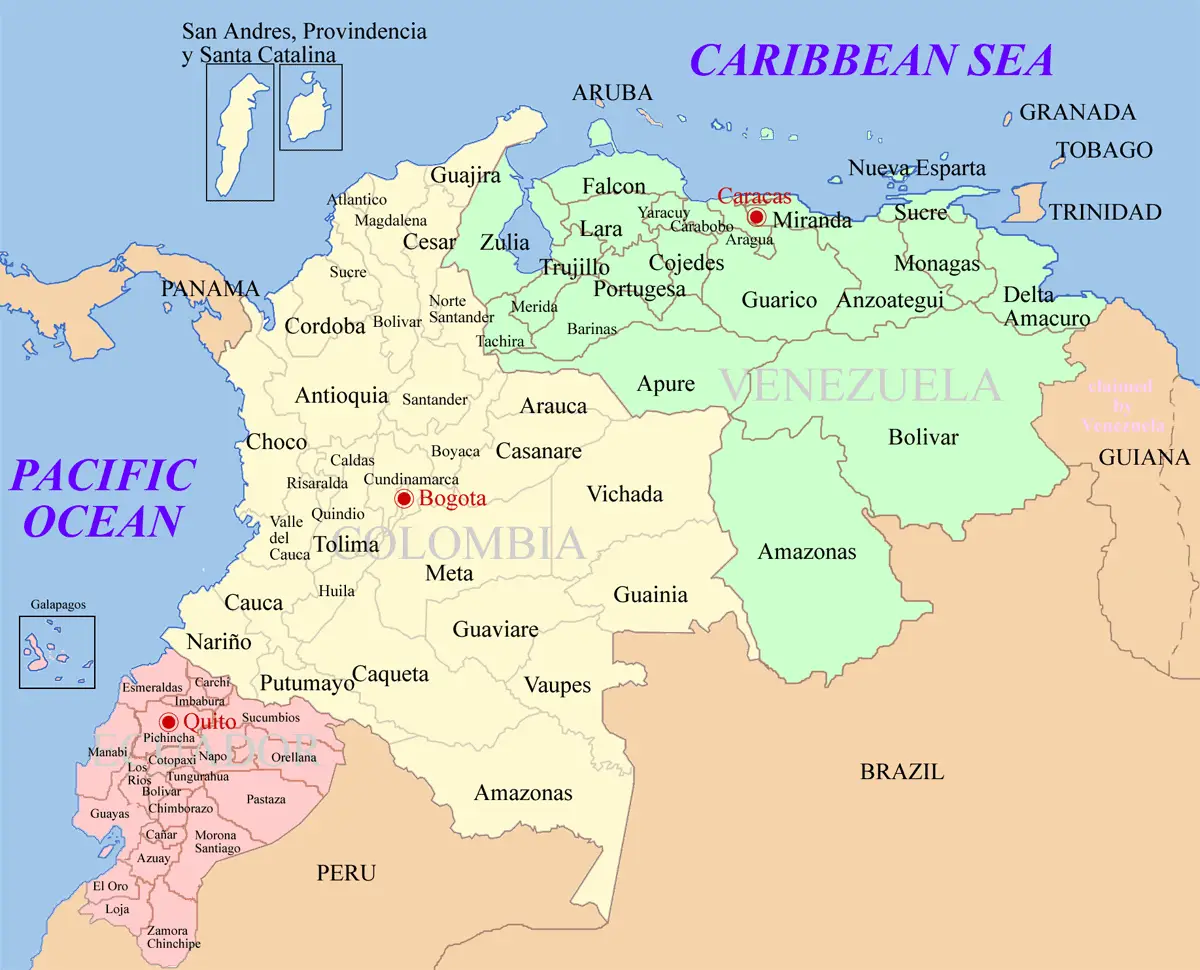
Below are the key figures for Venezuela population in 2016:
626 389 live birth & 171 716 deaths :
Natural increase : 454 672 people
Net migration : 14 414 people (official)
Males : 15 939 232 males as of 31 December 2016
Females : 15 836 139 females as of 31 December 2016According to the IMF, over 80 percent of households are now living in poverty. So it’s hardly surprising that a growing number of Venezuelans want to leave the country
Most better-off emigrants move to the United States. According to statistics from Veppex, a Spanish acronym for “politically persecuted Venezuelans in exile,” some 250,000 Venezuelan emigrants live in the state of Florida alone. Add to that, a number of those who arrive in the United States without authorization.
Venezuelan emigrant groups in the United States are pushing for the legal recognition of compatriots who are in the country without residency status. A bipartisan congressional bill presented in mid-October proposes that all Venezuelans who arrived in the United States prior to January 1, 2013, be granted permanent legal residency status.
US government figures from earlier this year this year showed that Venezuelans were behind only the Chinese and Mexicans for the number of asylum requests submitted to the US.
In recent months, Venezuelans have also started migrating en-masse to other parts of Latin America, where their personal connections are few, but the economic situation is more promising.
Currently less opportune Venezuelans are trying their luck in Colombia, Argentina, Brazil and Uruguay, as well as in Europe. Spain, with about 200,000 new arrivals, ranks just behind the United States
In July 2016, the government allowed Venezuelans to cross the border into Colombia on specific dates – which was closed from the start of the crises. In that month, over 200,000 Venezuelans poured into Colombia to purchase goods due to shortages in Venezuela.
On 12 August 2016, the Venezuelan government officially reopened its border with Colombia, with thousands of Venezuelans, again, entering Colombia to emigrate. They are also heading to the island of Curacao.
The arrival of skilled Venezuelan oil workers in past has been credited with reviving Colombia’s oil industry, but more recently the government there has deported Venezuelans working without authorization.
Recent reports indicate many Venezuelans have elected to make the more arduous trek to Chile.
“In the last five years, the number of Chilean visas issued to Venezuelans rose from 758 to 8,381,” Univision reported in September. “Almost 90 percent of visas issued to Venezuelans last year were work visas, most of them for immigrants ages 20 to 35.”
Even though Venezuela has seen a “pretty sustained level of emigration” over the last decade or so, said Alejandro Velasco, a professor at New York University, “There’s definitely been a spike over the course of the last year, for sure, and I think it’s picked over the course of the last four, five months.”
Despite the financial, emotional, and sometimes physical shock of uprooting and relocating their lives to new countries, many Venezuelans who’ve emigrated seem uninterested in returning, at least to Venezuela in its present circumstances
Political and Monetary ‘Reform’

Venezuelan President Nicolas Maduro named Ricardo Sanguino as the country’s central bank chief. Venezuela is facing an economic crisis with steep inflation, malfunctioning automatic cash machines, and product shortages, Sanguino is a supporter of Maduro’s policies.
Merentes had held the position since 2009, apart from a brief stint as finance minister in 2013. The mathematician was under intense pressure after the central bank had great difficulty releasing larger banknotes to the public.
Maduro announced the larger notes at a time of skyrocketing inflation. He also alleged that international “mafias” had stashed billions of bolivars in the previously highest denotation, 100-bolivar notes, especially across the Colombian border. Because of inflation that note was worth only a few US cents.
Sanguino has never held a ministerial position, but has served as a legislator since 2000 and headed the National Assembly’s budget commission. When asked about his thoughts on the role of the central bank, Sanguino said central banks “were the creation of the global capitalist system, which were created with a concept of autonomy that is even above the role of the head of state.”
Sanguino agreed with Maduro’s beliefs that Venezuela’s current economic and political crisis was a result of an “economic war” led by right-wing businessmen. Inflation in Venezuela is expected to hit 1,660 percent in 2017, according to the International Monetary Fund.
Opposition lawmakers have announced they plan to push for impeachment proceedings against Maduro at the National Assembly level after Venezuela’s National Electoral Council halted a drive to hold a recall referendum on Maduro.
Maduro has called such attempts at a no-confidence motion or impeachment as a “coup d’etat.”
The President then announced the creation of a “Special Anti-Coup Commission,” (i.e. Venezuelan Gestapo) which will be led by newly appointed Vice President Tarek El Aissami.
“This group will be dedicated 24 hours a day to take preventive, legal and corrective measures against all sectors wanting a coup and internal, political and economic terrorists. The commission would give peace and stability to the country.” he said. The commission will have members of the Venezuelan armed forces and police forces throughout the country.
Venezuela’s government today is nothing short of a modern day neo-fascist regime with de-facto military control over the masses.
Currency
Inflation in Venezuela is expected to rise 1,660 percent in 2017 and 2,880 percent in 2018, the International Monetary Fund reported.
Few people are aware that many of the country’s problems are caused by a complex monetary arrangement that makes use of four different exchange rates simultaneously. The result is that Venezuela can unbearably expensive, depending on the rate used.
First is the official one, called CENCOEX only intended for the importation of food and medicine. The next two exchange rates are SICAD I and SICAD 2. The last and newest exchange rate is the SIMADI, This rate is reserved for the purchase and sale of foreign currency to individuals and businesses.
Therefore, people naturally rely on the black market rate, which although it is much less advantageous, at least offers the possibility to procure the much needed foreign exchange.
Monetary chaos began in 2003 when the late President Hugo Chavez imposed currency controls to stem capital flight after an oil strike. At the time, one US dollar could fetch 1.6 Venezuelan bolivars. In 2016 the USD rate was 10 bolivars on CENCOEX, 660 bolivars on SICAD1 and 2200 bolivars on the black market. SICAD2 and SIMADI rates are not currently available. A piece of bread in Venezuela costs about 12 US cents or 500 bolivars in mid-Jan 2017
Venezuela released larger denomination banknotes weeks behind schedule as President Nicolas Maduro set out to rid Venezuela of the 100-bolivar note.
The new notes, valued between 500 and 20,000 bolivars, are meant to replace the 100-bolivar note, which was the largest denomination of currency available in Venezuela from 16 Jan 2017. Venezuelans often had to carry large amounts of 100 bolivar notes, worth just a few US cents, to go shopping.

President Maduro has said the 100-bolivar notes are hoarded by “mafias,” and have been pulled from circulation on 20th Fed 2017. Many automatic cash machines are still not programmed to handle the new larger denominations. The difficult release of the new bank notes was considered the last straw for Merentes.
Maduro has blamed the current economic crisis on the United States, calling it a capitalist conspiracy from within the socialist nation. The opposition blames Maduro’s policies for the crisis and is seeking a popular vote to remove Maduro from office.
Customers at banks in Caracas in late Dec 2016 told AFP the cashiers were issuing new 500, 5,000 and 20,000 bolivar notes. Three years of recession and soaring prices have pummeled Venezuelans, with many skipping meals and lootings of supermarkets now commonplace. Some economists have estimated that gross domestic product contracted by 10 percent or more in 2016.
Venezuela’s minimum wage, including food subsidies, is rising to 104,358 bolivars a month, or $31 a month in Jab 2017. The minimum wage was previously increased in October 2016, when the government raised it 40%. This increase will do little to help the masses when inflation runs at 1600%.
The real reason for the currency demonetisation was to control capital flight and check inflation from spiralling out of control. Currently this has only made it impossible for the people to conduct day-to-day affairs. The issue of new currency has not been quick enough to increase the damage to businesses – those that are still somehow functional.
The sharp depreciation followed a 14.2% increase in the total supply of bolivars in the last month, according to central bank statistics. Adding bolivars to the economy puts pressure on the exchange rate and increases inflation.
The funds that banks have available to make commercial loans, an indicator known as “excess bank reserves,” nearly tripled in the same period, according to the central bank.
In 2016, Venezuela started to sell gold in order to compensate for the loss of its monetary reserves. As a consequence, Venezuela’s gold reserves plunged from over 360 tons down to less than 190 tons. Instead of using gold as collateral and borrowing the currency required – Maduro’s people foolishly sold off a critical asset at a bargain basement price.
https://mises.org/sites/default/files/styles/full_width/public/mueller1.png?itok=yX6OFaCl

In 1998, before Hugo Chavez became president, the extended broad money supply (M3) stood at 10.6 billion bolivars. As of October 2016, money supply M3 reached 7,513.9 billion Venezuelan bolivars
https://mises.org/sites/default/files/styles/full_width/public/mueller2.png?itok=eKLHiJG2

Other than in the case that some foreign power, such as China, for example, would jump in as a lender, Venezuela’s default seems unavoidable
Health
Despite the Venezuelan government championing the health care plan, it has failed at times to be either free or comprehensive, with patients complaining about short supplies of medicines for people with cancer and diabetes and long delays at hospitals due to a lack of anesthetics and other medicines. Patients have also had to pay inflated prices for such hospitals staples like gauze, gloves and drugs for their doctors to use in operations when hospital supplies run dry.
Venezuelan Medical Federation president Douglas Leon Natera says patients are urged to show up at hospitals with their own disinfectant, gauze and pain killers.

“Doctors are working with our bare hands, without resources,” he says. The surgeon says doctors at 95 percent of all of the country’s hospitals have complained to him about the scarcity of surgical equipment.
Making up for the shortages in country, HIV/AIDS patients have had to get their supplies from NGO’s from abroad – chiefly from the United States. The donations, however, are not enough to meet the demand.
- Dr María Gonzales cannot recall the exact moment when she realised Venezuela’s health crisis had enveloped her hospital, the Luis Razetti in the Caribbean coastal city of Barcelona.
- It may have been during a surge in cases of scabies, a skin infection that ought to be easily prevented with soap, water and disinfectant. It could have been her first sight of an emaciated child, something she had only previously seen in medical books or documentaries about famines in Africa. Or perhaps it was when she found herself prescribing a 40-minute cold shower because the pharmacy had run out of anti-fever drugs.
- But the severity of the situation was certainly clear earlier this month, when a patient came in with a suspected case of diphtheria – a disease that Venezuela was supposed to have eradicated more than 20 years ago.
- “It’s like we have returned to the last century,” she says. “Everything is going backwards.”
The government has acknowledged that maternal mortality – a key healthcare indicator – has doubled in the past year. The opposition says the deterioration is five-fold – and that death of newborns increased 100-fold.
Maduro went on television and called on Venezuelans to start growing medicinal herbs.
The government has refused to let in humanitarian aid. So donations of medical supplies sit in warehouses and shipping containers in countries including the U.S., Spain and Panama.
The Venezuelan Health Observatory, a research centre at the Central University of Venezuela in Caracas, estimates that fewer than 10% of operating theatres, emergency rooms and intensive care units are fully operational. It says 76% of hospitals suffer from scarcity of medicines, 81% have a lack of surgical materials and 70% complain of intermittent water supply.
“We are seeing a collapse in the public health system.” said Maritza Landaeta, a senior member of the Health Observatory. “Venezuela is witnessing a miracle, a miracle of destruction.”
Social unrest and crime
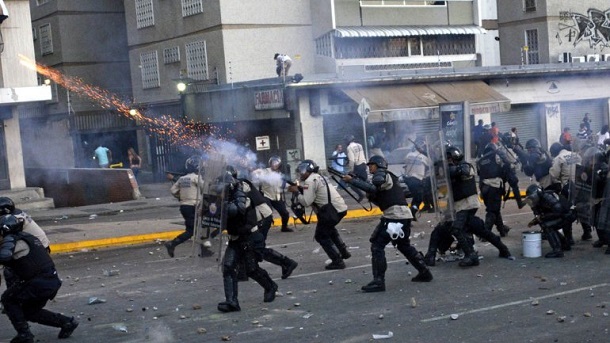
Police have been particularly hard hit by the violence. In the capital alone, there was an average of 2.5 police murders each week, the report found.
In 2016, there have been 125 law-enforcement officials murdered in greater Caracas alone. If that same rate held in the United States, it would be the equivalent of 6,572 police murders. Instead, there have been 33 shooting deaths of U.S. officers.
At La Urbina police station in eastern Caracas, officers were getting ready to head into a sprawling, violent neighborhood called Petare. Gone are the days when police could patrol the area alone or with a partner. Now they head into the zone in packs of six or more.
“Enrique” — who runs a gang of 15 hardened drug dealers, arms traffickers, thieves and kidnappers — agreed to talk to the Miami Herald under the condition of anonymity.
Showing off the Glock pistol that he claims his gang took from an officer a month ago, he said the authorities are outgunned. “The police want to wage war against us but they can’t,” he said. “Our weapons are meaner.”
- About two months ago, Yulibed Perdomo’s 32-year-old husband led a police raid into Petare.
- “I was terrified,” she said, “because that’s like the Wild West, you hear gunshots here and gunshots there.”
- Her fears were merited. That night, her husband, Aldrid Manuel Crespo, was ambushed and shot in the neck just above his protective vest. He died at the hospital, leaving behind his wife and two young children.
- The police paid for Crespo’s funeral and offered his widow 50,000 bolivares (about the same price as a black-market hand grenade) but little else. Perdomo said her husband never earned much while he was alive but always believed his family would be taken care of if something happened to him.
- “The situation was always difficult — he was depressed a lot because of all of his colleagues that had died,” she said. “But he was dedicated to his work.”
- Perdomo, who has moved back in with her mother to make ends meet, is trying to organize other police widows and orphans to press the government for benefits.
As the Venezuelan people stagger under the violence, Maduro rolled out “Operation Liberation of the People” in 2015. The massive criminal dragnet has involved almost 70,000 security forces, and the administration claims it has resulted in disbanding hundreds of criminal groups and produced thousands of arrests.
During the first 100 days of the program, authorities said they arrested 1,852 people, dismantled 109 gangs and seized 1,272 weapons.
But human rights groups say the OLP has resulted in arbitrary executions and detentions.
- On 16th Oct 2016 soldiers barged into Rafael González’s home as his mother and girlfriend looked on. It would be a routine questioning, they assured him and others arrested that night, before hauling them off to a dark military barracks.
- What happened next was anything but normal, Mr. González recalled.
He was stripped naked, kicked and struck with the butt of a rifle, he said. Soldiers hung him by his arms from the ceiling with a cord, demanding to know whether he belonged to one of the gangs that had terrorized his neighborhood in Venezuela’s rural area of Barlovento with robberies and kidnappings.- “They told me: ‘We are going to play a game, Little Rafael. It is called electrocution,’” said Mr. González, who is 17. “They shocked me on the abdomen, the neck, the penis, the butt, the back, my hands — everywhere. I felt like my eardrums would explode.”
- On 21st Oct. 2016, five days after he was arrested, Mr. González, bruised and terrified, was released.
- He would soon realize that he was among the lucky ones. Weeks later, the bodies of 13 others arrested in similar raids were found, most at the bottom of a mass grave. Many had been tortured, according to the authorities.
The killings at Barlovento, which government investigators have condemned as a massacre of innocents, have pointed to a troubling culprit in the country’s rising violence: its own security forces.

Venezuela has long suffered from one of the world’s highest crime rates. But the nation’s economic crisis, which has upended everything from its hospitals to its food supply, has deepened the misery and criminality.
Venezuela is likely the second most dangerous nation on earth, and with the situation of political, economic and social crisis set to worsen, escalating homicides are expected in 2017.
The Venezuelan Violence Observatory (Observatorio Venezolano de Violencia – OVV) estimated 28,479 “violent deaths” during 2016, a homicide rate of 92 per 100,000 residents.
As a point of comparison, the murder rate in the United States is less than 5 per 100,000 residents. The count included deaths from confrontations involving security forces, many of which are suspected to be extrajudicial killings.
In its annual report, the group said that Venezuela’s judiciary had shed all vestiges of independence and was being used as a political bludgeon. In addition, increased poverty and shortages “had promoted increased violence in the country.”
Also, for the first time, the group said it had observed “the presence of hunger-related generalized violence.”
Food shortages
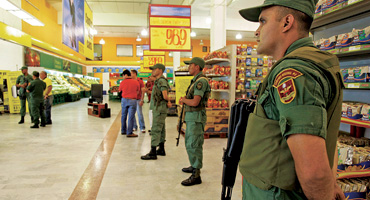
President Nicolas Maduro turned to the military to manage the country’s diminished food supply, putting generals in charge of everything from butter to rice.
But instead of fighting hunger, an Associated Press investigation finds the military made a profit from controlling much of the food distribution. That’s what grocer Jose Campos found when he ran out of pantry staples this year. In the middle of the night, he would travel to an illegal market run by the military to buy pallets of corn flour — at 100 times the government-set price.
With much of the country on the verge of starvation and billions of dollars at stake, food trafficking has become one of the biggest businesses in Venezuela, the AP found. And from generals to foot soldiers, the military is at the heart of the graft, according to documents and interviews with more than 60 officials, business owners and workers, including five former generals
As a result, food is not reaching those who most need it.
The government now imports nearly all of Venezuela’s food, according to Werner Gutierrez, the former dean of the agronomy school at the University of Zulia, and corruption is rampant, jacking up prices and leading to shortages.
“If Venezuela paid market prices, we’d be able to double our imports and easily satisfy the country’s food needs,” Gutierrez said. “Instead, people are starving.”
One South American businessman said he paid millions in kickbacks to Venezuelan officials as the hunger crisis worsened, including $8 million to people who work for the current food minister, Gen. Rodolfo Marco Torres. The businessman insisted on speaking anonymously because he did not want to acknowledge participating in corruption.
Although money was not mentioned, the businessman understood that he needed to give more in kickbacks. In the end, he told the general, the boat had to pull out because costs caused by the delay were mounting.
Bank documents from the businessman’s country show that he was a big supplier, receiving at least $131 million in contracts from Venezuelan food ministers between 2012 and 2015. He explained that vendors like him can afford to pay off military officials because they build huge profit margins into what they bill the state.
Ordinary Venezuelans have lost faith in the regime, if not in chavismo, the pro-poor populism espoused by the late Hugo Chávez. Mr Maduro, his successor, has an approval rating of 24%. In December 2015 Venezuelans elected a parliament dominated by the opposition.
Mr Maduro’s response has been to cling on to power more tightly. The electoral commission, controlled by the regime, has blocked a referendum to recall him from office. The supreme court, manned by government loyalists, has blocked almost everything the national assembly has tried to do. On January 15th Mr Maduro delivered his annual state-of-the-nation address not to the legislature, as the constitution requires, but before the court.
The regime says it wants dialogue with the opposition but has done little to enable it. Talks mediated by the Vatican and by Unasur, a regional body, broke down in December after the opposition accused the government of reneging on promises, including to release political prisoners and restore powers to parliament.
Mr Maduro’s recent appointment of a new vice-president suggests that the regime is moving further away from dialogue and reform.. He had an assault rifle and explosives in his car, the government claims; his party says the weapons were planted.
Mr Maduro appears to be making two bets. The first is on disarray among the opposition. Divisions within the Democratic Unity alliance, a grouping of many parties, are widening as their efforts to defeat chavismo falter. It lacks a leader who can appeal to poor Venezuelans who feel betrayed by the regime’s empty promises.
Mr Maduro’s second hope is that oil prices will bounce back. They have already recovered from $21 a barrel in 2016 to $45. But PDVSA has been so badly managed and starved of investment that it will struggle to reap the benefits. Output fell by 10% last year and no rise is likely in 2017. Venezuela’s foreign reserves have dwindled to less than $11bn; its easy-to-sell assets are about a fifth of that.
However it is portrayed – the future of Venezuela looks nightmarish and beyond anything experienced by a ‘developing’ country – short of war. It is expected that Venezuela will default on its debts – and if so the humanitarian crisis is large enough to consume the whole of South America.
If the civil government in any form is not able to hold on – anarchy from gangland rule or a possible military coup appear likely. There is also the case of Venezuela’s creditors, who will most likely demand a Greece-like bailout (or bail-in).
Economically Venezuela as a socialist state is finished. How the country moves forward depends on the decisions that need to be made once the default is acknowledged as unavoidable.
Mr Maduro vows that 2017 will be the “first year of the new history of the Venezuelan economy”. That will not shorten the passport queues.

Postnote:
As I write this I truly cannot imagine the lives these people must have to lead every day – with little hope of any future that does not require some form of sacrifice just to keep on going. They will be in my prayers.
Citations
http://www.nbcnews.com/news/latino/venezuela-military-trafficking-food-country-goes-hungry-n701191
http://www.economist.com/news/americas/21715694-nicol-s-maduro-draws-wrong-conclusions-economic-crisis-venezuela-crumbles
https://www.theguardian.com/world/2016/oct/19/venezuela-crisis-hospitals-shortages-barcelona-caracas
http://www.foxnews.com/health/2016/10/04/venezuela-health-care-is-such-failure-scraped-knee-turns-into-medical-crisis.html
https://www.washingtonpost.com/news/worldviews/wp/2016/12/13/how-to-fight-hyperinflation-in-venezuela-by-seizing-massive-amounts-of-cash/?utm_term=.98ed83015b59Another well done article from Yumbo. Standing Ovation here. SW.
When women lead, destruction is the destination. -- Me.
Another well done article from Yumbo. Standing Ovation here. SW
Thank you Sir – much appreciated
http://www.leavemeansleave.eu
http://www.telesurtv.net/english/opinion/The-Venezuela-Opposition-We-Never-Hear-About-20170309-0035.html
Thanks It’sallbs- I always wonder how some people can think pure socialism can actually work.
- AuthorPosts
You must be logged in to reply to this topic.
921526
921524
919244
916783
915526
915524
915354
915129
914037
909862
908811
908810
908500
908465
908464
908300
907963
907895
907477
902002
901301
901106
901105
901104
901024
901017
900393
900392
900391
900390
899038
898980
896844
896798
896797
895983
895850
895848
893740
893036
891671
891670
891336
891017
890865
889894
889741
889058
888157
887960
887768
886321
886306
885519
884948
883951
881340
881339
880491
878671
878351
877678