Home › Forums › Political Corner › The Dutch Lower House Elections 15 Mar 2017
Tagged: Cheese Heads
This topic contains 5 replies, has 5 voices, and was last updated by  Y_ 2 years, 11 months ago.
- AuthorPosts
Dutch head to polls amid tense immigration policy debate

Close to a dozen European countries will hold elections this year with populist-nationalists, many buoyed by US President Donald Trump’s victory, riding high in the polls. A strong showing for them could put the European Union, already rocked by Britain’s impending exit, under greater strain.
In France, Marine Le Pen — who wants France to drop the euro and has threatened, like Wilders, to hold a Brexit-style referendum on quitting the European Union — has made her right-wing National Front party a leading contender in April’s presidential ballot.
Meanwhile, German Chancellor Angela Merkel, who’s due to meet with Trump this week, faces attacks from the right over her handling of Europe’s refugee crisis.
Up to 13 million Dutch voters are heading to the polls on 15th March 2017 – today – to elect 150 members of the lower house of parliament in a symbolic Euroscepticism showdown that seems to have split their society along the immigration policy divide.
At the national level, legislative power is invested in the States General (Staten-Generaal), which is comprised of the House of Representatives and the Senate. The House of Representatives (Tweede Kamer) has 150 members, elected for a four-year term by proportional representation. Elections are also called after a dissolution of the House of Representatives.
All elections are direct, except for the Senate (Eerste Kamer), which has 75 members, elected for a four-year term by provincial councillors on the basis of proportional representation at the provincial elections.

The Netherlands has a multi-party system, with numerous parties, in which usually no one party ever secures an overall majority of votes (except occasionally in very small municipalities, such as in Tubbergen), so that several parties must cooperate to form a coalition government.
This usually includes the party supported by a plurality of voters, with only three exceptions since World War II, in 1971, 1977 and 1982, when the Dutch Labour Party (PvdA) was the largest party but did not take part in the coalition
Some 28 parties are competing in the 2017 election which is largely viewed as a face-off between ultranationalist Geert Wilders and the current Prime Minister Mark Rutte.
Under the proportional representation system, any party who receives more than 0.67 percent of the vote, will pass the mandated threshold and get at least one seat.
Following the latest round of televised debates on Tuesday night in which representatives of 13 parties competed, Prime Minister Rutte’s People’s Party for Freedom and Democracy (VVD) is leading Wilder’s Party for Freedom (PVV) by a small margin.
The Dutch Peilingwijzer website which tracks down six polling outlets says that VVD will likely gain between 24-28 seats, versus 19-22 that will most likely go to PVV. The Christian Democratic Appeal Party (CDA) and its leader Sybrand Buma are predicted to gain between 19-21 seats.
At least four other parties are likely to gain more than 10 seats. These include the centrist D66, Green-Left, the Socialist Party and the social democrat Labour Party (PvdA). Whichever party can secure the majority 76 seats in parliament, either on its own or through a coalition, will form the new Dutch government and choose the Prime Minister.
Rutte who took on Wilders in a heated debate on Monday night has made it clear that his party will not work with the PVV leader.
Wilders has said that Netherlands’ exit from the European Union would be “the best thing that could happen to us.”
Rutte instead argued that the so-called Nexit would cost 1.5 million jobs and create “chaos”.
Wilders, on the other hand, told the voters that after a Nexit, the Dutch would become the “master of our own country again.”
As part of his controversial agenda, the 53-year old Wilders wants to close Islamic schools and asylum centers. In addition, Wilders wants to shut down borders with a blanket ban on migrants from Muslim countries. The ultra-conservative also wants the Koran to be banned in the Netherlands.
During the final debate, Wilders engaged in an intense face-off with PvdA party leader Lodewijk Asscher over the issue of immigration.

The issue and debate around foreigners in the Netherlands has heightened in recent days following the diplomatic row and weekend rioting over the barring of the Turkish family minister from entering the Turkish Consulate in Rotterdam.
“If you want to tackle crime you should deport those foreigners who rape, commit a crime and laugh at our police,” Wilders said. “The Netherlands is not for everyone, the Netherlands is for the Dutch.”
When asked by RT whether anyone should be afraid of his potential victory, Wilders said that “nobody should be afraid, everybody should be happy…”
“…But the elite in Brussels might think twice [about] opening a bottle of champagne if we have a good result today.”
Some of Wilder’s supporters told RT ahead of the election that the Party for Freedom is shaping the new political agenda for the Netherlands.
“Wilders is a person who notices the frustration, what is brewing and annoying people and he expresses it. Other parties are now listening as well,” Wim Keizer a local politician in Volendam told RT.
But Wilders’ popularity has slipped in recent weeks, said Quentin Peel, associate fellow at London-based think tank Chatham House — and he believes that could be down in part to Trump’s arrival in power.
“I think that very well-grounded middle-of-the-road solid Dutch citizens have been a bit concerned about what has been happening in Washington,” Peel said.
“The trouble is [the results] are very difficult to predict. You’ve got no less than 28 parties running in this campaign, and you’re probably going to … end up with a very complicated coalition and Mr. Wilders is not going to be part of it.”
Electoral system and organisation
The House of Representatives, or Second Chamber (Tweede Kamer) is composed of 150 seats elected by proportional representation in a single nationwide constituency.
Preliminary results based on a “quick count” will be available on 15 March 2017, but the official result will not be announced until 16:00 CET on 21 March 2017
Expected seat allocation is given below:
https://assets.bwbx.io/images/users/iqjWHBFdfxIU/iNQqNnUatVHc/v1/800x-1.png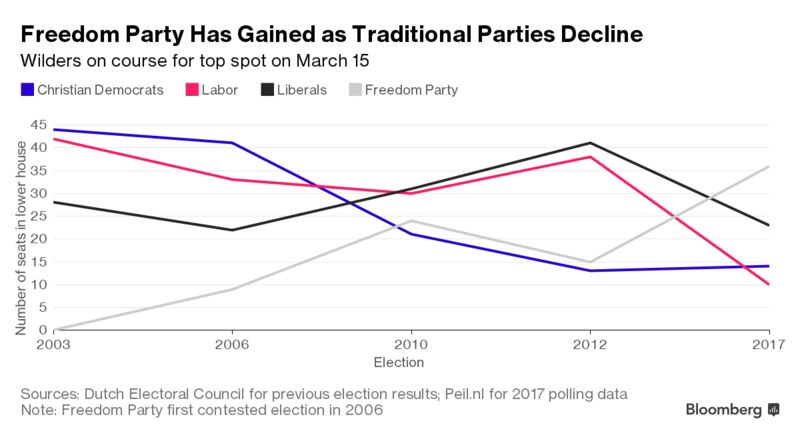
Wilders Looks Set to Finish First
All the opinion polls are in agreement: The anti-Islam, anti-European Union Freedom Party led by Geert Wilders is ahead and poised to win the largest number of seats. But here’s the rub: On current trends, it will still have less than a quarter of the members in the new lower house.
The Winner Doesn’t Necessarily Take It All
Taking first place confers no right to try and form a government, and there are historical precedents for the winning party being shut out of power. It’s happened three times since World War II.
Wilders is unlikely to be able to form the next government even if he wins the popular vote, as all mainstream parties have ruled out working with him.
A More Fragmented Political Landscape
So multiparty politics are nothing new in the Netherlands. But over the past few decades, as elsewhere in western Europe, the traditional major parties have been losing ground to insurgent groups. And that’s a trend that makes building coalitions with a parliamentary majority that much harder.
Maintaining the status quo is exactly what many Dutch voters have tired of, and Wilders rated strongly in pre-election polls thanks to his no-nonsense rhetoric and often controversial views. Other parties — including Rutte’s VVD — have lurched to the right in response.
Musician and actor Ron Mesland, from Amsterdam, said he was concerned about the wider impact of Wilders’ popularity. “Most other parties seem to adopt his speech and his ideas, and that really worries me,” he said.
Expected results from exit polls

The Election Is Just the Start
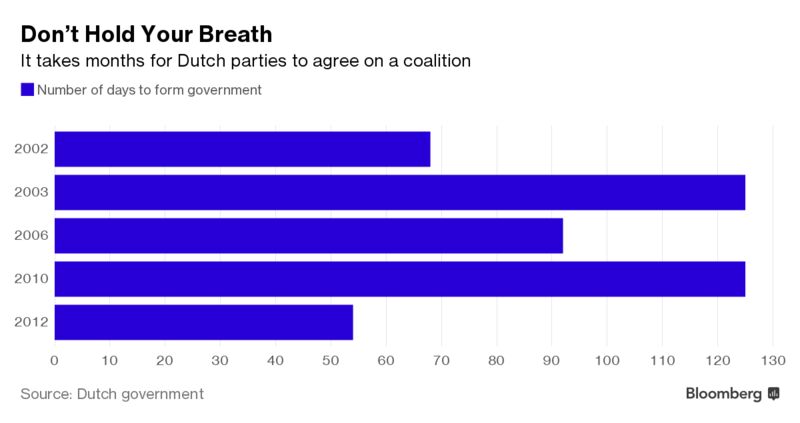
The process of forming a government in The Hague follows a well-worn yet time-consuming path. Parliament appoints a senior politician to take soundings, before a possible prime minister is named to finish the task of putting a team and a coalition accord in place.
https://assets.bwbx.io/images/users/iqjWHBFdfxIU/ihCxsXGIgITw/v1/800x-1.png
How to Form an Anti-Wilders Coalition?
“The most likely outcome of the elections is for a coalition of four or five center-right and center-left parties,” Martin van Vliet and Dimitry Fleming at ING Groep NV in Amsterdam wrote in a Jan. 9 note to investors. But it’s going to be tricky. At the moment, the numbers don’t quite add up.
https://assets.bwbx.io/images/users/iqjWHBFdfxIU/iu7qJYXdrSeM/v1/-1x-1.png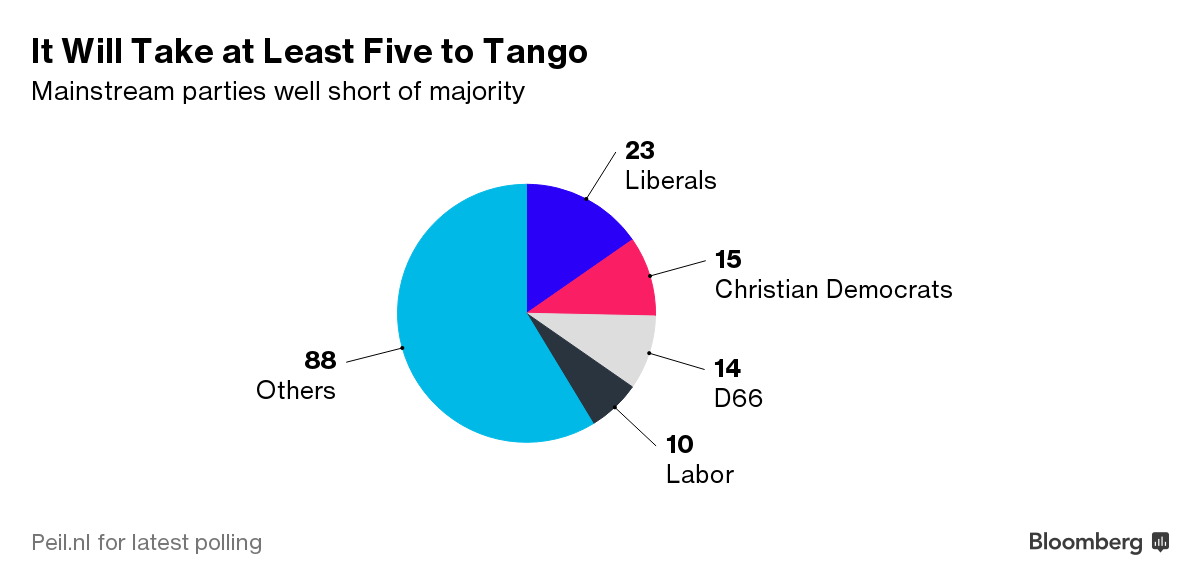
The four parties that cover the center spectrum would need to bring in a fifth partner to get to the magic 76-seat marker in the lower house. The Greens would make up the numbers, though party leader Jesse Klaver has said it’s very unlikely his party will team up with Rutte’s Liberals.
And there’s one more thing to take into consideration: The new government will also need to ensure it has enough votes to get legislation through the indirectly elected upper house, the Senate. The positive for the mainstream parties is that either possible coalition outlined above would have a Senate majority.
Tensions with Turkey
Meanwhile, tensions between the Netherlands and Turkey have escalated since the Dutch government refused to allow Turkish Foreign Minister Mevlut Cavusoglu to visit the Dutch city of Rotterdam for a political rally at the weekend.
Why are Turkey and the Netherlands clashing?
Turkey’s President Recep Tayyip Erdogan responded by accusing the Dutch of being responsible for the massacre of Bosnian Muslims in Srebrenica in 1995, when Dutch UN peacekeepers failed to protect them from Bosnian Serb forces who overran the town.
Donald Tusk, President of the European Council, waded into the diplomatic row Wednesday, tweeting that Rotterdam was “destroyed by Nazis” but now has a Moroccan-born mayor. “Anyone seeing fascism there is detached from reality. We are Europeans & proud,” he said.
Key issues for voters
The Islamisation of the Netherlands is the key issue of this election.
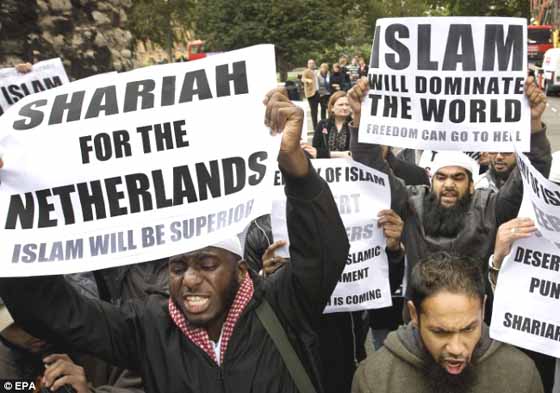
“My biggest concern is that the working class is being put down,” said delivery driver Tony Regnerus. “The immigrants are all coming in, and they get a better life than the working man. They’re not pushed to do anything with their life, they’re not pushed to get a job.
“Every day, I go to big cities like Rotterdam and Gouda and Delft, they’re all wearing Canada Goose jackets — €600, and I can’t pay it — [but] I’m a working man. It’s gotta be the other way around.”
The Netherlands’ relationship with the European Union has been another hot topic on the campaign trail. The Dutch were founding members of the union, but attitudes have cooled in recent years. The economy may be on the verge of a debt crisis as too much borrowing to fund the Government debt or the negative current account has not been addressed by Brussels and the current government.

According to preliminary Eurostat data, the Netherland’s economy grew by 2.1% last year, and investors have remained reasonably calm throughout the campaign.
But Rutte’s tough austerity measures aimed at combating the 2011-2012 recession have hit the country’s poorest the hardest and that has weighed on their minds as they prepare to visit the ballot box.
Fisherman Jan de Boer said he is concerned about the future of his industry — which he says is threatened by EU regulations — and this will be at the forefront of his mind when he comes to fill out his ballot on election day.
“The rules are very bad for the fishermen of the Netherlands,” he said. “We want fishing and our children want fishing.”Until now, de Boer has always voted for the Christian Party — but this time around, he said, that will change. “Geert Wilders’ … is the only party that fights European rules, and for me that’s important.”
But bus company worker Leonard Schaab said he didn’t believe Wilders will do as well as expected: “The polls are always a little bit off, and when the real elections [take place] most of the time people will vote for other parties.”
“The man doesn’t have the skills to do it,” he added. “The only thing Geert Wilders does is shout about all kinds of problems … he creates problems, but he never has solutions.”
“They don’t listen to us,” says Cornelius Cas, a 72-year-old former fisherman who is running errands in clogs and wool pantaloons. “In March, we must vote and, in the past, whoever we choose, every time it is the same, and so we will vote for Mr Wilders.”
The latest figures released by the Netherlands’ central bureau of statistics show a net increase of 56,000 immigrants in 2015 and 88,000 in 2016, with the largest number last year, about 29,000, coming from Syria.
The number of municipalities that have populations with 10 percent to 25 percent non-Western migrants doubled between 2002 and 2015, according to the Netherlands Institute for Social Research, a government agency that studies social policy.
A disproportionate amount of crime is committed by young Muslims, especially Moroccan teenagers and young men, but that is also true of immigrants from the Netherlands Antilles in the Caribbean.

Citations
https://en.wikipedia.org/wiki/Elections_in_the_Netherlands
https://www.rt.com/news/380754-dutch-election-wilders-rutte/
https://www.bloomberg.com/politics/articles/2017-01-18/your-guide-to-dutch-elections-a-bellwether-to-european-populismOnce again my brother—kick ass article(s)
I don’t think Gert is going to win–but I am watching for gains made by his party. The only question for the Netherlands and the rest of Europe is: When/IF their fuzzy liberalism is finally going to succumb to the fear/reality that their culture/people/country is at risk of dying.
Great post.
A lot of work.
Thanks for the excellent information.
I hope European people wake up and stop the cultural suicide.Once again my brother—kick ass article(s)
Great post.
A lot of work.
Thanks for the excellent information.Yes sir, thanks Yumbo. Where do you find all of the time to compile these posts?
Thanks for posting. I visit Holland a couple of times a year. A great place, generally laid back and easy going. Nice people
Life's a bitch, then you're supposed to marry one and then die- sod that for a game of soldiers!
Yes sir, thanks Yumbo. Where do you find all of the time to compile these posts?
Your support appreciated guys. I get back from a 9 – 12 hour workday and spend another 4 -5 compiling this kind of stuff.
I’m a knowledge freak so it’s just part of what I do.
I get a kick out of posting these so it’s good fun all around.
- AuthorPosts
You must be logged in to reply to this topic.
921526
921524
919244
916783
915526
915524
915354
915129
914037
909862
908811
908810
908500
908465
908464
908300
907963
907895
907477
902002
901301
901106
901105
901104
901024
901017
900393
900392
900391
900390
899038
898980
896844
896798
896797
895983
895850
895848
893740
893036
891671
891670
891336
891017
890865
889894
889741
889058
888157
887960
887768
886321
886306
885519
884948
883951
881340
881339
880491
878671
878351
877678