This topic contains 4 replies, has 5 voices, and was last updated by  JVB 2 years, 10 months ago.
- AuthorPosts
South Africa’s Economy – Possible Crisis Looms
The economy of South Africa is the second largest in Africa and accounts for 24% of Africa’s gross domestic product (PPP), and it was – until recently – ranked as an upper-middle-income economy by the World Bank – one of only four such countries in Africa (alongside Botswana, Gabon and Mauritius).
Since 1996, at the end of over twelve years of international sanctions, South Africa’s Gross Domestic Product has almost tripled to $400 billion, and foreign exchange reserves had increased from $3 billion to nearly $50 billion. This created a growing and sizable middle class, within two decades of establishing a viable democracy and ending apartheid.
However this has not improved the economic situation of the common people significantly. Most economic progress has stalled within the last three years – the current global economic slowdown from 2011 has decimated the country’s socialist political system and put the middle class to flight.
Currently performing far below its potential, South Africa’s economy has been stifled by political instability. a socialist economic system and a weakening rule of law.
The judicial system has become vulnerable to political interference, and numerous scandals and frequent political infighting have severely undermined government integrity.
Government spending has not been kept in check and private-sector growth remains constrained by structural and institutional impediments caused by growing government encroachment into the marketplace.
This includes persistent uncertainties surrounding key government policies to private investment and to the necessary expansion of the production base.

Undermining overall macroeconomic stability – a combination of loss of confidence in the government, rising public debt, inefficient state-owned enterprises and spending pressures – are contributing to increasing fiscal vulnerability of the markets and causing investors to take flight.
South Africa has a competitive advantage in that the infrastructure relating to conventional production sectors have been developed to a workable degree. These need to be improved for economic growth to take place.
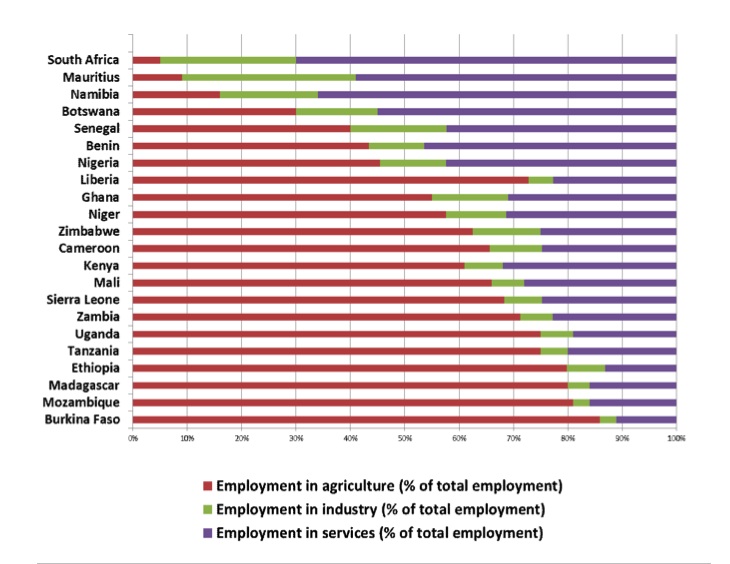
Capital has shifted from a primary (agricultural) and secondary (industrial) economy in the mid-twentieth century to an economy driven primarily by the tertiary (services) sector in the present day which accounts for an estimated 65% of GDP (or $230 billion in nominal GDP terms.)
The country’s economy is reasonably diversified with key economic sub-sectors including mining, agriculture and fisheries, vehicle manufacturing and assembly, food processing, clothing and textiles, telecommunication, energy, financial and business services, real estate, tourism, transportation, and wholesale and retail trade. South Africa is one of the world’s largest producers and exporters of gold and platinum.
South Africa has key sectors roughly contributing to GDP as follows in 2015:

http://www.gautengonline.gov.za/Business/PublishingImages/gauteng-economy.jpg
It can be seen that the services and government sectors dominate the GDP. The agricultural and industrial sectors together cannot sustain the population and depend heavily on imports.
There are therefore structural problems in the economy if there is a drop in global demand for mining products which sustain the GDP export market.
Current Economic Standards
It is clear from the chart below that real GDP is dependent on social spending by the government. Without the social stimulus there is no real economy. The exports forming a limited number of consumer products – although of high commercial value – are not sustainable in a global recession.

South Africans are poor by design, and the main export industry – mining – has been hurt by falling commodity prices and bitter labour strikes that have driven up production costs. Thus has caused a chain reaction in the socialist-run economic system.
Like most developing or third world countries that depend on a few export items to the detriment of other more necessary sectors such as agriculture and industry, South Africa is quickly joining India, Venezuela, Zimbabwe and Greece as the next nation to go into an economic meltdown.
To pay for the rising spending deficits South Africa has followed the time-honoured method of printing more paper to devalue its currency while lowering interest rates (therefore ensuring capital flight of its middle class).
Progress in combating this deficit by diversifying South Africa’s economic potential has been limited and uneven, indicating a need for regulatory changes that would encourage more dynamic private development in the primary and secondary sectors.
Corruption hampers the functioning of government, however, and enforcement of anti-corruption statutes is inadequate. The process of tendering public contracts can be politically driven and opaque.
Trade is important to South Africa’s economy; the value of exports and imports taken together equals 63 percent of GDP. The average applied tariff rate is currently 3.9%. Imports are substantially food and everyday essentials. Exports are narrowly focused and are mainly mining products. South Africa is therefore heavily dependent on imports for survival and exports to pay for the social system.
However since the new ANC-led government took office in 2014 GDP growth declined from 1.5% to a forecast of 0.7% in 2017. This mainly comes from losses in the mining sector. The fallout of this on the economy has been devastating.
The financial sector is one of the largest among emerging markets and includes sophisticated banking and bond markets. The JSE Securities Exchange, a large and active stock exchange that ranks 18th in the world in terms of total market capitalisation as of March 2009.
The banking industry, overseen by the South African Reserve Bank, is dominated by four local players: Nedbank, ABSA, Standard Bank and First Rand.[ These banks provide both retail and investment banking services as the sector has become highly competitive with the re-entry of many experienced foreign banks, which returned to the market in the mid-1990s, having left in the late 1980s.
Banks operating in South Africa, when left short of liquidity, need to borrow from the SARB at a fluctuating repo rate, which in turn allows the central bank to monitor liquidity positions.
However these services has not been improved livelihoods for the general public. South Africa operates as a socialism and welfare state. The money comes from the small number of working businesses in each sector to fund the lifestyle of its politicians and pay for the upkeep of the population.
Currently, more than 45 percent of the country’s households receive what are referred to as “social grants” from the government, which are paid out on a monthly basis – these as essentially the equivalent of welfare cheques in the U.S.
It’s not just welfare checks the government is handing out like candy — a number of other government programs, intended for the masses but funded, in large part, by the few, are driving the country to the brink of bankruptcy.
The government has abolished price controls on all but a handful of items such as coal, petroleum and petroleum products, and utilities. This has fully exposed the lower sectors of society to rising inflation and high interest rates affecting business and personal expenditure. Rates of crime are high, and the quality of public education is below acceptable standards.
Access to infrastructure and basic services such as health and social care is lacking for a considerable proportion of the population. Electricity shortages and low consumer and business confidence continue to restrain the growth of economic activity.
Politics of Corruption

What happened to Nelson Mandela’s plucky and inspiring African nation?
The answers include many things beyond its control and some within its own economy: a worldwide decline in commodities prices and waning demand from China (its biggest trading partner) plus the worst drought in 50 years. The performance of South Africa compared to its neighbours is shown below
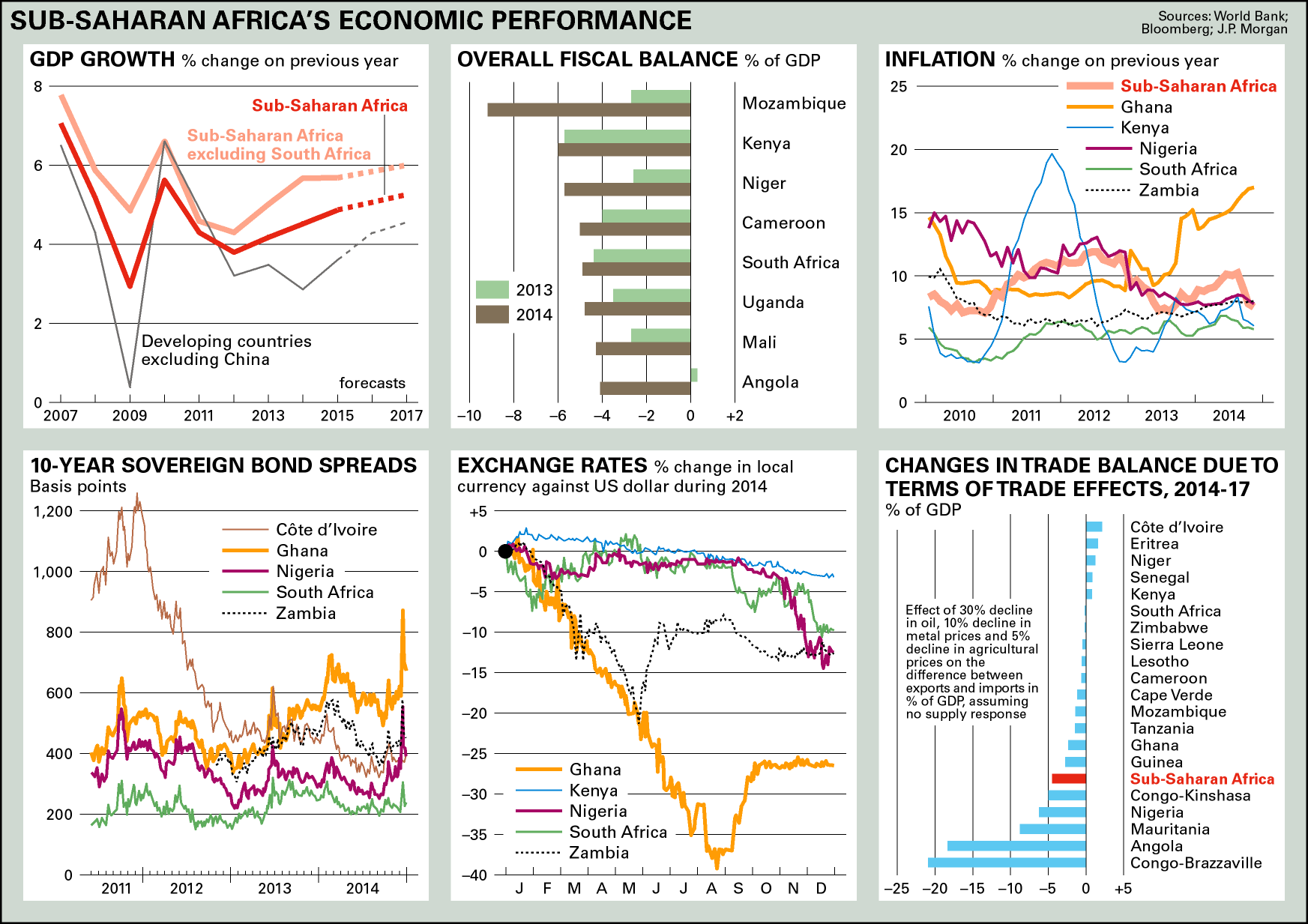
It is noted that that the current economic balance and system of governance occurred during the apartheid era – which ignored the majority of the indigenous population in the political and economic cycles. The post-unification era did little to actively seek to redress this balance to provide legitimate education and employment for the majority of the underclasses.
Labor market rigidity has contributed to persistently high unemployment which remains stubbornly high at 25%, and is particularly pervasive among the youth, at 52% in 2016. High unemployment, especially among black South Africans, is the main cause of the widening income inequality, as shown by a Gini Coefficient of 0.69, which is one of the highest in the world.
The official unemployment rate, though very high by international standards, understates its magnitude because it includes only adults who are actively looking for work, excluding those who have given up looking for jobs.Only 41% of the population of working age have any kind of job (formal or informal)
Numerous state-owned enterprises currently distort the economy, and recent efforts to ban foreign ownership of land and facilitate expropriation discourage foreign investment.
In 2016 the top five challenges to doing business in the country were inefficient government bureaucracy, restrictive labour regulations, a shortage of educated workers, political instability, and corruption, whilst the country’s robust banking sector was rated as a strongly positive feature of the economy.
But there is a consensus among analysts that one of the biggest problems is President Jacob Zuma.

Jacob Zuma of the African National Congress was elected president by the ANC-controlled National Assembly in 2009 and then re-elected for another five years in May 2014. The ANC has dominated politics since the end of apartheid in 1994.
Zuma’s rise to the presidency of Africa’s most industrialized nation is an unlikely story. The son of a domestic worker, he didn’t learn to read until he served time in prison with Mandela, who admired the way he sang and joked to keep spirits up. Charisma and street smarts carried him up the ranks of the ANC.
He was acquitted of rape charges and escaped corruption charges — prosecutors dropped them — before his election in 2009. He was reelected to a five-year term in 2014.
After apartheid, the ruling African National Congress and business adhered to an unwritten agreement: No matter how much socialist rhetoric the government used publicly, it would always maintain fiscal rectitude and a strong central bank.
Zuma seems to have blown up that understanding.
His critics point to a litany of misdeeds, starting with expanding the civil service and stacking state enterprises with his allies to the point that nearly 40% of the budget goes to paying government workers.
His sprawling Cabinet includes 35 ministers and 37 deputy ministers, whose perks include first-class international air travel, two cars each, free housing and domestic workers.
His government has guaranteed state-owned companies $14 billion in loans, even though many of those enterprises are in distress and may not be able to pay it back.
It has also introduced a raft of bills — some of which have been approved by the Parliament — that raise doubts about the ownership rights and safeguards that had long helped draw foreign investors.
Some analysts point to one political move that seemed to sum up Zuma’s economic mismanagement: his firing in 2015 of Nhlanhla Nene, the finance minister, who was widely respected by investors.
Nene was replaced with a former mayor of a small municipality with little experience in finance. Evidence emerged suggesting that a powerful business family close to Zuma may have had a hand in the firing. One was the deputy finance minister, who alleged that the family had offered him Nene’s job days before the firing.
Four days later — after the currency and the stock market tumbled and bankers warned of a financial meltdown — Zuma backed down and removed the official, replacing him with the former Finance Minister Pravin Gordhan – ho was widely respected and had the confidence of the markets and investors.
There was only one problem with Pravin Gordhan – he could not be bribed or made to play politics.
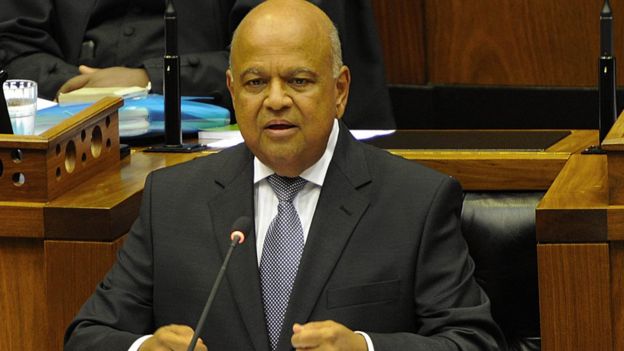
In a briefing ahead of the 2017 Budget, Mr Gordhan said: “There is no doubt about the fact that we are in crisis.”
The measures announced in Parliament were aimed at stopping the country falling into recession and to appease the rating agencies who have threatened to downgrade South Africa to junk status, which would raise borrowing costs for the country.
Mr Gordhan unveiled government spending cuts, a civil service job freeze and some moderate tax rises.
These tax increases affect property sales, fuel, sugary drinks, alcohol, tobacco and and capital gains, as well as environmental levies, which are expected to bring in an extra 18bn rand ($1.18bn; £840m).
He had been expected to announce plans on privatising state assets – he fell short of that but said the government was looking at the possibility of merging the loss-making national carrier, South African Airways, with the state-owned SA Express airline “with a view to engaging with a potential minority equity partner”.
Privatisation has long been resisted by sections of the ruling African National Congress since it ate into their black market businesses.
Mr Gordhan was blunt on his outlook for the country.“We cannot spend money we do not have. We cannot borrow beyond our ability to repay. Until we ignite growth and generate more revenue we have to be tough on ourselves.”
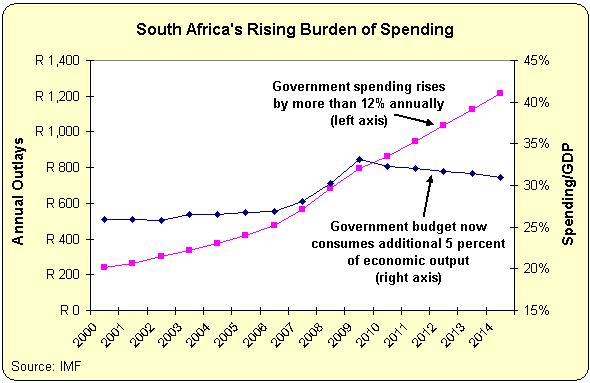
Maike Currie, investment director at Fidelity International, said she was unsure if the measures announced would stop the rating agencies cutting their outlook for the country.
She added that it was interesting that Mr Gordhan had focused on cutting down government spending without enforcing austerity measures on everyday South Africans, such as raising income tax.
It seemed that despite the odds the Finance Minister still had the ear of the local and international financial institutions, Their response to his budget speech was considered positive.
Financial Ruin
In March 2017 Finance Minister Pravin Gordhan was sacked based on what the ANC calls a frivolous intelligence report. This has ignited a bitter struggle within the party between Zuma supporters and opponents.

The clash is likely to paralyze the government, leaving it incapable of much-needed economic reforms, said Justice Malala, a political analyst and author of a book on South Africa, “We Have Now Begun Our Descent.”
“There’s no real governance in South Africa,” he said. “And you have a country that’s just not working.”
Barclays Bank recently announced it was selling most of Barclays Africa, the vast majority of which is in South Africa. The mining giant Anglo American is also reducing its South African holdings.
About 950 millionaires moved out of the country last year, according to one survey.
The International Monetary Fund is predicting growth of 0.7% in 2017, with some analysts forecasting a recession.
In December 2016, business confidence fell to its lowest level since the end of apartheid, according to the South African Chamber for Commerce and Industry.

Violent demonstrations have become a daily occurrence, as protesters set up roadblocks, burn tires and government buildings, flip cars or throw stones at police to register their frustration with interruptions in basic services such as electricity.
Arguing for Zuma’s removal, Allister Sparks, a longtime political analyst, recently wrote that Zuma’s continuation in office carries “the risk of triggering a populist political uprising leading to chaos and violence.”
But Zuma keeps a tight hold on the ANC national executive committee, the only body that could dismiss him. A network of patronage also keeps him in power, experts said.
Without structural changes that renew business confidence and spur growth, the country’s debt rating is unlikely to avoid junk status. “The traders are already expecting that it’s a fait accompli,” said business analyst Alec Hogg, director of the website BizNews.
Standard & Poor’s rates South Africa’s credit as BBB-minus, or one notch above junk, and in December 2016 changed its economic outlook from “stable” to “negative,” a move that often precedes a rating downgrade. Fitch Ratings also ranks South Africa BBB-minus.
Peter Attard Montalto, a London-based emerging markets analyst with Japanese investment bank Nomura, said a downgrade was likely mid-2017.
Jakkie Cilliers, an executive director at the Institute for Security Studies, an African think tank, said that the necessary reforms were not possible “with a president prepared to see the entire governance edifice collapse in order to protect himself.”
It appears that South Africa is headed for the same economic outcome as Venezuela, India, Zimbabwe and Greece.
In the current year the prediction of a junk bond rating will most likely crash the economy and start hyperinflation. We have seen this all before so there is nothing new to add in South Africa’s case.
Citations
http://www.heritage.org/index/country/southafrica
http://www.sabc.co.za/news/a/f33ee880409b6c1ead3cfd42beef4d8c/Gordhan-sacked-based-on-frivolous-intelligence-report-20173103
http://www.news.co.za/politics
https://en.wikipedia.org/wiki/Economy_of_South_Africa
https://www.resbank.co.za/Pages/default.aspx
http://www.latimes.com/world/africa/la-fg-south-africa-precipice-20160330-story.html
Anonymous5But this 16 second video shows women are different in South Africa so it won’t matter if men are broke.
Anonymous1possible crisis?
The place is heading straight for Zimbabwe levels of disaster at the moment.
Yep. It’s already in the crapper. I was in SA back in October. The exchange rate was 14Rand : 1USD. Great times to travel there, s~~~ times to live there.
Their President has a 3rd grade education [let that breathe for a moment]. He currently has 4 [?? 5] wives and is under investigation for misappropriating government funds to pay for separate homes for all of them. Consider the following amusing video.
Also [it gets better], he’s accused of raping an AIDS activist, who happened to also be HIV + at the time. He claimed the sex was consensual [even though he’s an idiot, I believe him on this one]. When asked if he used any “protection” during the encounter, he responded, “I took a shower afterward.”
Brilliant.
When women lead, destruction is the destination. -- Me.
What a s~~~hole. That’s why I left.
Peace is > piece.
- AuthorPosts
You must be logged in to reply to this topic.

921526
921524
919244
916783
915526
915524
915354
915129
914037
909862
908811
908810
908500
908465
908464
908300
907963
907895
907477
902002
901301
901106
901105
901104
901024
901017
900393
900392
900391
900390
899038
898980
896844
896798
896797
895983
895850
895848
893740
893036
891671
891670
891336
891017
890865
889894
889741
889058
888157
887960
887768
886321
886306
885519
884948
883951
881340
881339
880491
878671
878351
877678