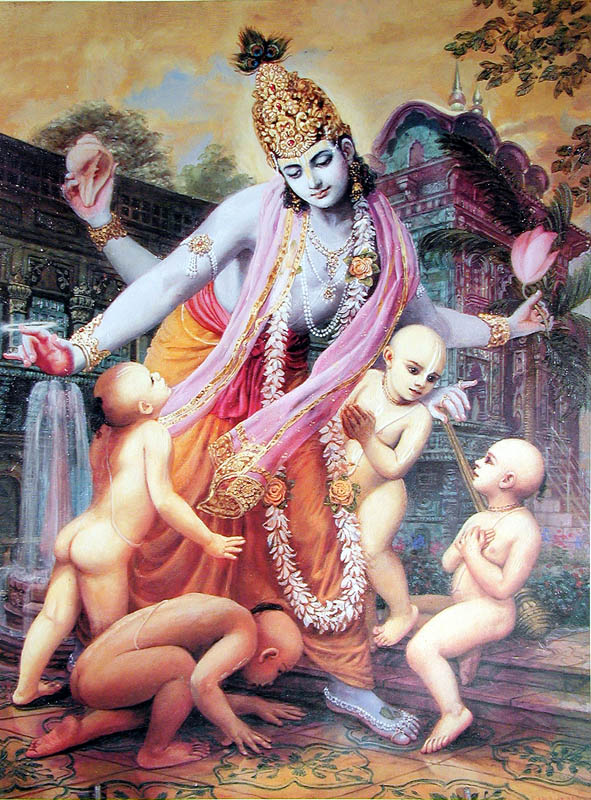
The four Kumaras are the eldest sons of the creator-god Brahma. When Brahma undertook the task of creation of the universe, he first created some beings from different parts of his body to aid him. The Kumaras was the first such beings. They were created from his mind and appeared as infants. Brahma ordered them to aid in creation, but as manifestations of Sattva (purity), and uninterested in worldly life, they refused and instead devoted themselves to God and celibacy, against the wishes of their father. The Bhagavata Purana narrates further that their refusal made Brahma angry and his wrath manifested into the god Rudra, also known as Lord Shiva. As per a variant, Brahma practised austerities (tapas) and pleased the Supreme God Vishnu, so he appeared in the form of the four infant Kumaras as Brahma’s sons.[8] Some texts like the Devi Bhagavata Purana and the Bhavishya Purana narrates the four Kumaras appeared even before the Brahma of the present age. (In a cycle of time, some texts say that a Brahma dies and is reborn.)
The four Kumaras learnt the Vedas at the age of four or five. They thus became great jnanis (learned beings), yogis and Siddhas (the perfect enlightened ones). The Kumaras remained in form of children due to their spiritual virtues. The age of the sages varies in various sacred texts. While five is the most popular, they are also mentioned as being fifteen- or sixteen-year-old youths. They practised the vow of renunciation (Sannyasa) and celibacy (brahmacharya) and remained naked.They wander together throughout the materialistic and spiritualistic universe without any desire but with purpose to teach. They are sometimes included in the list of Siddhars (Tamil equivalent for Siddha).
The four Kumaras are said to reside in Jana Loka or Janar loka (loka or world of the intellectuals in the present parlance) or in Vishnu’s abode Vaikuntha. They constantly recite the mantra Hari sharanam (Vishnu – “God the Redeemer our Refuge”) or sing Vishnu’s praises. These hymns and glories of Vishnu serve as their only food. Another son of Brahma, the sage Narada, who is described as their disciple, extolls their virtues in the Padma Purana. Narada says though they appear as five-year-old children, they are the great ancestors of the world.

The Bhagavata Purana narrates the visit of the four Kumaras to the court of King Prithu, the first sovereign in Hindu mythology and an avatar of Vishnu. The king worships the sages and asked them about the way of emancipation (moksha) that can be followed by all people who caught in the web of worldly things. Sanat-kumara tells the king that Vishnu is the refuge to all and grants liberation of the cycle of births and rebirths. His worship frees one from material desires and lust. One should be freed from material objects, lives a simple life of non-violence and devotion of Vishnu and follows the teachings of a good guru and undergo Self-realization. One should realize that all living things are forms of God. Without devotion and knowledge, humans are incomplete. Out of four purusharthas (“goals of life”), only moksha is eternal, while religious duty, wealth and pleasure decay with this life. While all beings are subject to destruction, the soul and God in our bodies is eternal. So it is paramount that one surrenders to God (as Vishnu or Krishna), said Sanat-kumara ending his counsel. Prithu worships the Kumaras again, who blessed him.
 Cú Chulainn 2 years, 5 months ago.