Home › Forums › Cool S~~~ & Fun Stuff › Friday Night Organ; Make mine a triple
This topic contains 5 replies, has 5 voices, and was last updated by

It’sallbs 1 year, 10 months ago.
- AuthorPosts
Tonight we have the trio sonatas by Bach. What is a trio sonata? Glad you asked. Beginning early in the 17th century there emerged a chamber music idiom that both exemplified some of the defining stylistic traits of the Baroque era and proved to be popular over the entire span of the era–the trio sonata. This multi-movement type of instrumental work involved two active and often contrapuntal treble lines played, most typically, by a pair of violins (but pairs of flutes, recorders or oboes could also be written for or used to substitute for the violins), and an anchoring bass line provided by a bass viol, violone, violoncello, or bassoon. The middle register between these extremes was filled in by an improvising harmony-producing instrument such as a small organ, a harpsichord or a theorbo. Together, the bass line and the improvised harmony part are referred to as the ‘basso continuo.’ Pairs of the first four instruments would be used for the treble range parts. The base line of the basso continuo could be rendered on any of the next three chordophones and aerophones in the pictorial inventory.
Despite the description above Bach’s trios are written for organ, not multiple instruments. This however does not invalidate the voicing arrangement outlined above. The organ is singularly capable of reproducing the treble lines played on the positive manual, the middle register harmony on the great manual and the base line in the pedal. There are 6 such trios each has three or four parts and below are all 6—yes I know its a bit long, but go put a log in fire place and grab a couple of beers and enjoy. (some of the individual parts are very short so if you blink you might miss it. (Example the Adagio from Nr.4 is 32 seconds)
1. BWV 525 — Organ Sonata No.1 in E-flat major – The Chapel of New College Oxford
2. BWV 526 — Organ Sonata No.2 in C minor – Cathedral at Ratzeburg Germany
3. BWV 527 — Organ Sonata No.3 in D minor – The Chapel of Knox Grammar School Sydney Australia
4. BWV 528 — Organ Sonata No.4 in E minor – DTTO
5. BWV 529 — Organ Sonata No.5 in C major – DTTO
6. BWV 530 — Organ Sonata No.6 in G major – Cathedral at Ratzeburg GermanyNice!! Do you mind if I join in?

Don't chase tail. Turn yours around, walk away, and live free!
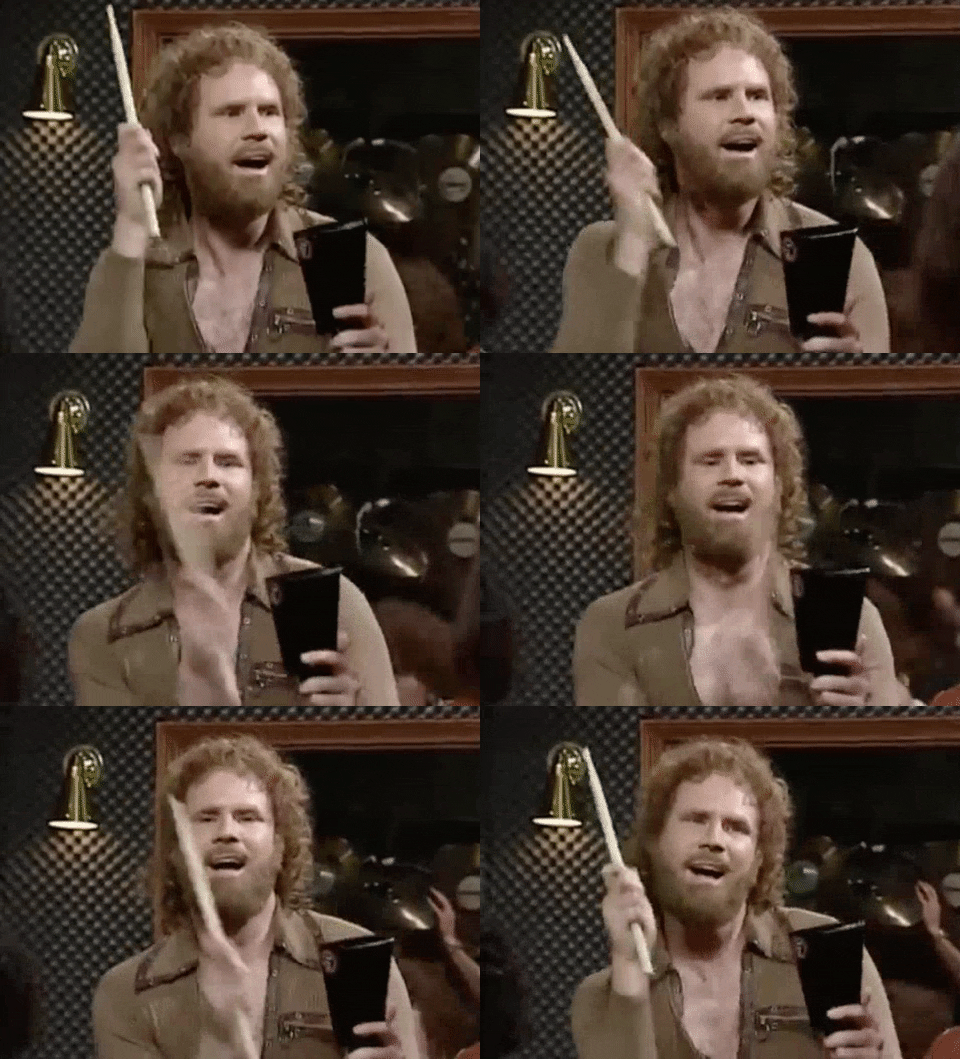
That guy is playing the one instrument I probably CAN play…cowbell
Love cowbells! So funky!
Don't let them Blame, Shame or Tame you!
Give 'em NOTHING, not even an answer!
#GenderSegragationNow!Wonderful. Thanks so much for sharing both the music and your introduction: as a musicologist, I can say that what you write is spot on.
I know its a bit long, but go put a log in fire place and grab a couple of beers and enjoy.
We live in a society which increasingly expects immediate gratification from everything. One of the great joys of the classical music tradition is that it doesn’t yield everything up immediately: it takes time to listen to it, and repeated listenings to get more out of it. I feel very few people understand this nowadays (including professional colleagues and my music students) other than my MGTOW brothers.
Enjoy, gentlemen!
There aren't holes in your pockets. It's called marriage.
- AuthorPosts
You must be logged in to reply to this topic.

921526
921524
919244
916783
915526
915524
915354
915129
914037
909862
908811
908810
908500
908465
908464
908300
907963
907895
907477
902002
901301
901106
901105
901104
901024
901017
900393
900392
900391
900390
899038
898980
896844
896798
896797
895983
895850
895848
893740
893036
891671
891670
891336
891017
890865
889894
889741
889058
888157
887960
887768
886321
886306
885519
884948
883951
881340
881339
880491
878671
878351
877678