This topic contains 3 replies, has 4 voices, and was last updated by  hollowtips 2 years, 10 months ago.
- AuthorPosts
China Begins Opening Up $9 Trillion Bond Market
China, the world’s third-largest bond market accounting for $9 trillion in debt instruments, has started the process of opening up to foreign investors.
Two major investment banks, including Citigroup, have announced plans to join the fray and several others are expectantly watching the unfolding situation.
It’s not a sudden desire to liberalise, but pressure from three fronts that has motivated Beijing’s communist leaders into this new and uncertain path.
1. Shrinking foreign capital inflows and expanding outflows as a result of a long term economic slowdown caused by a population contraction, higher wages, falling demand and too much debt incurred by the system (currently estimated at USD $40 trillion)
China has suffered some serious loss of capital because of uncontrolled outflows and a recent decline in its foreign direct investments, which saw a drop of 9.2 percent in January. The country also suffered its first trade deficit in three years last month.
2. Beijing’s inability to maintain adequate liquidity as seen from FOREX reserves dropping to USD$ 3 trillion (of which only 1 trillion is liquid). This is from the PBoC (People’s Bank Of China) propping up the renminbi (RMB) due to pegging against the US dollar to maintain economic viability. This reserve will vanish by the end of 2017.
To overcome the situation, Beijing recently allowed overseas investors to hedge their currency risks at the local derivative market. This partially opened the doors to foreign players and allowed strengthening of the renminbi through investments, This also alleviated currency risk as a major deterrent in the Chinese bond market.
“China’s purpose is to attract capital inflows from investors needing RMB assets for their portfolio,” said Jacob Kirkegaard, economist with the Peterson Institute of International Affairs. “This will also help to stabilise the RMB exchange rate.”
3. Capital flight from Chinese mainlanders trying to get their RMB assets out before the expected further devaluation of the renminbi. This offers the only way out for the PBoC when the FOREX reserves become inadquate to prop up the renminbi.
Chinese Premier Li Keqiang threw in a sweetener in mid-February, saying the government would launch a trial program to connect the bond market in mainland China with Hong Kong, which is the base of operations for a large number of foreign investors. The bond connect will make it easier for Hong Kong-based investors to access domestic Chinese instruments without leaving the city.
“I see that as a part of China of becoming a major player and becoming an important destination for financial investors, ” Lourdes Casanova, Director of Emerging Markets Institute at Cornell University’s SC Johnson School of Management, said.
4. A fourth reason which has been brought forward unintentionally – the desire to compete with the US bond market and achieve IMF ranking for the RMB as a secondary world reserve currency.
This move is also meant to promote the use of RMB as an international currency.This would create the dollar alternatives which will assist in shifting the wealth of the world. This shift will free the USD up for some much needed devaluation.
“These efforts indicate that China wants to assert its economic, business and financial power with all the inherent advantages and risks,” Casanova said.
The past few weeks have seen Bloomberg Barclays become the first major index provider to include Chinese yuan bonds in its global offerings. Citigroup has announced plans to embed China bonds into its bond market benchmark WGBI-Extended. JPMorgan Chase & Co., another index maker, said it is evaluating the entry of China markets into its JPMorgan Global Emerging Market Bond Index.
This is not surprising because on 1 October 2016, the RMB became the first emerging market currency to be included in the IMF’s Special Drawing Rights (SDR) basket, the basket of currencies used by the IMF to determine the composite value of the SDR.
China is negotiating for OPEC to trade in RMB – a series of deals and events have occurred in the past two years (ignored by Obama’s administration) between China and OPEC that may have cemented some sort of tentative deal. If the RMB was allowed to be traded for oil by OPEC there would be a seismic shift in the use of the US dollar as the world reserve currency. It may be this is part of Trump’s concern regarding relations with
the DevilSaudi ArabiaWith Trump perceived as aggressively pushing for an isolationist policy and the US dollar now in shortage the outcome for a full or a partial world trade recovery looks bleak. Unless this shortage is rectified – possibly by a secondary new reserve currency such as the RMB – world trade is not expected to recover.
There is currently a recovery of the US Treasury’s 10 and 30 year yields that affect the China offerings. The higher the US Treasury rates are – the lower the China rates (and investments) as a competing currency will be.

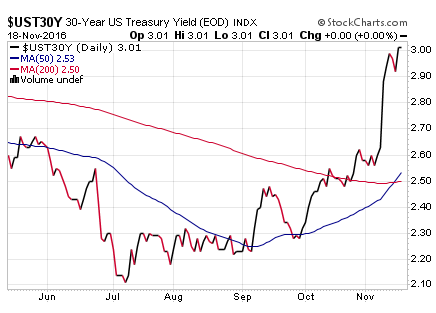
A continuing shortage of USD will cause a global recession.
In-lieu of a secondary reserve currency The IMF may then be forced to issue SDR’s (Special Drawing Rights or World Money) to governments as the trade alternative – which would end the US dollar hegemony in major financial markets around the world.
“There are global investors who wish to shadow the IMF SDR basket, and needs RMB exposure,” said Kirkegaard.
At present, foreign investments account for just about $120 billion, or 1.33 percent, of China’s bond market. But the situation is expected to change soon as investment banks and index makers have started the process of measuring steps before entering the market in a big way.
Given China’s role as the second-biggest economy, it is natural for Chinese investors to want Chinese bonds in their portfolio, Casanova said. In fact, foreign investors face fewer challenges in China’s bond market compared to what they are up to in other emerging markets, she said.
“Yes, there are many doubts, there are many doubts in many countries. I am European, I am from Spain, there are doubts about the viability of the euro. In the U.S. there are other types of worries,” she said adding, “That’s why also for the international investors, China is not as risky as it used to be.”
“Foreign investors will have to tread carefully because it is not easy to seriously analyse credit risk in China where the markets are not transparent and there is not much information available about issuers and major buyers of debt instruments” said Kirkegaard
“Their [foreign investors’] willingness to invest will be dependent on the implicit government guarantee against default as foreign investors won’t be able to seriously analyse credit risk in China,” he said.
Casanova sees the situation differently. She points out there are risks in most markets across the globe, and international investors will choose what suits them best.
Expected Real Risks of the Market
Still, policymakers need to take additional steps in areas such as market access, liquidity, and reporting rules to address concerns, Goldman Sachs Group Inc analysts said in a research note last month.
Deutsche Bank estimates China’s bond market will expand by 27% this year, making it as large as the nation’s Gross Domestic Product. Bloomberg Barclays Indices, owned by Bloomberg, included Chinese domestic bonds in some indexes on 1st March 2017.
This level of foreign investment will enable China to provide temporary relief to possible RMB devaluation from the economic downturn and pegging practice to the USD. However the attempt is risky and does not address the fundamental problems of the current downturn associated with a shrinking population and excessive debt.
The revenue situation may be actually exacerbated by this desperate measure in that at the end of the bond growth period or from impact by the US bond rates there might be large capital flights by foreign investors that would cause a bond market collapse.
In an comment shared by the Wall Street Journal, Hao Hong, co-head of research at Bocom International said that “People in China woke up to the fact that the bond bubble is too large. The bond market in China is under severe pressure, across the board.”
To exemplify the problem, a PBoC bond selloff started on 14th Dec 2016 when the US Federal Reserve raised rates. Chinese government bond futures plunged by 2% in the session (the biggest daily drop in history), and erased in a week the gains of the past 18 months, after previously hitting a 16 month high yield of 3.4%
The crash, however, was just the start of China’s woes, because what happened next spelt far more headaches for a market that is now in a “bursting bubble” mode.
As the WSJ reported, Chinese authorities halted trading in key bond futures for the first time next day, as panicky investors sold the securities on concern that a long, credit-fueled bull market was coming to an end amid slowing growth, capital outflows and heightened government concern about asset bubbles.
Exchange authorities had no choice but to suspend the securities to avert a selling panic. Trading resumed only after China’s PBoC came to the rescue – as it always eventually does – injecting $22 billion RMB into the short-term money market.
The furious selloff, captured in the chart above, began in late November and has accelerated this week on concerns of capital outflows, a hawkish Fed and rising inflationary pressures. A similar scenario may occur every time the US Fed raises rates.
As is widely known by now, China years of abundant, cheap credit have lead to a series of price bubbles in various asset classes from housing, to stocks, to commodities, to cars, to chickens, and now bonds. Many of these bubbles have burst dramatically over the last 18 months, with the crash in China’s stock markets last summer the most notable example.
These risks happening again is something the PBoC appears to be willing to take. Or perhaps they have no other choice.
The danger of countries with bond markets is to rely on them as the main source of fiscal funding – ignoring the production sectors to the point of dilapidation. There is then no resource sector to fall back on when bond markets crash – as they would from time to time.
It is viewed that a world secondary reserve currency – if applied correctly – would help regulate global fiat currency policy. However under the current circumstances the alternative appears just as risky, if not more. Still, there are those who would consider the risks as acceptable.
And therefore for an economy driven entirely by cheap, abundant credit, the consequences of the bursting of the bond bubble will only emerge as China’s economy – lubricated by said cheap credit – slows down dramatically, and the monetary effects will not be fully seen until a capital flight occurs – which in turn will spillover to both the global economy and other capital markets in a very sudden and unexpected contagion.
The only question left to answer is when.
Citations
http://www.zerohedge.com/news/2016-12-15/china-halts-trading-bond-futures-after-record-bond-market-crash
http://www.voanews.com/a/china-begins-opening-up-bond-market/3773419.html
http://www.businesstimes.com.sg/banking-finance/china-moves-to-make-64t-yuan-domestic-bond-market-more-global
Anonymous42I smell a bunch of banks diving in on promises like and empty pool in the debt of night. I’m not borrowing anymore money from them, my new tact is to downsize and eliminate the shortcomings that way.
I don’t like being the pump and dump for the entire financial institution, let them go f~~~ someone else!
I smell a bunch of banks diving in on promises like and empty pool in the debt of night. I’m not borrowing anymore money from them, my new tact is to downsize and eliminate the shortcomings that way.
I don’t like being the pump and dump for the entire financial institution, let them go f~~~ someone else!
This screams a pump and dump for the banks. China is might trying to get that last little bit of money before they lite the world war with the banks taking a bath on the bonds they bought from China.
Think about it. If one was going to expand a military one such weapon would be economic in the form of drying up liquidity of foreign banks to hurt foreign nations and weaken any military response.
After all, an army marches on its stomach.
Hopefully they don’t call for money from the loan they gave the U.S. if their economy is looking for rough times.
- AuthorPosts


You must be logged in to reply to this topic.

921526
921524
919244
916783
915526
915524
915354
915129
914037
909862
908811
908810
908500
908465
908464
908300
907963
907895
907477
902002
901301
901106
901105
901104
901024
901017
900393
900392
900391
900390
899038
898980
896844
896798
896797
895983
895850
895848
893740
893036
891671
891670
891336
891017
890865
889894
889741
889058
888157
887960
887768
886321
886306
885519
884948
883951
881340
881339
880491
878671
878351
877678