Home › Forums › Political Corner › A Review of Washington's World Order :Assets & Liabilities
This topic contains 6 replies, has 5 voices, and was last updated by  Y_ 1 year, 9 months ago.
- AuthorPosts
A Review of Washington’s World Order :Assets & Liabilities [1]
James Petras
The Unz Review
February 19, 2018James Petras is a retired Bartle Professor (Emeritus) of Sociology at Binghamton University in Binghamton, New York and adjunct professor at Saint Mary’s University, Halifax, Nova Scotia, Canada who has published on political issues with particular focus on Latin America and the Middle East, imperialism, globalization, and leftist social movements
Petras is the author of more than 60 books published in 29 languages, and over 600 articles in professional journals, including the American Sociological Review, British Journal of Sociology, Social Research and Journal of Peasant Studies. He has published over 2,000 articles in publications such as the New York Times, The Guardian, The Nation, Christian Science Monitor, Foreign Policy, New Left Review, Partisan Review, Canadian Dimension, and Le Monde Diplomatique.

The US empire spans the globe; it expands and contracts, according to its ability to secure strategic assets, willing and able to further military and economic power to counter emerging adversaries.
The map of empire is a shorthand measure of the vectors, reach and durability of global power and wealth. The map of empire is changing — adding and subtracting assets and liabilities, according to the successes and retreats of domestic and overseas power centers. While the US empire has been engaged in intense conflicts in the Middle East, the imperial map has been enlarged elsewhere at lower cost and greater success.
Enlarging the Empire
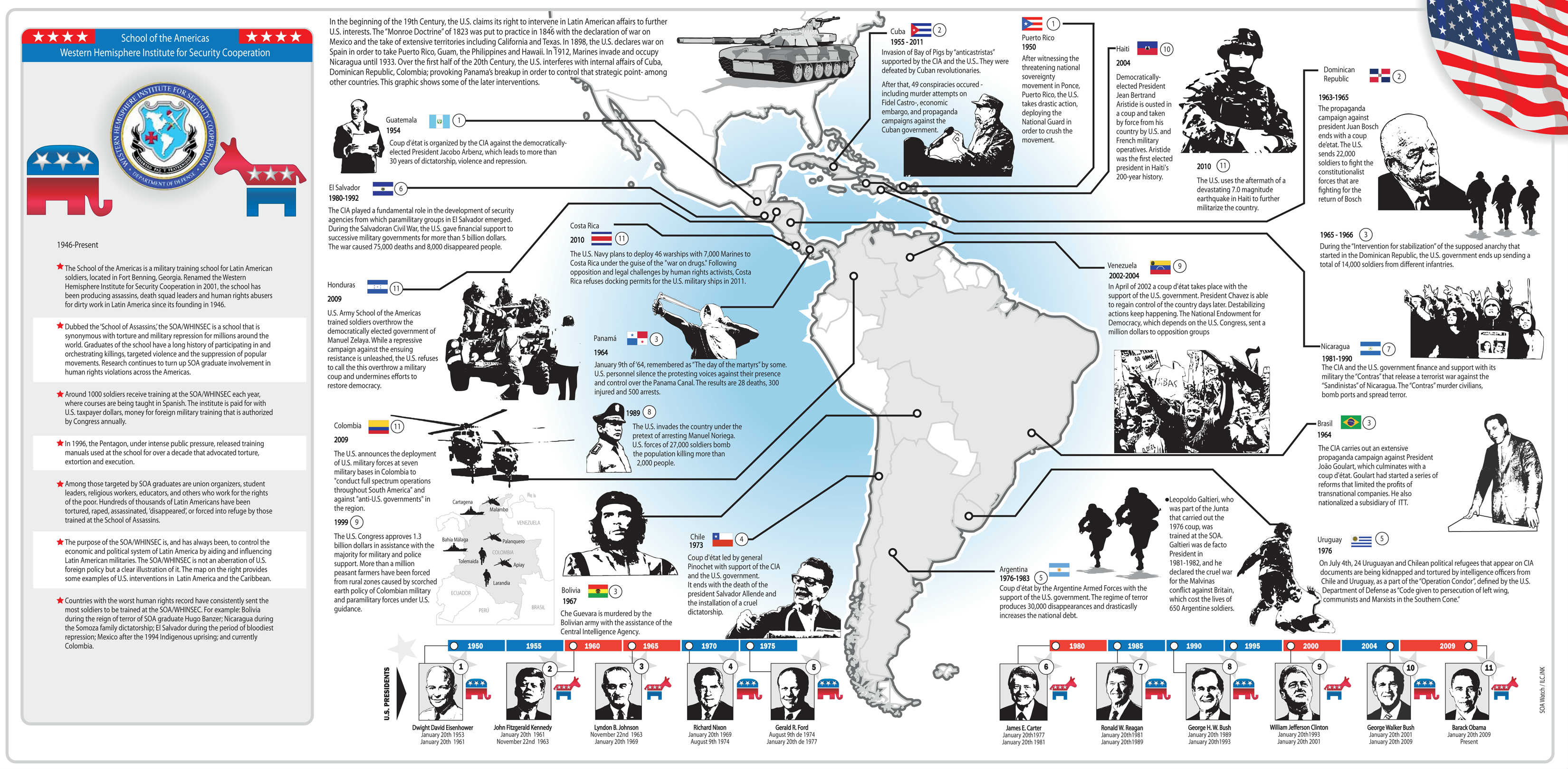
The US empire has substantially increased its scope and presence in several regions, especially in Latin America. The additions and enlargements include Argentina, Brazil, Colombia, Mexico, Central America, Peru and the Caribbean. The most important asset redrawing the empire in Latin America is Argentina. The US has gained military, economic and political advantages. In the case of Argentina, political and economic advances preceded military expansion.
The US provided ideological and political support to secure the election of its client Mauricio Macri. The new Argentine President immediately transferred over $5 billion dollars to the notorious Wall Street Vulture speculator, Paul Singer, and proceeded to open the floodgates for a lucrative multi-billion dollar flow of financial capital. President Macri then followed up by inviting the Pentagon and US intelligence services to establish military bases, spy stations and training operations along its borders. Equally important, Argentina embraced the US directives designed to overthrow the government of Venezuela, undermine Bolivia’s nationalist government under Evo Morales and pursue a policy of US-centered regional integration.
Bigger Map http://files.abovetopsecret.com/files/img/dl534c66cd.jpgArgentina: A Client without an Economic Patron
While Argentina is a useful political and military addition to the US empire, it lacks access to the US market — it still depends on China – and has failed to secure a strategic trade agreement with the European Union. Washington has enlarged its military presence with a one-legged client.
Colombia and Mexico, long time US client states, have provided springboards for enlarging US influence in Central America, the Andean region and the Caribbean. In the case of Colombia, the US has financed its war of extermination against anti-imperialist insurgents and their peasant and working class supporters and secured seven military bases as launch pads for Washington’s destabilization campaign against Venezuela.
Mexico has served a multitude of military and economic functions – from billion dollar manufacturing platforms to multi-billion dollar laundering of narco-profits to US banks.
Brazil is the new addition to the empire with the ousting and arrest of the leaders of the Workers Party. The shift in political and economic power has enhanced US influence through its leverage over the wealthiest country in the continent. In sum,the US has enlarged imperial influence and control via its acquisition of Latin America. There is one caveat: At least in the cases of Brazil and Argentina, the US advance is tentative and subject to reversal, as it lacks firm economic and political foundations.
If Latin America reflects an enlargement and upsurge of US imperial influence, the rest of the global map is mostly negative or at best – contradictory.
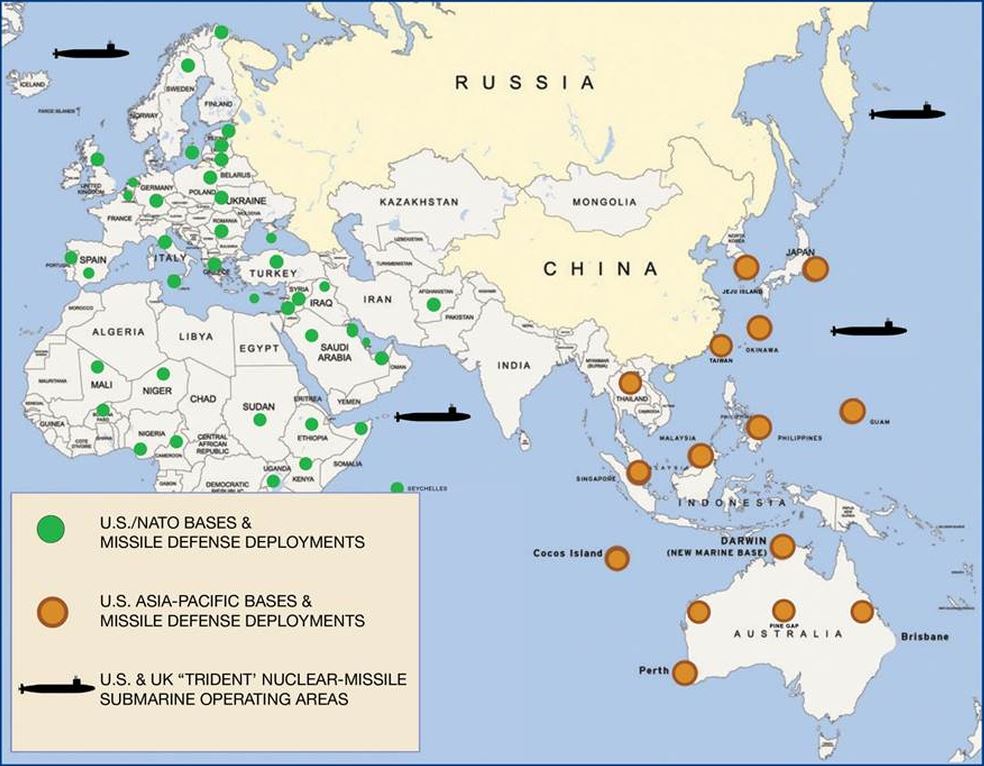
The empire-building mission has failed to gain ground in Northeast Asia, the Middle East and North Africa. In Europe, the US retains influence but it appears to face obstacles to enlarging its presence.
The key to the enlargement or decline of empire revolves around the performance of the US domestic economy.
Imperial Decline: China
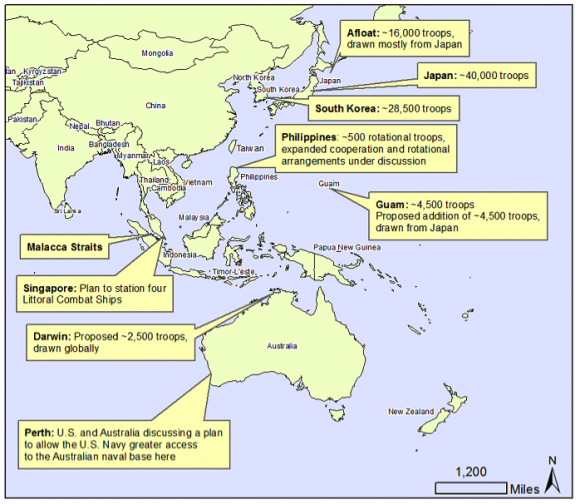
The determination of the US in remapping the global empire is most evident in Asia. The most notable shift in US political and economic relations in the region has taken place with China’s displacement of the US as the dominant investment, trading infrastructure building and lending country in the region.
Moreover, China has increased its role as the leading exporter to the US, accumulating trade surpluses of hundreds of billions of dollars each year. In 2017, China’s trade surplus reached $375 billion dollars.
Against the relative economic decline of the US, Washington has compensated by widening the scope of its maritime-military presence in the South China Sea, and increased its air and ground forces in South Korea, Japan, Australia, the Philippines and Guam.
As to how the bolstering of the US military presence affects the US ‘re-mapping’ of its imperial presence, it depends on the dynamics of the US domestic economy and its ability to retain its existing principal military clients – South Korea, Japan, Australia and the Philippines.
Recent evidence suggest that South Korea shows signs of slipping outside of the US economic and military orbit. Seoul has trade issues with the US ‘protectionist agenda’ and opportunities to expand its trading links with China.
Equally important, South Korea has moved toward reconciliation with North Korea, and downgraded the US military escalation. As goes South Korea, so goes the US military power base in northern Asia.
The US military strategy is premised on sustaining and expanding its client network. However, its protectionist policies led to the rejection of a multi-lateral trade agreement, which erodes its economic ties with existing or potential military partners.
In contrast to Latin America, the US remaking of the imperial map has led to economic shrinkage and military isolation in Asia. US military escalation has poured even more deadly strategic US arms into the region, but failed to intimidate or isolate China or North Korea.

Re-mapping the Middle East
The US has spent several trillion dollars over the past two decades in the Middle East , North Africa and West Asia. US Intervention from Libya and Southern Sudan, Somalia, across to Syria, Palestine, Iraq, Iran and Afghanistan has resulted in enormous costs and dubious advances. The results are meagre except in terms of suffering.
The US has spread chaos and destruction throughout Libya and Syria, but failed to incorporate either into an enlarged empire.
The Middle East wars, initiated at the behest of Israel, have rewarded Tel Aviv with a sense of invulnerability and a thirst for more, while multiplying and unifying US adversaries.
Empires are not effectively enlarged through alliances with with armed tribal, sectarian and separatist organizations. Empires, allied with disparate, fractured and self-aggrandizing entities do not expand or strengthen their global powers.
The US has waged war against Libya and lost the political leverage and economic resources it enjoyed during the Gaddafi regime. It intervened in Somalia, South Sudan and Syria, and has gained enclaves of warring self-serving ‘separatists’ and subsidized mercenaries. Afghanistan, the US’s longest war in history, is an unmitigated military disaster. After seventeen years of warfare and occupation, the US is holed up in the walled enclaves of the capital, Kabul. Meanwhile, the puppet regime feeds on multi-billion dollar monthly subsidies.
Iraq is a ‘shared’ imperial outpost — the result of fifteen years of military intervention. Kurdish clients, Sunni-Saudi warlords, Shia militia, Baghdad kleptocrats and US contractor-mercenaries all compete for control and a larger piece of the pillage. Every square meter of contested ‘terrain has cost the US five hundred million dollars and scores of casualties.
Iran remains forever under threat, but retains its independence outside of the US-Saudi-Israeli orbit. The US geo-political map has been reduced to dubious alliance with Saudi Arabia and its micro-clients among the Emirate statelets – which are constantly fighting among themselves – as well as Israel, the ‘client’ that openly revels in leading its patron by the nose!
Compared to the period before the turn of the millennium, the US imperial map has shrunk and faces further retrenchments.

The US-NATO-EU Map
Russia has reduced and challenged the US pursuit of a uni-polar global empire following the recovery of its sovereignty and economic growth after the disaster of the 1990’s. With the ascent of President Putin, the US-EU empire lost their biggest and most lucrative client and source of naked pillage.
Nevertheless, the US retains its political clients in the Baltic , the Balkans and Eastern and Central European regimes. However, these clients are unruly and often eager to confront a nuclear-armed Russia, confident that the US-NATO will intervene, in spite of the probability of being vaporized in a nuclear Armageddon.
Washington’s efforts to recapture and return Russia to vassalage have failed. Out of frustration Washington has resorted to a growing series of failed provocations and conflicts between the US and the EU, within the US between Trump and the Democrats; and among the warlords controlling the Trump cabinet.
Germany has continued lucrative trade ties with Russia, despite US sanctions, underscoring the decline of US power to dictate policy to the European Union. The Democratic Party and the ultra-militaristic Clinton faction remains pathologically nostalgic for a return to the 1990’s Golden Age of Pillage (before Putin).
Clinton’s faction is fixated on the politics of revanchism . As a result, they vigorously fought against candidate Donald Trump’s campaign promises to pursue a new realistic understanding with Russia. The Russia-Gate Investigation is not merely a domestic electoral squabble led by hysterical ‘liberals.’ What is a stake is nothing less than a profound conflict over the remaking of the US global map.
Trump recognized and accepted the re-emergence of Russia as a global power to be ‘contained’, while the Democrats campaigned to roll-back reality, overthrow Putin and return to the robber baron orgies of the Clinton years. As a result of this ongoing strategic conflict, Washington is unable to develop a coherent global strategy, which in turn has further weakened US influence in the EU in Europe and elsewhere.
Nevertheless, the intense Democratic onslaught against Trump’s initial foreign policy pronouncements regarding Russia succeeded in destroying his ‘pivot to realism’ and facilitated the rise of a fanatical militaristic faction within his cabinet, which have intensified the anti-Russia policies of the Clintonite Democrats.
In less than a year, all of Trump’s realist advisers and cabinet members have been purged and replaced by militarists. Their hard core confrontational anti-Russia policy has become the platform for launching a global military strategy based on vast increases in military spending, demands that the EU nations increase their military budgets, and open opposition to an EU-centered military alliance, such as the one recently proposed by French President Emmanuel Macron.
Despite President Trump’s campaign promises to ‘pull-back’, the US has re-entered Afghanistan, Iraq and Syria in a big way. The Trump shift from global containment and realism to ‘rollback and aggression’ against Russia and China has failed to secure a positive response from past and present allies.
China has increased economic ties with the EU. Russia and the EU share strategic gas and oil trade ties. Domestically, the US military budget deepens the fiscal deficit and drastically threatens social spending. This creates a scenario of increasing US isolation with its futile aggression against a dynamic and changing world.
Conclusion
The Trump remaking of the global empire has had uneven results, which are mostly negative from a strategic viewpoint.
The circumstances leading to new clients in Latin America is significant but has been more than countered by retreats in Asia, divisions in Europe, turmoil domestically and strategic incoherence.
Remaking global empires requires realism – the recognition of new power alignments, accommodation with allies and, above all, domestic political stability balancing economic interests and military commitments.
The key shift from realism toward a recovered Russia to militarization and confrontation has precipitated the breakdown of the US as a unified coherent leader of a global empire.
The US embraces prolonged losing wars in peripheral regions while embracing destructive trade wars in strategic regions. It budgeted vast sums on non-productive activities while impoverishing state and local governments via sweeping tax ‘reform’ favoring the oligarchs.
Global remapping now involves a volatile and impulsive US-driven empire incapable of succeeding, while emerging powers are immersed in regional power grabs.
There is no longer a coherent imperial empire controlling the fate of the globe. We live in a world of political maps centered on regional powers and unruly clients, while the most incompetent, gossip-mongering politicians in Washington compete with an arrogant, benighted President Trump and his fractured regime.
James Petras
The Unz ReviewCitation
http://www.unz.com/jpetras/mapping-trumps-empire-assets-and-liabilities/When is comes to domestic matters, for the last forty years, until President Trump, debt was considered an asset and U.S. citizens being employed was considered a liability.
By the way, the top article lies and pretends China is contracting, when China is expanding with its Silk Road and String of Pearls project. At the same time it pretends President Trump’s actions without motive, such as the tens of millions of U.S. citizens whom voted for President Trump for their own future.
In summary, the top article is a globalist crying in his wine that the U.S. will no longer willing impoverish its population to enrich the globalists.
And?
What is gonna change?
And who is gonna change it?
Not me, I’m out.
To those following me, be careful, I just farted. Men those beans are killers.
And?
What is gonna change?
And who is gonna change it?
Not me, I’m out.
Carnage, look at this way. A lot of the people writing against nationalism are heavily invested in the current globalists economic framework. If the boat rocks on globalism, they could lose their shirts.
Empires always go broke and collapse. We don’t need to be in 95% of those places. China wants to play the empire game? Good for them…learn the hard way guys.
It is long past time for the US to withdraw from these places.
Anonymous1Yeah, the USA is destroying itself by trying to be an Empire. The Project for A New American Century (PNAC) has successfully destroyed the United States that I grew up in. Its not even the same country anymore. The NEOCONS killed it.
By the way, the top article lies and pretends China is contracting, when China is expanding with its Silk Road and String of Pearls project.
Apologies. Nowhere does the article categorically state or imply that China is contracting.It implied the opposite as you mentioned.
At the same time it pretends President Trump’s actions without motive, such as the tens of millions of U.S. citizens whom voted for President Trump for their own future.
The article points out the inconsistencies in US policy since the Trump Administration took office. The issues are real. How the current US policies relate Trump’s voter base is not the purpose of this article.
In summary, the top article is a globalist crying in his wine that the U.S. will no longer willing impoverish its population to enrich the globalists.
The article is neither globalist or isolationist. It states a number of points on current US ‘policy’ and known outcomes.
- AuthorPosts



You must be logged in to reply to this topic.

921526
921524
919244
916783
915526
915524
915354
915129
914037
909862
908811
908810
908500
908465
908464
908300
907963
907895
907477
902002
901301
901106
901105
901104
901024
901017
900393
900392
900391
900390
899038
898980
896844
896798
896797
895983
895850
895848
893740
893036
891671
891670
891336
891017
890865
889894
889741
889058
888157
887960
887768
886321
886306
885519
884948
883951
881340
881339
880491
878671
878351
877678