- Search Results
How Trump outfoxed the Deep State on the Budget
Brian Maher
Managing Editor
The Daily Reckoning
“Democracy is the theory that the common people know what they want and deserve to get it good and hard,” said Baltimore’s own H.L. Mencken.
The American people are about to get it — good and hard…
The President signed a budget-busting $1.3 trillion “omnibus” spending bill Friday — the second largest ever of its kind.
American democracy will glory in even more spending… even more boondoggles… even more cronyism… even more debt.
As with P.T. Barnum’s circus, there is something for everyone…
The bill authorizes a 10% “defense” increase — $80 billion more than previously authorized spending levels…
And an extra $63 billion for domestic spending of every cut and flavor.
There’s the infrastructure, of course.
But also funding to battle the opioid epidemic currently ravaging the land.
21st Century Community Learning Centers nationwide will dip their hands deeper into the national collection plate.
We are not certain how these differ from 20th century learning centers— but let it pass.
Meanwhile, Planned Parenthood also extends its claim upon the American taxpayer.
The National Endowments for the Arts and Humanities will enjoy a $3 million boost.
We could continue… but mercy forbids it.
The bill’s additional $143 billion piles atop the existing federal deficit that already stretches to the sky.
Democrats declared immediate victory.
Nancy Pelosi and Chuck Schumer exulted the bill’s “job-creating, lifesaving investments.”
Not only does the bill protect Obama’s spending priorities, says Politico, it “expands them.”
Conservative National Review declared it “the sort of legislation that would have been right at home in the Obama administration.”
Just so.
But the swamp got in a good belly laugh at Mr. Trump’s expense.
The bill denies Trump funding for “the wall.”
The $1.6 billion the bill allocates was already agreed to and is mostly to patch existing fencing.
“I will never sign another bill like this again,” thundered the President.
Why did he sign it at all?
We can reduce the answer to two words:
The Swamp.
Written in complete secrecy, Congress heaved up the 2,232-page methane cloud just 52 hours before Friday’s government “shutdown” deadline.
No one had time to read it.
Had Trump failed in his signatory duty, parts of the United States government would have gone dark.
And Trump would not have gotten his beloved defense spending.
If you think the timing is coincidence… we suggest you climb back aboard the turnip truck from which you tumbled.
Politico:
The bill was crafted behind closed doors by congressional leaders — most back-benchers had less than a day to read its 2,232 pages — so it’s hard to say how much of it reflects genuine Republican enthusiasm for big government and how much reflects a political decision to cave to Democrats to avoid a shutdown on Trump’s watch.
And so we find American democracy cloaked in its overcoat of glory.
Surely Jefferson smiles down from his celestial Monticello.
Ah, but we had our agents give the bill a thorough ransacking over the weekend.
And their research turned up a wild card… a joker in the deck Trump could use to shock his opponents…
In December 2017, Trump declared a human rights emergency that broadly empowers the federal government to crack down on, say, human trafficking or drug smuggling.
And on Friday, Trump notified Congress that he’s invoking the Balanced Budget and Emergency Deficit Control Act of 1985.
These two facts, says John Salisbury — a a fellow who spent 30 years in government — “opens up new options.”
Congress allocates money to be spent, yes. But the president spends the allocated money, he reminds us.
Congress can’t say how the money is spent — as long as the spending is legal.
Salisbury on the implications:
By making these two declarations, President Trump has just communicated that he has the authority to NOT spend any funds he doesn’t deem necessary and will return them to the U.S. Treasury. So funds for Planned Parenthood? He can simply not allocate the funds…
If he determines that building a wall on the southern border is a defense against human trafficking? He can move funds from anywhere else in the Defense Department allocation and simply build the wall.
Congress is powerless to stop cash reallocations on an omnibus bill AND cannot stop the Defense Department from taking measures under a declared emergency. Despite their language in the omnibus bill about the border wall, it is trumped by the state of emergency that Trump declared.
Salisbury concludes:
I’ve worked for government for 30 years and I’ve never seen ANYONE making the moves he’s making right now.Is Trump preparing to strike back against the swamp to fund his wall?
Who is doing what in Syria and why Part 1 of 3
by Ghassan Kadi for The Saker Blog [1]
10th February 2018Ghassan Kadi is a Syrian reporter and activist who’s work is published regularly in internet sites such as The Saker Blog, Geopolitica RU, The International Reporter, The Syrian Free Press and many others
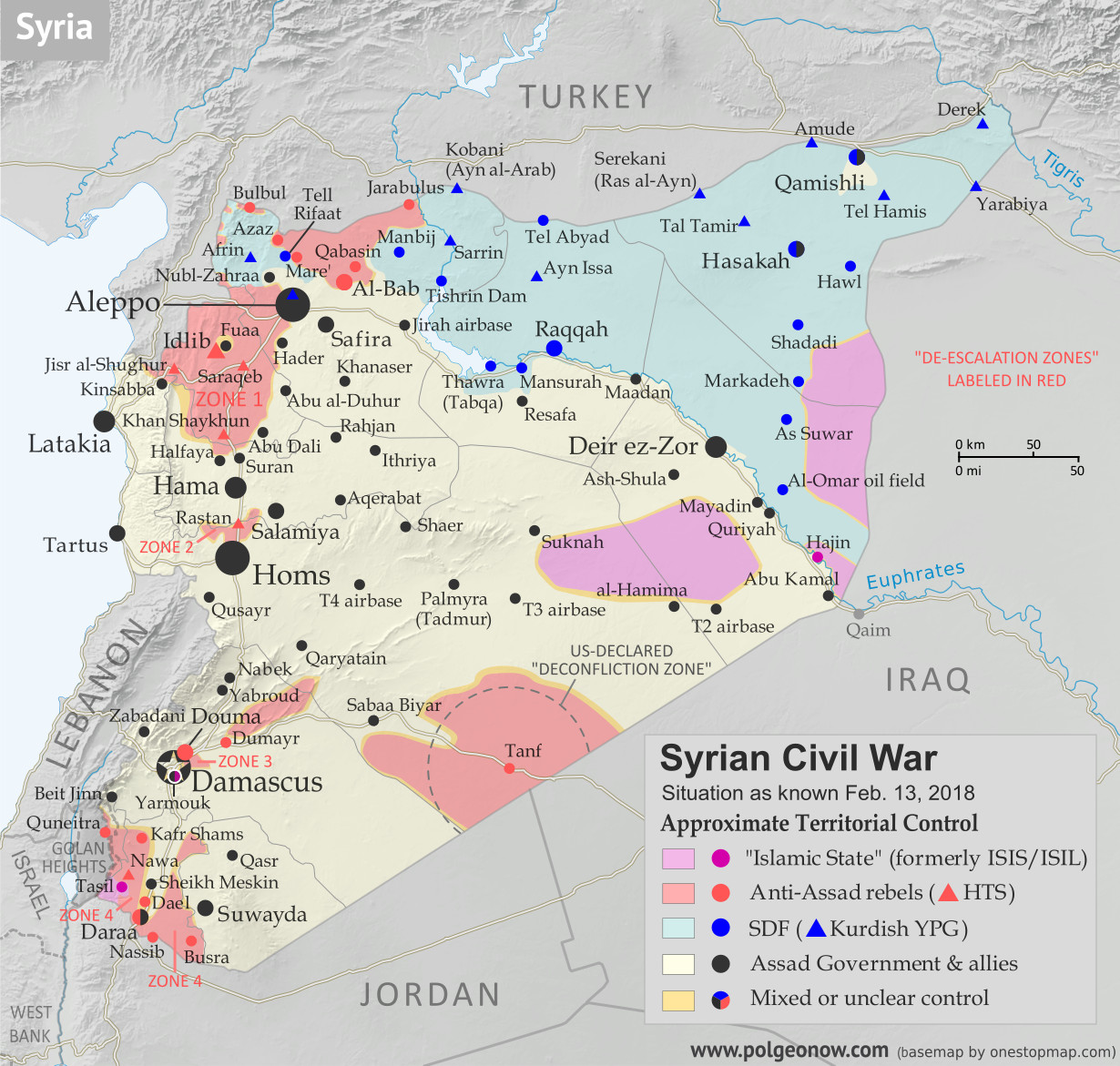
It seems that every time a chapter in the war on Syria comes to an end, a new factor surfaces. Just like the 1975-1989 civil war in Lebanon before it, and which started off with a clash between the PLO and the Lebanese rightwing Phalangist militia and then ended up with an Israeli invasion and its aftermath, the war on Syria is now a totally different war from the one that started seven years ago.
With other players gone or having their roles changed, the only persisting player is the Syrian Army [SAA] of course, fighting here for the integrity and sovereignty of Syria. We cannot include its allies, because even its allies have changed.
There is much speculation about recent events, a lot of war and fear-mongering, but if all elements of the current powers on the ground are dissected and analyzed, it becomes very easy to see what is going on and who is doing what.
Before we try to understand who is doing what and why, let us first identify who are the main players on the ground and behind the scenes; past and present. This is a short list:
Syria of course
Saudi Arabia
Qatar
Kurds
Turkey
Iran
Hezbollah
Israel
the USA [and vassal states]
RussiaNotwithstanding the inevitable continuing role and presence of Syria and popular national Syrian allied forces in the war against her, we must acknowledge that Saudi Arabia and Qatar have already played their role and walked away as losers. For the sake of historic documentation, this had to be mentioned even though they do not have much of an influence and clout at all at present.
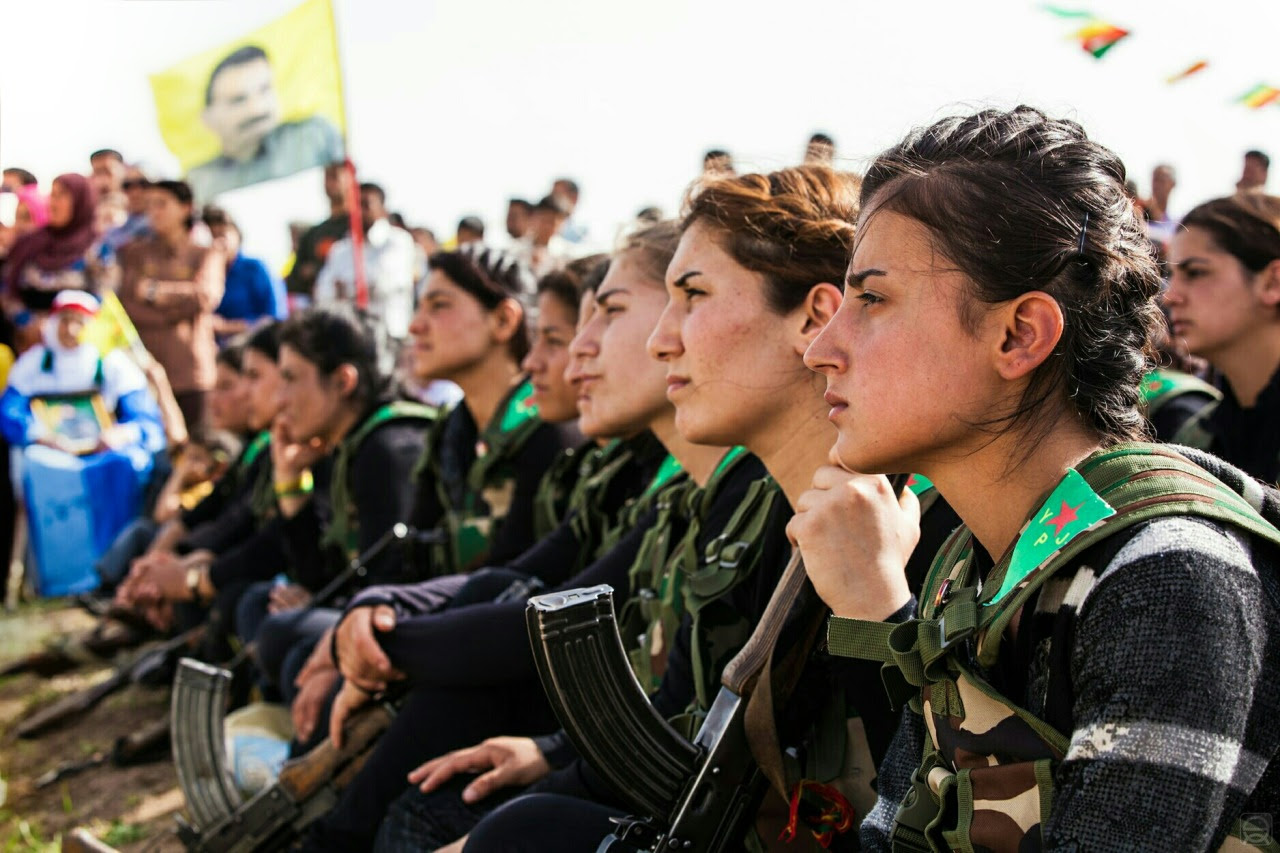
Kurds are playing a role that cannot be discussed without acknowledging the role they played between 2011 and 2015/16. Kurdish fighters, separatists or otherwise, have upheld Syrian border integrity in Syria’s north from as early as 2011 when the Syrian Army had no allies on the ground. And even though the Syrian Army and Kurdish fighters did not fight physically within the same trench, the Kurds fought fiercely in the north, holding their ground, against Turkish-facilitated incursions and against ISIS later on.
However, as Kurdish separatist movements were established and as they were not preemptively contained under the roof of Damascus, something had to give.
Kurds who are separatists will do anything and make deals with anyone to make their dream come true. History has shown that they are prepared to join hands with America and even Israel.
It must be acknowledged however that Kurds who are not separatists, and there is no way of telling their percentage any more than there is a way of telling the percentage of those who are, do not seem to have much of a voice in their community.
Furthermore, seemingly there isn’t an all-inclusive nationally-endorsed rationale where they can address their concerns against those who are separatists and in a manner that can allay their fears and apprehensions as a minority group in such a way that would quell their desire for independence.

Turkey’s role has been changing with the tides in the last seven years. From wanting to topple the Syrian Government and Erdogan praying at the Omayyad Mosque as the conqueror of Damascus, Erdogan is now in a much more humble damage-control mode hoping to at least be able to prevent the formation of a Kurdish state south of his borders.
The turn of events in the war, and the bargain plea reconciliation he has had with Russia after Turkey downed a Russian Su-24 in Nov 2015 has put Erdogan in that position. But Erdogan, the compulsive Islamist and nationalist, will always try to look for opportunities to turn and stab anyone in the back because his dreams of a great Turkey-based Muslim sultanate are bigger than any deal and treaty he signs with anyone.
That said, Erdogan will not settle for any outcome that will mean the establishment of a Kurdish state. Unless the tides change in his favour, it is highly unlikely that he will change course and demand more.
In effect, the war in northern Syria is more or less totally separate from the one heating up in the south with Israel.

Iran: The Syrian theatre has brought Iran physically closer to Israel in a manner that opened up a new border line that is bigger than the one Hezbollah has in Southern Lebanon. Israel does not have the reciprocal privilege.
That said, whilst Israeli presence is not officially recognized in states like Qatar, Saudi Arabia and the UAE, there is little doubt that the Eastern coast of the Persian/Arabian Gulf is under Israeli direct or indirect control in more ways than one.
That said, it must be remembered that Iran’s issue with Israel is doctrinal and not territorial.
In brief, Iran’s military presence in Syria is in adherence to the common defense treaty it has with Syria, but it is also aimed at protecting Iran’s own interests and establishing military presence and rocket-launching capabilities that are only a few kilometers from major Israeli cities in comparison to the one thousand or so kilometers that separate Israel from Iran, or at best a couple of hundred that separate the east coast of the Persian/Arab Gulf from Iran’s southern cities.
Given that Iran is not a nuclear power and Israel is, based on the above, any conventional military confrontation with Israel will put Iran in a position of advantage.
Iran’s status in Syria can be either seen as offensive or defensive vis-à-vis Israel. Most likely, it is defensive, and Iran is unlikely to use its Syrian-based positions to initiate an unprovoked attack on Israel given Israel’s nuclear deterrence.

Hezbollah: In more ways than one, ideologically-speaking, Hezbollah is an extension of Iran. But strategically-speaking, Hezbollah is a part of the Lebanese political process. Moreover, Hezbollah’s issue with Israel is both doctrinal, and territorial.
Hezbollah went into Syria to defend Syria of course, but in defending Syria, Hezbollah was defending itself and Lebanon.
The supply lines for Hezbollah came from Syria, and this is no secret. But even if Hezbollah had to establish alternative routes after seven years of war, Hezbollah remains dependent on Syria for ensuring the depth of its survival and ability to fight. Even if Hezbollah went further and managed to establish its own military manufacturing base, and this is not unlikely, it remains entwined with Syria at levels that are essential for its survival and continuity.
Ideologically, Hezbollah is perhaps closer to Iran than any other ally, but strategically, it cannot be closer to any other ally more than Syria. To expect Hezbollah to yield to pressure and withdraw from Syria prematurely is tantamount to expecting North Korea to surrender its nuclear arsenal.
Israel: It wouldn’t be surprising to say that the post-Kissinger USA has left Israel feeling secure and privileged to the extent that it was able to coerce the world’s single superpower to rubber-stamp what suited it; even if it was against the interests of that superpower.
However, with all the support America gave Israel, Israel was not able to find peace, real lasting peace. Military superiority and peace are two different things, and America was able to provide Israel with the former, but not the latter.
But even that military superiority that meant once upon a time that Israel was untouchable has been eroded. The rise of Hezbollah to power in a manner that enabled it to bomb “Haifa and beyond” in July 2006 has sent shivers down the spines of Israeli military strategists.
Israel now has no idea what to expect if and when another military escalation ensues with Hezbollah and it is bracing for the worst.
Given the latest confrontations with the Syrian air defenses, Israel seems to be in a similar position in not knowing what to expect from Syria either.

The USA: In all what the USA has done in supporting the initial Saudi/Qatari/Turkish attack in the war on Syria, it achieved nothing more than defeat after defeat.
If there was ever a time during the last seven years for America to launch a major attack on Syria, it would have been done on the pretext of a chemical weapon attack allegedly perpetrated by the Syrian Army on Eastern Ghouta, but Obama did not take the Saudi-orchestrated bait.
If Obama took a single and somber decision for which he will be positively remembered once all the dust has settled, it will have to be his decision not to attack Syria in early September 2013.
But Trump’s America inherited a Syria in which America has no presence or influence. The ailing nation cannot be seen to be standing still doing nothing about this.
Russia: Discussing the role of Russia was left till the end because to emphasize once again, as per previous articles, that the role of Russian diplomacy is becoming increasingly important in Syria and the Levant in general.

To put all of the above into a realistic perspective, there is a potential war brewing in southern Syria, a war that has little to do with the one raging in the north, and only Russia has the potential of dealing with the conflict.
There is no speck of doubt in my mind that Russia has a Middle East peace plan.
There is no doubt in my mind that Russia wants to catapult America out of its role as the Middle East peace talk negotiator; a role that it played for more than four decades now without any scores on the board.
It must be remembered that despite all the concessions PLO leaders gave Israel, America was unable to provide any peace to Palestine, and not even to Israel for that matter. It is highly likely that even Israel is growing tired of America’s elusive promises of peace; and the peace Israel was promised was based on quashing the axis of resistance and establishing toothless puppet Arab regimes that dance to America’s tune, and who would normalize relationships with Israel and not pose any threat at all, not now, not in the future.
So Russia is strengthening her position in the Middle East in preparation for the opportune moment to elevate herself to be accepted by all parties concerned as the single arbitrator who is capable of negotiating an all-inclusive deal.
The rest is simply posturing.
The recent escalation between Syria and Israel is not a prelude for a bigger war. Nobody wants a war; not right now, as they are all aware of the damage that can be inflicted upon them.
Israel keeps testing the waters, testing Syria’s air defense capabilities, and above all, testing Russia’s resolve and determination to create a true balance of power in the Middle East.
Some Arabs would be disappointed that Russia would not allow the total destruction of Israel, but Russia has never promised this. On the other hand however, Russia is pushing Israel to be realistic, and has never promised Israel total and unconditional support like the USA did since the days of Kissinger.
Unless Israel can safeguard itself against Hezbollah rockets, and which it can’t, it will never initiate an all-out war with either Syria, Hezbollah, or both; not forgetting the Iranian presence on the ground in Syria, just outside Israel’s borders.
Israel has to either accept that the rules of the game have changed, or risk an escalation that will inflict huge damage on its infrastructure and civilians. The recent downing of an Israeli F-16 by Syrian air defenses and the subsequent call Netanyahu made to Russian President Putin is a clear indication that Israel is not happy with the fact that Russian arm supplies to Syria are changing the balance of power.
An astute look at recent events can only propose that Russia is trying to drag Israel into peace talks that are based on a regional balance of power, but Israel is not convinced yet that it has to do this anymore than it is convinced that it has lost its military upper hand. On the other hand, Russia will find it very difficult to convince Syria, Hezbollah and Iran that they should have any peace at all with Israel.
All the while, America realizes that it has no presence in the war in the south, and is using the Kurdish pretext to have “a” presence in the north in order not to miss out on being party to any settlement.
Erdogan is doing his bit to prevent the creation of a Kurdish state in Syria. Other than that he has no role to play in the potential brewing conflict in the south.
At the end, America will stab the Kurds in the back like it did many times earlier, the Kurdish aspirations for independence will be pushed back for many decades, and the real focus will be on the south, on Russia’s yet undeclared role and plan for a Middle East peace plan.
End of Part 1
Citation
[1]http://thesaker.is/who-is-doing-what-in-syria-and-why/Topic: John Huber
U.S. attorney for Utah is investigating GOP-raised concerns about the FBI surveilling Trump aide and about Clinton’s uranium ties
U.S. Attorney General Jeff Sessions said in a letter to some congressional leaders Thursday that he appointed senior federal prosecutors — led by Huber — to review concerns raised by Republicans that the FBI ignored those issues while focusing on investigating the Trump campaign for possible collaboration with Russia.
——–I have little faith in Sessions,….not going to appoint a second special investigator.mgtow is its own worst enemy- https://www.campusreform.org/









.png?1442200509)


925069
924988
922113
921526
921524
919244
916783
915526
915524
915354
915129
914037
909862
908811
908810
908500
908465
908464
908300
907963
907895
907477
902002
901301
901106
901105
901104
901024
901017
900393
900392
900391
900390
899038
898980
896844
896798
896797
895983
895850
895848
893740
893036
891671
891670
891336
891017
890865
889894
889741
889058
888157
887960
887768
886321
886306
885519
884948
883951
881340
881339
880491
878671
878351
877678